The Village Hands That Turn Bamboo Into East Java’s Living Art

Before the sun clears the ridgeline, a bamboo grove is already talking. Tall culms sway and rub against one another, producing a creak somewhere between a ship’s rigging and a slow wooden door. Leaves hiss. Now and then a dry stalk knocks against its neighbor with a hollow, musical tock.
Across the villages of East Java, that sound is part of daily life. Bamboo, known in Indonesian as bambu, is the plant that frames the house, fences the yard, carries the water and, in the right hands, becomes music, masks and sculpture.
This is a story about how an everyday grass becomes art, and about the communities that keep that knowledge alive.
A Grass That Built the Village
Before bamboo is art, it is infrastructure. In many Javanese villages it has long been used for walls woven into panels, roof supports, fences, rice-drying trays, baskets, ladders and pipes that channel spring water to fields.
Then there is the kentongan, a hollow bamboo or wooden slit drum struck to send signals through a settlement. Different rhythms have traditionally been used to announce events such as danger, a death or a gathering, so a single hollow tube serves as the village’s public voice.
The groves themselves matter too. Ecologists often point out that bamboo’s dense, fibrous root mat helps hold soil on slopes and around springs, which is one reason village groves have traditionally been kept near water sources.
Not all bamboo is the same, and craftspeople know the difference. Thick-walled bambu petung (Dendrocalamus asper) is favored for heavy construction. Slender, flexible bambu apus (Gigantochloa apus) is prized for weaving. Dark bambu wulung, or black bamboo, is often chosen where color and polish matter.
Osing Banyuwangi: Music Played From the Rice Fields
At the eastern tip of Java, the Osing people of Banyuwangi maintain a language, customs and arts distinct from those of both Central Java and neighboring Madurese-influenced regions. Bamboo is central to some of their best-known music.
The Angklung Paglak
According to local accounts, farmers once built a small raised hut, a paglak, at the edge of the paddies. From this lookout, a musician plays bamboo angklung, instruments made of tuned tubes that sound when shaken, while the rice ripens. The sound carries across the fields and, as the tradition is often explained, helped keep watch over the crop in the season before harvest.
The instrument is not a museum piece. It is a way of listening to the landscape from above it, with the paddies spread below and the music drifting out over the stalks.
Angklung Caruk
Another Banyuwangi tradition, the angklung caruk, brings two groups together to play against each other in a spirited exchange. It is a social art as much as a musical one, built on friendly rivalry and shared rhythm.
It is important not to confuse these Osing forms with the Sundanese angklung of West Java, which has its own history and playing style. Indonesian angklung was inscribed by UNESCO in 2010, but the instrument is practiced in several distinct regional traditions, and East Java’s versions should be understood on their own terms.
Mataraman Craft: Woven Horses and Ceremonial Frames
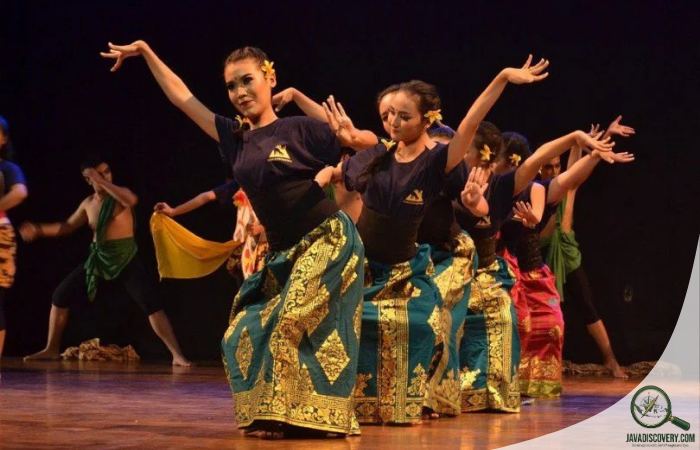
In the western half of East Java, in the Mataraman cultural region closer to Central Javanese traditions, bamboo takes the shape of performance.
The kuda kepang is a flat horse figure woven from split bamboo, painted and decorated, then held between the legs of a dancer in jaranan performances, in which riders enact trance-linked and martial scenes to the beat of gamelan and drums. Each horse begins as a bundle of strips and ends as a character with a face, a mane and a swagger.
In Ponorogo, the Reog tradition features the dadak merak, an enormous mask crowned with peacock feathers. Its framework is commonly built from bamboo and rattan, a lightweight skeleton that must still support a feathered crown so large that it is carried by the dancer’s teeth and neck strength alone.
The origins of Reog are told in different ways. According to local tradition, one version casts it as a veiled satire by a court figure, Ki Ageng Kutu, against a Majapahit-era king, while another links it to a royal courtship story. Historians have not settled the matter, and the tales are best read as living legend rather than documented fact.
Inside a Village Workshop
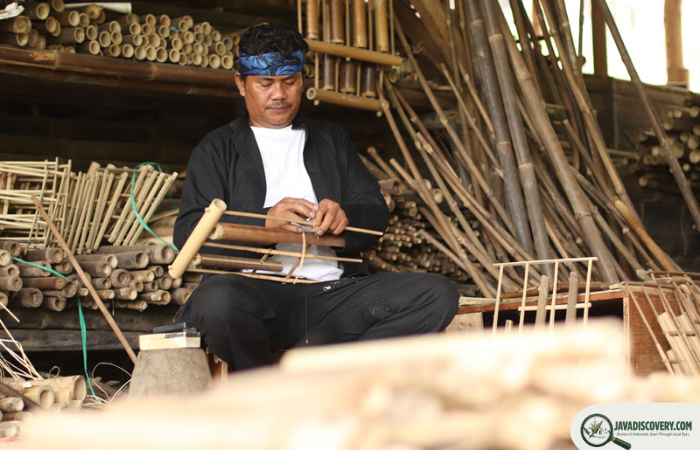
In a typical workshop, work begins long before a knife touches the material. Craftspeople choose mature culms, often several years old, since young bamboo is soft and prone to shrinking. Many describe cutting at particular times of the year or lunar cycle, a custom they say helps reduce insect damage, though practices vary from village to village.
Curing follows. Depending on the craft, bamboo may be soaked, dried slowly in the shade, or smoked over a fire to harden it and discourage borers. The air fills with a sweet, grassy, faintly smoky smell.
Then come the hands. A golok, or machete, splits the culm lengthwise. Strips are shaved thinner and thinner until they can bend without cracking. For weaving, the maker passes strip over strip in the patterns known as anyaman, and the sound is a steady, dry whisper like rain on leaves.
The finished object may be a basket, a horse, a mask frame or an instrument. Each carries small signs of its maker, a slightly different tension in the weave or a preferred curve in the cut.
Craft as a Living Economy
For many families, bamboo work is both a heritage and a livelihood. Sales of baskets, furniture, performance props and instruments can supplement farm income, and a single set of tools may serve several generations.
The pressures are familiar. Plastic containers and factory goods have displaced many everyday bamboo items, and younger villagers often leave for work in cities. Craft groups, performance troupes and village programs have worked to keep the skills visible, but how widely those efforts succeed varies from place to place and is difficult to measure with any single statistic.
What is clear is that the demand for bamboo as art, a performance object or a sustainable material has given some makers new reasons to continue.
What Remains When the Bamboo Is Cut
Bamboo is among the fastest-growing plants on earth, and a well-tended grove replaces what is taken. That fact has a quiet moral in village life: a resource used wisely renews itself.
The same may be true of the skills. A woven horse, a hut above the paddies and a drum that calls the village together all depend on hands that remember. As long as someone still splits the culm, shaves the strip and listens to the grove, the knowledge goes on.
In the end, the bamboo does not simply become art. It carries the village with it, in every curve of the weave and every note that rises from the rice.
Writer: Sari Mahendra