Traditional Boat Builders Probolinggo Wooden Fishing Vessels

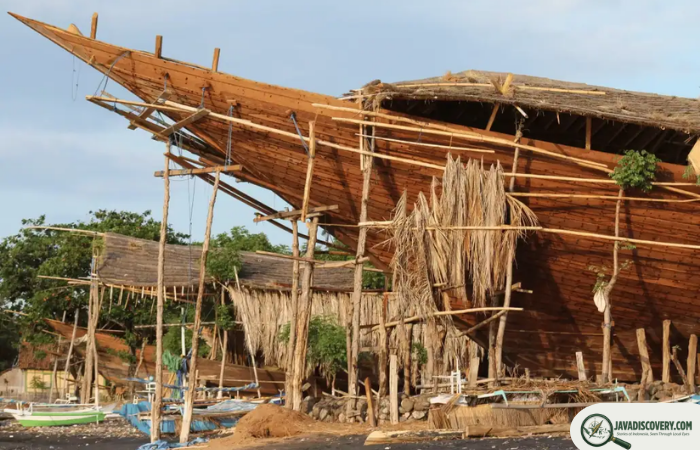
javadiscovery.com – The intoxicating scent of sea salt, warm teak resin, and burning sawdust drifts across the sheltered coastal inlet of Mayangan in Probolinggo, along the wind-swept northern coast (*Pasisir*) of East Java. Framing the narrow strip between the calm blue waters of the Madura Strait and the towering volcanic silhouette of Mount Bromo, this historic port town has served for centuries as a vital maritime hub. Here, directly along the tidal muddy banks and open-air beach yards, teams of veteran shipwrights (*punggawa*) maneuver massive beams of dense Javanese teak (*Tectona grandis*) and ironwood. Guided without a single sheet of paper, printed architectural schematic, or written blueprint, these master boat builders construct giant wooden fishing vessels—some exceeding thirty meters in length—relying entirely on oral tradition, spatial memory, mental geometry, and ancestral maritime wisdom passed down across generations.
Maritime Heritage: The Madurese and Javanese Shipwright Synergy
The unique boat-building culture of Probolinggo represents a profound fusion of Javanese woodworking finesse and the formidable seafaring tradition of the neighboring island of Madura. For centuries, Madurese fishermen and shipbuilders settled along East Java’s northern coast, establishing a specialized shipbuilding center tailored to the harsh waters of the Java Sea:
- The Iconic Vessel Types: Probolinggo’s yards are famous for building traditional motorized fishing schooners, including the heavy-hulled Perahu Slerek (purse seine fishing boats) and the legendary Perahu Leti-Leti, recognized by their low, broad hulls, steeply curved stern posts, and remarkable cargo stability.
- Living Architectural Libraries: A master shipwright (*Punggawa*) carries the entire structural design of a vessel inside his head. From timber curvatures and hull displacement to frame spacing and mast placement, calculations are performed mentally on-site using traditional body measurements—such as hand spans (*jengkal*), arm lengths (*depa*), and finger widths.
- Spiritual Vessel Conception (*Slametan Perahu*): Building a ship is treated as bringing a new living entity into the world. Before the first keel timber is laid, shipwrights perform sacred *slametan* rituals, making offerings to seek protection from sea spirits and ensure the ship’s balance amidst monsoon tempests.
Constructing the Hull: The Shell-First Technique
Unlike modern Western naval architecture, where a steel or timber rib cage is erected first and outer planking is attached afterward, Probolinggo’s traditional boat builders utilize the ancient Mediterranean and Southeast Asian “shell-first” construction method:
- 1. Laying the Sacred Keel (*Lunas*): The central keel beam, carved from a single, flawless trunk of old-growth teak, is laid horizontally along wooden block stilts. The junction where the keel meets the bow and stern posts is carved with precise interlocking mortise-and-tenon joints, locked together with wooden pegs (*pasak*).
- 2. Planking the Hull (*Mapan*) Without Nails: Thick planks are bent using open fire hearths to match the sweeping curves of the hull. Planks are edge-joined directly to one another using hidden internal wooden dowels made from ironwood. Iron nails are strictly avoided below the waterline because rust weakens timber over time in tropical saltwater.
- 3. Fitting the Ribs (*Gading-Gading*): Only after the outer wooden shell of the vessel is fully shaped and locked together do shipwrights slide custom-curved internal rib frames into place to reinforce the structure from within—a testament to the incredible accuracy of their mental geometry.
- 4. Organic Caulking (*Limbat*): To ensure total waterproofing, joints between hull planks are packed tightly with natural fibers—typically crushed bark from coastal trees or coconut husks—soaked in boiled tree resin (*damar*) and peanut oil. Expanded by sea water, this organic caulk creates an impenetrable watertight seal that lasts for decades.
Sustaining Coastal Economies along the Pasisir
In an era dominated by mass-produced fiberglass and steel industrial trawlers, Probolinggo’s hand-built wooden vessels remain the preferred choice for fishing fleets across East Java and the Lesser Sunda Islands:
- Superior Thermal Insulation and Riding Comfort: Thick teak hulls offer far better natural thermal insulation for ice-filled fish holds compared to steel, while the heavy timber keel provides a soft, smooth roll against choppy sea swells, reducing crew fatigue during month-long fishing trips.
- Coastal Artisan Employment: A single large fishing vessel construction project provides months of continuous employment for dozens of local woodworkers, sawyers, caulkers, and master carvers who adorn the vessel’s bow with intricate colorful carvings.
- Sustainable Timber Sourcing: Modern yards work closely with state forestry agencies (*Perhutani*) to source sustainably harvested, plantation-grown teak and hardwoods, preserving regional forest ecosystems.
Preserving Java’s Unwritten Maritime Architecture
On the sunny shores of Probolinggo, as adzes chop into fragrant teak planks and heavy mallets drive wooden dowels into thick hulls, one of humanity’s most extraordinary unwritten architectural traditions continues to thrive. Through their reliance on mental precision, physical memory, and ancestral wisdom, the master shipwrights of Probolinggo ensure that Java’s legendary wooden navy continues to sail proudly into the horizon.