Gunung Gede Pangrango Geothermal Protest and Local Concerns

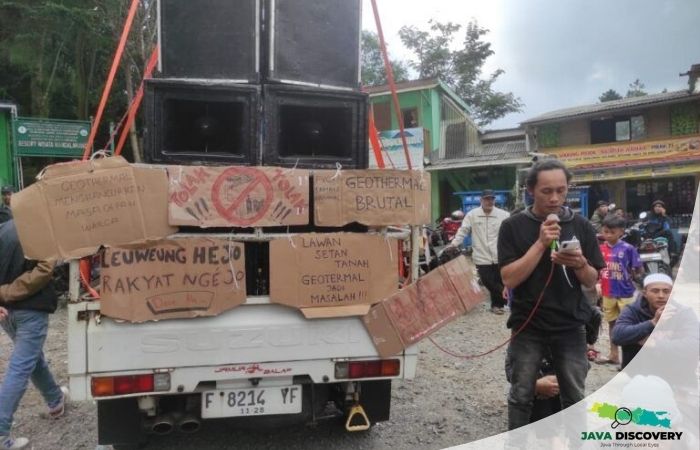
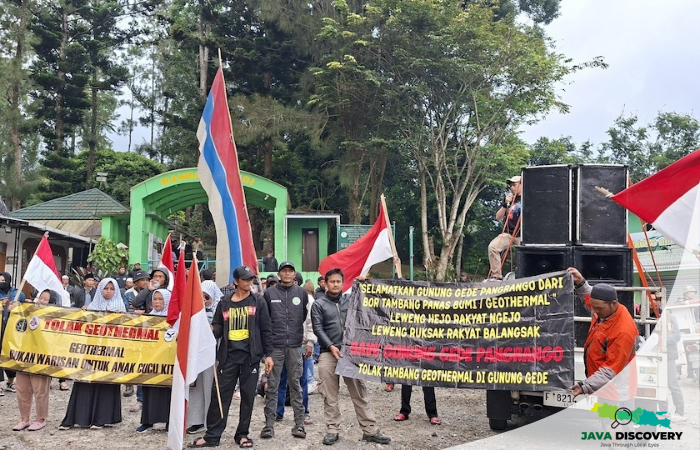
javadiscovery.com – The Gunung Gede Pangrango geothermal protest has drawn national attention as farmers, community leaders, and conservation advocates raise concerns about the future of one of Java’s most important water and forest ecosystems. Their worries go beyond land disputes — they are tied to the stability of water sources, cultural landscapes, and the livelihood of thousands who depend on the mountain.
Farmers Raise Alarm Over Land and Livelihood
The tension began when farmers from Sukatani Village in Cianjur received notices regarding field verification and boundary mapping for geothermal exploration. The information arrived suddenly, and not all farmers received official letters. Many felt excluded and suspected that only individuals aligned with the company’s interests were invited.
Feeling threatened, dozens of residents marched to the Balai Besar Taman Nasional Gunung Gede Pangrango (BBTNGGP) office in Cibodas. Their message was clear: they rejected geothermal activity in the area. For many of them, the mountain is the backbone of their daily life — for farming, water, and heritage.
Some villagers, including environmental observers, claimed that geothermal activity has the potential to pollute air and water sources. They pointed to examples in other regions, like Kamojang in Garut, where communities reported water contamination after geothermal operations.
The Mountain as a Critical Water Source
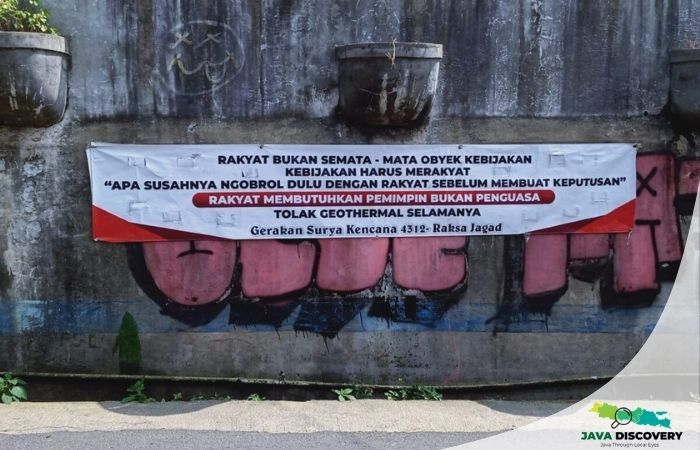
One of the strongest points raised during the Gunung Gede Pangrango geothermal protest revolves around water security. Gunung Gede Pangrango feeds four major watersheds: Citarum, Cimandiri, Cisadane, and Ciliwung. These rivers supply drinking water to tens of millions of people in West Java and Jakarta.
TNGGP hosts at least 94 natural springs with an annual discharge of nearly 600 billion liters — a lifeline not only for nearby villages but for the entire region. To residents, any risk to this delicate hydrological system is a risk shared by cities downstream, including Bogor and Jakarta.
Research from WALHI and CELIOS suggests geothermal operations consume significant amounts of water. Producing just one megawatt of geothermal electricity could require the daily water consumption equivalent of 10–23 households. This creates fears that the project may compete with local communities for water access.
Concerns Over Forest Integrity and Deforestation Risks
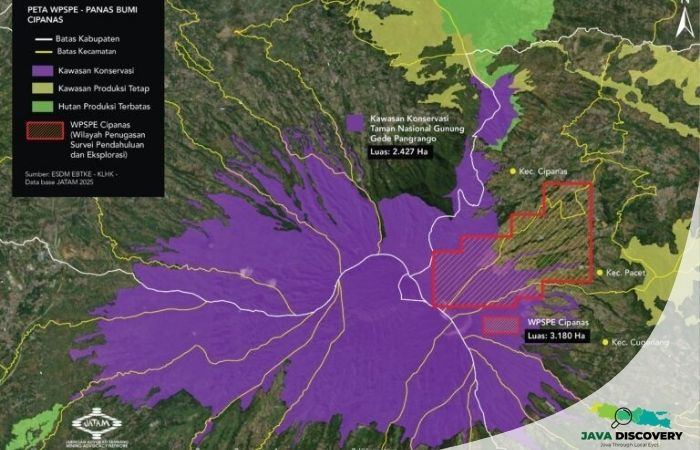
The geothermal concession spans across protected and production forest areas in Bogor, Sukabumi, and Cianjur. Conservation activists argue that opening roads, drilling wells, and building support facilities can directly cause deforestation. Even indirect impacts — like increased access and illegal logging — may follow once forest boundaries are opened.
Historical examples intensify these worries. Kamojang Nature Reserve, a geothermal site operating since the 1980s, recorded more than 60 hectares of forest loss between 2000 and 2011. For communities living around Gede Pangrango, this serves as a warning of what could happen to their own forests.
Social and Economic Stress in Mountain Communities
The project affects far more than the environment. In villages across Cipanas, Pacet, and Cugenang, farming is the main source of livelihood. More than 300 farmers depend on the 5.46 hectares now included in the geothermal survey area. The region produces high-quality vegetables distributed to major markets in Jakarta and Banten.
Local tourism is another key pillar of the economy. Gunung Gede Pangrango is one of Indonesia’s busiest hiking destinations, with a daily quota of 600 climbers. Residents manage homestays, equipment rentals, guiding services, and porter work. Any disruption to the ecosystem could impact visitor numbers and local income.
The geothermal proposal has also caused social friction. Villagers describe rising tension between those who support and oppose the project. Traditional cooperation practices — such as helping during community events or shared labor — are beginning to fracture.
Researchers warn that such divisions can create long-term social scars, especially in rural communities where togetherness is central to daily life.
Concerns Over Militarization and Public Pressure
Another issue that intensified the Gunung Gede Pangrango geothermal protest was the involvement of military and police units in the project’s socialization process. Notices were reportedly copied to regional police, Brimob units, and military commands. Legal aid organizations view this as a disproportionate approach that could intimidate civilians.
They argue that using security forces in non-emergency civilian matters risks violating principles of human rights and civilian supremacy. For residents, such involvement adds a layer of unease and raises questions about whether dissenting voices will be heard fairly.
Response from the National Park Authority
The management of TNGGP denies that the clearing of farm plots is related to geothermal development. They frame their actions as law enforcement within the conservation area, based on the Ministry of Environment and Forestry’s regulation on unauthorized land use.
They maintain that the geothermal project is a national strategic initiative designed to support sustainable energy, and that any activities will follow strict environmental and biodiversity assessments. According to officials, community empowerment programs are being prepared for those affected, though details remain limited.
A Conflict Reflecting Larger Questions
The situation around Gunung Gede Pangrango is more than a dispute over land boundaries. It reflects deeper questions about conservation, energy, and justice. How can renewable energy projects proceed without threatening ecosystems? How can development balance national needs with local rights? Who gets to decide the fate of a landscape that sustains millions?
The ongoing protest shows that for many residents, safeguarding the mountain is part of safeguarding their identity, culture, and future. Gunung Gede Pangrango is not just a landmark — it is a shared home, a water tower, and a guardian of life for Java’s western region.