When the Sky Blessed Java: The Sacred Meteor of Prambanan

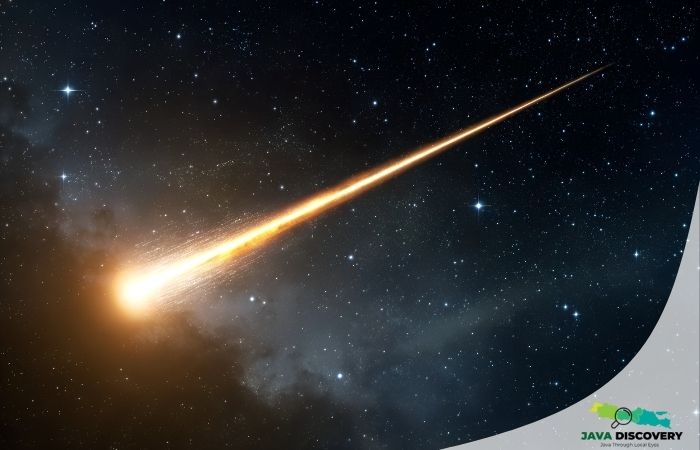
javadiscovery.com – On a Sunday night—October 5, 2025—the sky above Cirebon and Kuningan briefly turned to fire. A flash, a roar, and then a tremor in the heart: neighbors ran from their homes, prayers spilled into the night, and cameras shook as they tried to catch the light that fell from heaven.
In Java, such moments rarely live only as headlines. They awaken older memories, whispers from centuries past, when the boundary between the seen and unseen felt thinner—when people believed the sky could speak to the earth.
The Night Cirebon Looked to the Sky
The light fractured the dark like a blade. Some said it thundered; others said the wind changed. In the confusion, calm voices rose—grandmothers invoking familiar prayers, children asking if the moon had fallen. By morning, rumors and readings intermingled. Was it a meteor? A passing fragment of iron and fire, burning its message on its way to dust?
On this island, fear and wonder rarely travel alone. And when the sky performs, memory takes over.
The Memory of Fire from the Heavens
Centuries ago, near Prambanan—where stone temples hold the breath of kings—something fell. It struck the earth with a force that cracked the soil and jolted stories awake. People came to see not a mere stone but a titah langit, a decree from the heavens.
Messengers ran with news to Surakarta. In the palace, the King weighed the omen. The object—heavy as verdict—had to be brought to the court where signs from above were read with care, where iron could be counsel, where light might be law.
The Birth of Kanjeng Kyai Pamor
Abdi dalem descended to the pit, prayers on their tongues. The stone—iron-cold, dusk-grey—resisted the pull of men. The earth had swallowed it hungrily. To free it, they used thunder born from powder—dinamit—so the ground would release what the sky had given. When at last it rose—roughly a cubic meter of celestial metal—the King named it Kanjeng Kyai Pamor.
It was kept in a sanctum, not for spectacle but for purpose. A presence, some said, that calmed halls and stiffened spines. It did not need a throne; its weight was its own authority.
The Iron That Breathes: From Meteor to Keris
In Prambanan, smaller fragments remained. Villagers gathered them carefully, the way one gathers seeds after a rare wind. Smiths—keepers of heat and patience—folded the sky into steel, letting patterns rise like mist on water.
From this iron, keris were born with pamor that seemed to breathe—lines of light and shadow, flowing like the memory of rain. The palace kept the larger mass as a sacred store, while slivers found their way into blades that would guard homes and hearts.
The old masters would later say the metal carried a different temperament: iron laced with whispers—traces of lime, iron, titanium, niobium—each fold a prayer, each pattern a map back to the night the sky bent low.
Between the Sacred and the Scientific
On this island, there is little quarrel between mystery and measure. What science names—a meteorite, an iron body ablaze with friction—tradition wraps in language of grace: wahyu sang jagad, a charter handed down by the cosmos.
In villages near the fall, people left offerings: a bowl of water, a flower, a lamp lit with oil. They were not bargaining with the sky; they were greeting it, acknowledging the thin thread that binds cloud to soil, distance to destiny.
The Return of the Sky’s Message
So when Cirebon’s night split open in 2025, it did more than startle the streets. It reopened an old book. It reminded Java that the heavens and the fields are still in conversation, that iron can be both evidence and emblem, that a stone from space can be a mirror for the soul of a people.
Perhaps the fire was only physics. Perhaps the tremor was only air. Yet on this island, light is never merely light. It is a way the universe remembers our names—and how we, with reverence, remember it back.