Civilisatie is Syphilisatie: Hidden Cost of Dutch Rule

The Paradox of Civilization – When Colonizers Bring Disease
When the Dutch East India Company first set foot in the Indonesian archipelago, they arrived with a message of progress—an ambition to “civilize” the East. This mission, cloaked in the rhetoric of enlightenment and development, would forever alter the social, political, and physical landscape of the land we now call Indonesia. But buried beneath this grand narrative was a shadow few care to remember.
The bustling colonial capital of Batavia—modern-day Jakarta—was envisioned as the shining example of European order amidst the tropical chaos. However, it soon became known not for its civility, but for its decay. A Dutch physician stationed there, Van der Burg, once noted with disquieting irony that the city most affected by the “civilizing” mission had become the fastest-growing hub for one of the most feared diseases of the time: syphilis.
From this stark observation, a biting phrase emerged among critics and colonial observers: “Civilisatie is syphilisatie”. Civilization is syphilization. It wasn’t just a play on words—it was a diagnosis of a deeper rot. The colonial dream promised order, but delivered affliction; it preached morality, but planted decay. The promise of progress masked a plague that seeped into bodies, relationships, and institutions.
The Dutch colonial government, while busy laying the foundations of bureaucracy, trade networks, and European architecture, failed to curb the spread of venereal diseases within its own military ranks and among the native population. Batavia, under the scorching tropical sun, became a petri dish where imported ideologies mixed with systemic exploitation—producing a new, unintended epidemic.
This was no accident. It was the byproduct of power unrestrained, of empire masked as mentorship. While European doctors and officials claimed they were curing ignorance, they were simultaneously ignoring the very afflictions their system unleashed.
Military Lust, Native Flesh – The Systemized Exploitation
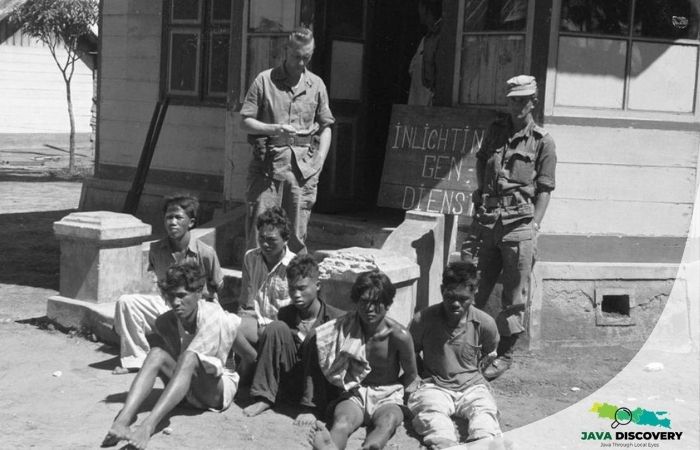
At the heart of the Dutch colonial apparatus was the KNIL, the Royal Netherlands East Indies Army. Composed of European officers and a growing number of local recruits, this military force became one of the most potent instruments of control across the archipelago. But within the barracks and outposts, far from home and far from European women, another reality took shape—one of systemic exploitation under the guise of order.
Dutch commanders recognized a “need” among their soldiers: sexual release. With very few European women present in the colonies, the solution was to institutionalize prostitution. Across Java and other colonial centers, regulated brothels sprang up—often under direct or indirect military management—populated almost exclusively by native women. These women, many of them impoverished or coerced, became the unseen backbone of an unspoken policy: maintain morale through exploitation.
For the colonial government, it was a matter of pragmatism. Local women were cheap, available, and expendable. Their bodies became collateral in the empire’s pursuit of dominance and stability. While white soldiers came and went, these women remained—trapped in cycles of dependency, abuse, and disease.
The consequences were devastating. With limited medical knowledge and poor access to health services, venereal diseases like syphilis and gonorrhea spread rapidly. The KNIL became a reservoir of infection, and yet the blame seldom fell on the soldiers. Instead, the narrative that emerged was one of moral panic—targeting native women as both temptresses and threats to the health of the nation.
It was a cruel irony. The very system that commodified these women now painted them as vectors of vice. While European men retained their dignity—even in illness—native women bore the full weight of colonial shame. Branded as impure, dangerous, and disposable, they were stripped of humanity and history, remembered only as symptoms of a disease they did not cause.
Political, Moral, and Medical Discourses – Who Was to Blame?
As syphilis swept through colonial Batavia and beyond, it did more than scar bodies—it fractured the way people spoke, judged, and understood health and morality. To the Dutch colonial government, the disease was not only a medical concern but a threat to the empire’s manpower. Sick soldiers meant weaker garrisons. A weakened army meant a fragile regime.
Colonial doctors framed venereal diseases as monstrous afflictions, eating away at both the body and the social order. But these medical narratives rarely questioned the systems that allowed the diseases to flourish. Instead, they pathologized the victims—almost always women, especially native women—as the primary sources of infection.
In popular media of the time—pamphlets, colonial newspapers, medical bulletins—a single phrase became common: “penyakit perempuan” or “women’s disease.” It was a linguistic weapon, reducing complex socio-political structures into a moral panic centered on gender and race. Venereal disease was no longer seen as a byproduct of empire, but as a reflection of the so-called moral deficiency of colonized women.
Scholar Gani, in his groundbreaking study, unveiled how these diseases became discursive battlefields. To the authorities, syphilis was not just an illness—it was a metaphor for disorder, a symbol of decay that threatened the image of a “civilized colony.” And in this metaphorical war, native women became convenient scapegoats.
Yet the reality was different. These women were not the architects of decay—they were its casualties. Trapped in economic desperation, robbed of choices, and caught in systems built for their exploitation, they suffered under the very civilization that claimed to uplift them.
The phrase “civilisatie is syphilisatie” endures not only as an indictment of Dutch hypocrisy but as a reminder that the wounds of colonialism were not just in the cities they built or the resources they extracted—but in the bodies they scarred, the dignity they stole, and the narratives they rewrote.