The Archaeological Mystery of Batujaya Temple

javadiscovery.com – The archaeological mystery of Batujaya Temple begins quietly, in a landscape that looks almost ordinary. Stretching across the flat coastal plains of Karawang in West Java, rice fields shimmer in the heat, water birds glide low over the paddies, and village paths wind between houses of brick and bamboo. Nothing in this calm scenery immediately suggests that one of Indonesia’s oldest Buddhist temple complexes rests just beneath the soil.
Yet here, under layers of mud and time, the Batujaya Temple complex has slowly emerged as a key to understanding the forgotten beginnings of Java’s civilization. These red-brick ruins challenge old assumptions about when Buddhism arrived on the island, how early communities organized their sacred spaces, and why this once-thriving religious center vanished for more than a thousand years.
Tracing the Archaeological Mystery of Batujaya Temple
The story of Batujaya’s rediscovery began to unfold in the late 20th century. Local villagers had long noticed unusual brick mounds protruding from rice fields around the villages of Batujaya and Segaran. To most, they were just “old bricks,” useful for building or filling ditches. But when archaeologists from Indonesian universities and research centers visited the area in the 1980s, they realized these bricks were much more than leftover rubble.
Systematic excavations revealed the outlines of circular platforms, square foundations, and staircases. Slowly, the form of stupas and shrines became clear. Radiocarbon dating and analysis of ceramics suggested that the structures dated from roughly the 2nd to 7th centuries CE, placing them within or even before the period of the early Tarumanagara Kingdom. This meant that the archaeological mystery of Batujaya Temple was not just about one or two ruins, but about a vast and very early Buddhist landscape in West Java.
A Hidden Sacred Landscape on the Coastal Plain
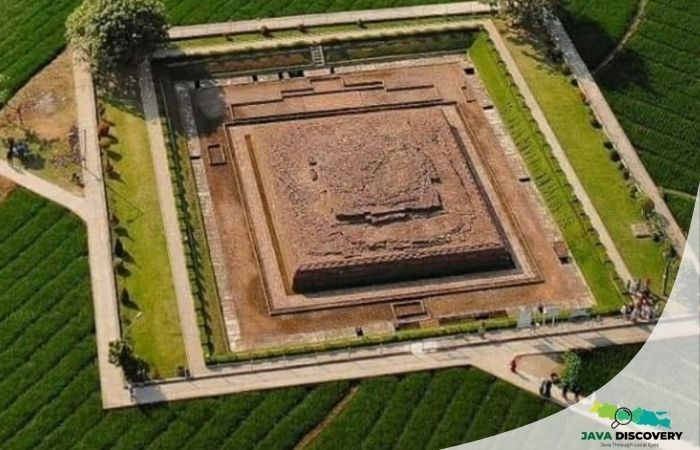
Today, researchers believe that the Batujaya complex covers an area of nearly five square kilometers. Scattered across this zone are more than 60 archaeological sites, many of them still partially buried beneath farmland. Among them, two temples stand out as the most iconic: Candi Jiwa and Candi Blandongan.
Candi Jiwa, often called the “Soul Temple,” appears as a circular stupa rising from a low platform. Its form evokes the earliest Buddhist monuments of the Indian subcontinent, where simple domes symbolized the Buddha and the universe. In Batujaya, this design seems to have been adapted to local materials and aesthetics, creating a structure that is both foreign and familiar, Indian and Javanese at the same time.
Candi Blandongan, on the other hand, is larger and more complex. It features layered terraces, stairways, and what appears to be a central chamber. Some archaeologists suggest it might have served as the main ritual hub of the complex, where monks recited sutras, conducted ceremonies, and preserved sacred relics. The arrangement of platforms and the orientation of the building hint at a carefully planned sacred geometry.
Bricks, Rice Husks, and the Language of Materials
One of the most intriguing aspects of the Batujaya Temple complex lies not only in its layout but also in its materials. Unlike the later temples of Central Java, such as Borobudur and Prambanan, which were built from volcanic stone, Batujaya’s structures are made almost entirely of fired red bricks.
When archaeologists examined these bricks closely, they discovered something unusual: many contained traces of rice husks. These organic inclusions may have been used to strengthen the bricks during firing, but some researchers also see a symbolic dimension. Rice has long been associated with fertility, prosperity, and the cycle of life and death in Indonesian cultures. Embedding rice husks in the fabric of the temple could have been a subtle way of inscribing meaning into the very walls of the sacred space.
Alongside the bricks, excavations have uncovered terracotta figurines, fragments of stupas, beads of glass and semi-precious stone, and pottery of various shapes and colors. Each object adds another line to the story: a monk’s daily ritual, a lay devotee’s offering, a trader’s gift from across the sea.
Clues from Graves and Rituals
The archaeological mystery of Batujaya Temple deepens when human remains enter the picture. In some parts of the site, archaeologists have uncovered burials that show signs of cremation or partial burning, practices associated with certain Buddhist funerary traditions. These graves suggest that Batujaya was not just a place to worship but also a place to say farewell to the dead, to transform grief into spiritual hope.
Yet even here, questions remain. Were the people buried at Batujaya monks, local elites, or ordinary villagers? Did they live within the sacred complex, or did they travel there specifically for ritual purposes? So far, the evidence has not yielded clear answers, but each excavation season brings new fragments—teeth, bone, fragments of charred wood—that slowly expand the puzzle.
Why Was Batujaya Abandoned?
Perhaps the greatest unanswered question in the archaeological mystery of Batujaya Temple is why such an important site was abandoned. By around the 7th century, activity at the complex appears to have declined sharply. Over time, the temples fell into disuse, their bricks collapsing and sinking into the saturated soil of the coastal plain.
Historians have proposed several possibilities. The coastal environment of Karawang is dynamic, shaped by shifting river courses and regular flooding. It is possible that changes in the Citarum River’s flow or the encroachment of swamps made the area less hospitable. Others suggest that trade and political power gradually shifted toward new centers in Central Java, making Batujaya less strategically important. The rise of new kingdoms and religious centers may have drawn people, resources, and attention away from this once-vibrant Buddhist enclave.
Whatever the cause, the result was the same: the temples sank into silence, covered by mud, grass, and eventually rice fields. For centuries, the memory of Batujaya faded, preserved only in fragments of local stories and the stubborn presence of buried bricks.
Ongoing Excavations and New Technologies
Unlike many famous ancient sites that are “finished” in the public imagination, Batujaya is still very much a work in progress. Excavations and research are ongoing, and each season brings new discoveries that reshape our understanding of the site. This living, unfolding nature is part of what makes the archaeological mystery of Batujaya Temple so compelling.
Teams from Indonesian universities, the National Archaeology Research Center, and local authorities continue to map and investigate the area. They use traditional excavation methods alongside modern tools such as ground-penetrating radar and 3D scanning. These technologies allow them to detect buried structures without fully digging them out, revealing patterns that hint at yet undiscovered temples and ancient infrastructure beneath fields that today produce rice for nearby villages.
As more of Batujaya’s hidden layers are revealed, scholars are beginning to see the complex not as an isolated religious site but as part of a broader network of settlements, trade routes, and cultural exchanges stretching across the Sunda Strait and the wider Indian Ocean world.
Visiting Batujaya Temple Today
For visitors, Batujaya offers a very different atmosphere from the monumental grandeur of Borobudur or Prambanan. There are no towering stone reliefs or crowded stairways. Instead, you walk along narrow paths between paddies, where farmers still tend their crops and children ride bicycles. The temple mounds rise gently from the landscape, their red bricks exposed like memories resurfacing from the past.
Standing at Candi Jiwa, you can feel how closely the sacred and the everyday have always intertwined here. Chickens scratch near the base of the stupa, the wind rustles through rice stalks, and the horizon is low and wide. This is not a remote mountaintop monastery but a coastal sanctuary, deeply embedded in the daily life of the people who once lived and prayed here.
Simple shelters protect some excavated structures from sun and rain, while information boards describe the ongoing research. Because excavations continue, parts of the site may look like open trenches, with layers of bricks, soil, and artifact fragments carefully recorded and left in place. In that sense, you are not visiting a finished museum, but stepping into an active archaeological story still being written.
Why Batujaya Still Matters
The importance of the Batujaya Temple complex extends far beyond Karawang’s borders. It forces us to rethink long-held narratives about Java’s religious and cultural development. For many years, the island’s ancient story was dominated by Central Java—by the stone silhouettes of Borobudur, Prambanan, and the great temples around Yogyakarta and Magelang.
Batujaya reminds us that other centers existed earlier, in different landscapes and using different materials. It shows that Buddhism had taken root in West Java’s coastal communities centuries before the peak of Central Javanese temple building. It also highlights the fluidity of cultural boundaries: ideas traveled along trade routes, across seas, and up rivers, mixing with local beliefs to create something uniquely Javanese.
For archaeologists, Batujaya is a rare opportunity to study an early Buddhist landscape in a tropical, riverine environment. For local communities, it is a source of identity and pride, a sign that their fields and villages stand atop a heritage as old and rich as any royal capital.
Guarding a Fragile Window into the Past
At the same time, Batujaya is fragile. Its brick structures are vulnerable to erosion, water damage, and the pressures of modern life. Farmland expansion, infrastructure projects, and simple neglect can easily destroy what took centuries to build and millennia to preserve underground.
Efforts are underway to protect the core areas of the complex, promote responsible tourism, and integrate local communities into conservation programs. Some scholars and advocates hope that Batujaya will one day join the ranks of sites recognized by UNESCO, gaining additional support and visibility on the global stage.
Yet even without that formal status, the archaeological mystery of Batujaya Temple already speaks loudly to those who visit and study it. It reminds us that history is never fully settled, that new evidence can rewrite old stories, and that beneath familiar landscapes—rice fields, village roads, and irrigation canals—there may lie entire worlds still waiting to be uncovered.
In the quiet plain of Karawang, where farmers walk the same earth that monks once crossed in saffron robes, Batujaya continues to reveal itself grain by grain, brick by brick. Its mystery is not just about what has been found, but about all that remains hidden, inviting future generations to keep asking questions of the past.