The Ancient Guardian of Banten and the Story of the Dwarapala Statue

javadiscovery.com – A stone face, carved with a ferocity that still arrests the eye, was tugged from the river’s slow current and the river delivered a story: of a city with walls, of trade routes that threaded the coast, and of a belief world where guardians stood at thresholds between the profane and the sacred.
When a guardian emerged from the river
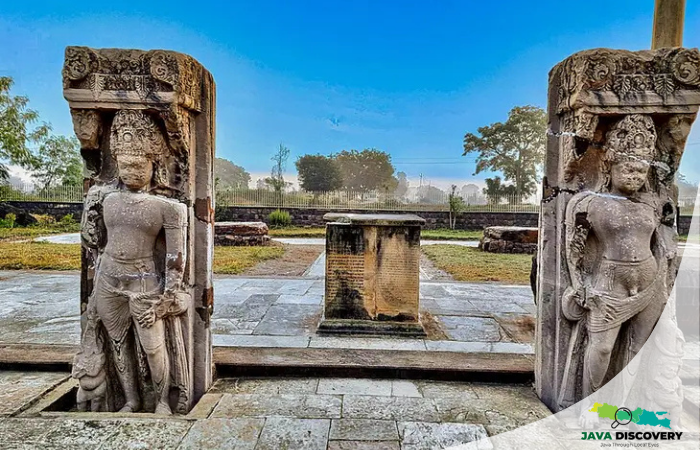
In the tenseness before dusk the river speaks in low voices; fishermen mend nets, children race the last light along its embankments. In the 1990s, local stories told of more than driftwood and clay: a bulky form lodged in the silt. What came up from the Cibanten was a stone figure, its face carved into a brutal, watchful mask. The find would later be identified as a dwarapala — a gate-guardian figure commonly associated with Hindu-Buddhist sacred sites across the Indonesian archipelago.
The statue’s discovery — often dated in oral accounts to the decade of the 1990s and linked in scholarship to fieldwork that took place in the late 1980s and early 1990s — reframed how archaeologists and local historians imagined the pre-Islamic presence in the Banten region. This is not merely a relic; it is an argument carved in stone.
What is a Dwarapala?
The word itself is compound: dwara, the path or gateway, and pala, the guardian. Across Java, when one approaches an ancient temple or a ritual precinct, the silhouette of the dwarapala is expected — a beastly, sometimes even comic, sometimes terrifying attendant with a mace or club, a protector at the threshold whose duty is to keep malign forces at bay.
“Dwarapala acts as a sentinel — placed where people cross from everyday to sacred. Its presence marks a polity with ritual architecture and social complexity.” — paraphrased observations from regional archaeological studies.
In iconography they belong to a larger cosmology: yaksha and guardian figures that bridge the human and the supernatural. They are not merely decoration; they are civic symbols. The placement of a dwarapala at a gateway implies an investment in permanent, monumental space — an assertion of control and a declaration of ritual order.
Banten Girang: earthworks, ceramics and a forgotten town
The statue’s riverine recovery cannot be separated from the landscape that yielded it. Banten Girang — a site on the southern approaches of the modern Serang area — preserves the traces of a settlement that once bore defensive ditches and raised earthen walls. When researchers mapped the area, what they found were irregular embankments that suggest planned enclosure, not random occupation.
Excavations and surface finds in the region have uncovered ceramics of foreign origin, beads, metalwork and fragmentary inscriptions. The datable material points toward a broad period from the tenth to the thirteenth centuries. Taken together, the objects record a community plugged into maritime exchange and local ritual life — a community that called for monuments and guardians.
The Dwarapala and the question of place
The dwarapala recovered from the Cibanten raised a hypothesis: might it once have stood at the entrance to a temple or palace complex within the Banten Girang settlement? That hypothesis gains force when the carved figure is read alongside the physical layout of the site. Gate monuments accompany thresholds — not only of single sanctuaries but of urban and ritual zones where power was concentrated.
Several scholars have suggested a relationship between the Dwarapala and the fortifications visible at Banten Girang. The statue becomes, in this reading, both an index of ritual activity and a civic sentinel: a marker that the place it came from was an organized, monumental center rather than a scatter of hamlets.
Voices in the archive: archaeologists and local memory
Archaeological attention in the region received a burst of focus with surveys and excavations conducted in the late twentieth century. Fieldwork by foreign and Indonesian scholars mapped features and assembled material culture, while local knowledge preserved stories of vanished walls and buried stones. The figure of Claude Guillot, who worked widely in western Java during the late 1980s and early 1990s, appears in regional accounts as part of the period that intensified research interest.
Indonesian researchers have since continued to probe the site’s remnant deposits, while educators and cultural institutions have noted the find as an important element in the narrative of Banten’s deep past. For local communities, the dwarapala is more than an object of study; it is a fragment of memory that surfaces when elders recall older place names and the way the land once looked.
River pathways and urban change
The fact that the dwarapala was pulled from a riverbed is itself telling. Rivers are not passive backdrops; they are the arteries of premodern transport and trade. The presence of a monumental guardian near a waterway suggests a built environment oriented to navigation — wharves, processional steps, and a city that expected visitors and goods by boat.
In this light the Cibanten find presses us to imagine a Banten less as a remote forest pocket and more as a node in a network — connected to the Sunda Strait, to mountain resources, to far-flung traders and to religious circuits that borrowed forms from Indian and Southeast Asian models and remade them in local hands.
Material form and function
Close study of the dwarapala’s carving reveals technical and stylistic choices. The face is carved with a severe mouth, wide eyes and a ridged forehead — elements designed to impress and intimidate. Such visual cues perform a social function: they declare sacred order by threatening transgression. The figure’s scale — often described by observers who saw the piece during its post-discovery study as exceeding a meter — marks it as visible from a distance, a looming presence at a gate.
The materiality of the stone — the way it holds chisel marks, the traces of wear from water and decades buried in silt — helps archaeologists reconstruct phases of reuse, movement and abandonment. Water abrasion suggests that the figure did not fall in place and remain undisturbed for centuries; rather, it had a movement story, a biography that included human hands and the river’s slow but persistent force.
Ritual meanings and civic symbols
Where the dwarapala stands is where the sacred begins. In Javanese religious worlds the threshold is a charged zone. Guardians enforce boundaries between profane life and ritual space. But guardians also communicate values: sovereignty, protection, and the permanence of the group that erected them. In the case of Banten Girang, the dwarapala compels us to read the settlement as a center where ritual and authority were publicly performed.
From archaeology to public memory
Despite the weight of its significance, Banten Girang has not achieved the same visibility as later Islamic monuments in the region. The ruins of later courts and mosques draw attention — understandably, because they dominate the narrative of later centuries — yet the dwarapala asks us to hold a longer view. It insists that before the sixteenth century — before the consolidation of Islamic courts in coastal Banten — the landscape threaded with other beliefs and polities whose material traces still surface under soil and river silt.
The process of interpretation is ongoing. Questions persist about where precisely the statue stood, about the full plan of the settlements that once clustered on the plain, and about the social worlds that produced the iconography of the guardian. Each fragment recovered from the earth or the river is a prompt for new inquiry.
Because stones remember
The Dwarapala of Banten Girang is not merely an object locked in a museum case or an illustration in a field report. It is a listener: it listens to how we ask questions of the past and it replies in the blunt rhetoric of stone. It shows that Banten’s identity is layered — a palimpsest where Hindu-Buddhist cosmologies were once inscribed on earth and rock, later to be inscribed over by different faiths and regimes.
Walking the levees and earthen walls of Banten Girang today, one senses how history accumulates: in moss on an embankment, in pottery shards half buried in a later plough horizon, in names that survive in the mouths of elders. The dwarapala returned from the river is a single, eloquent voice among many. It does not tell us everything, but it demands that we listen.
Findings cited in this piece (selected):
- Reports of fieldwork and surveys in the late 1980s and early 1990s, including surveys associated with work in the region.
- Surface finds at Banten Girang: ceramics, beads, metal fragments, and fragmentary inscriptions indicating activity between the 10th–13th centuries.
- Local oral history and accounts recorded during the period of discovery in the 1990s.