Sugar Factories and the Birth of Industrial Java

javadiscovery.com – At dawn in East Java, mist drifts low over fields where sugarcane once stood in disciplined rows. Rusted gears lie half-buried in grass. Brick chimneys rise like sentinels over quiet villages. The silence is deceptive. Nearly two centuries ago, these grounds trembled with the sound of steam engines, iron rollers, and human labor. Sugar factories did not merely process cane. They reshaped Java’s economy, reordered its villages, and marked the island’s decisive turn toward industrial modernity.
The Arrival of a Sweet Empire
In the early nineteenth century, Java became the center of one of the world’s most profitable sugar industries. Under Dutch colonial rule, the island’s fertile volcanic soil was reorganized to serve global markets. The Cultivation System, introduced in 1830, required Javanese farmers to devote portions of their land and labor to export crops, particularly sugarcane. What had once been subsistence rice fields began to alternate with regimented rows of cane destined for refineries.
The change was not gradual. It was swift and structural. Entire districts were measured, mapped, and recalibrated according to production quotas. Rivers were redirected to power waterwheels. Roads were widened to transport harvests. The rhythm of agricultural life shifted from seasonal cycles of rice to the relentless deadlines of factory processing.
Architecture of Industry
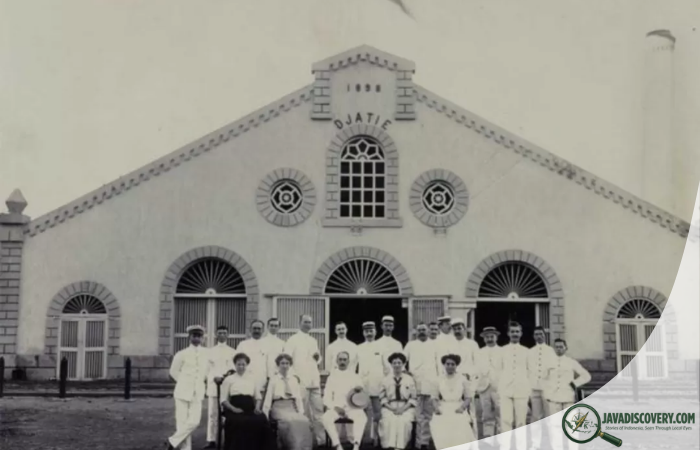
The sugar factory was unlike anything rural Java had seen before. Built of thick brick walls with tall arched windows, it combined European engineering with tropical adaptation. High ceilings allowed heat to rise. Wide verandas provided shade. Massive iron machinery imported from Europe was assembled on site, its presence a stark contrast to bamboo houses nearby.
Inside, the atmosphere was dense with moisture and scent. Freshly cut cane released a grassy sweetness that mingled with the metallic tang of steam. Boilers hissed. Conveyor belts clattered. Workers fed stalks into crushing rollers that squeezed out pale green juice, which flowed through a series of vats before crystallizing into raw sugar.
At night, chimneys glowed faintly as furnaces continued burning. Villagers miles away could see the orange pulse against the dark horizon. It was the light of industrial Java emerging.
Transformation of Rural Landscapes
Before the rise of large scale sugar production, most Javanese villages were organized around rice cultivation. Irrigation systems, known as subak or sawah networks depending on region, structured cooperation among farmers. The introduction of sugarcane altered that balance.
Cane required different irrigation patterns and longer growing periods. Fields had to be cleared and replanted with precision. Oxen and later mechanical plows carved deeper furrows. Rail tracks were laid across plantations, linking fields directly to factory yards. Small locomotives hauled cane wagons in steady lines, their whistles echoing across valleys.
Where rice once shimmered in reflective paddies, tall cane now formed green walls that blocked the wind. The visual identity of entire districts changed. From hilltops, one could see geometric grids stretching toward factory smokestacks, symbols of a new economic order.
Labor and Discipline
The birth of industrial Java was inseparable from labor discipline. Thousands of villagers became seasonal factory workers in addition to tending their own plots. Work shifts were regulated by bells rather than roosters. Time itself became measured differently.
Elders in some communities still recount stories passed down from grandparents who labored in the mills. They describe hands sticky with syrup, skin darkened by furnace heat, and overseers who monitored output with strict calculation. Wages were modest, often entangled with colonial taxation systems that left families in cycles of debt.
Yet the factories also introduced new skills. Mechanics learned to repair engines. Carpenters built storage crates for export. Account clerks kept ledgers that tracked tonnage and shipment schedules. Industrial literacy slowly took root.
The Railway Web
Sugar demanded transport. By the mid nineteenth century, networks of narrow gauge railways connected plantations to ports such as Surabaya and Semarang. These lines were initially built to serve sugar estates, but they later formed the backbone of Java’s broader railway system.
Villages once accessible only by footpaths became junction points. Markets grew near stations. Traders arrived with textiles, metal tools, and imported goods. Industrial infrastructure radiated outward from the sugar factory, pulling rural life into a global web of exchange.
The soundscape shifted accordingly. Steam locomotives punctuated the day with sharp whistles. Iron wheels rattled across bridges. For many villagers, these sounds signaled both opportunity and upheaval.
Social Hierarchies in the Factory Yard
The sugar complex functioned as a microcosm of colonial hierarchy. European managers occupied spacious residences shaded by tamarind trees. Indigenous administrators, often drawn from local elites, mediated between management and laborers. Workers lived in barracks or simple village houses nearby.
Despite rigid divisions, daily interaction blurred boundaries in subtle ways. Technical expertise sometimes granted skilled Javanese workers leverage and respect. Oral accounts describe master machinists whose knowledge of engines made them indispensable. Within the hum of machinery, a different kind of authority could emerge.
Still, inequality was visible. Separate dining areas, separate schools, separate wages. Industrialization in Java did not dissolve colonial stratification. It often intensified it.
Environmental Consequences
The sweetness of sugar carried ecological costs. Vast tracts of land were cleared for monoculture. Soil fertility declined in areas subjected to repeated cane cycles. Rivers that once supported diverse fish populations were diverted or polluted by factory runoff.
During dry seasons, irrigation disputes grew more frequent as water was prioritized for plantations. Farmers who relied on rice cultivation sometimes struggled to maintain yields. The transformation toward industrial agriculture altered not only economic patterns but ecological equilibrium.
Crisis and Collapse
The prosperity of Java sugar factories was vulnerable to global market fluctuations. In the late nineteenth and early twentieth centuries, price drops and international competition exposed the fragility of monoculture dependence. Some factories modernized with advanced turbines and centrifuges. Others fell into decline.
World wars and the Japanese occupation further disrupted production. Machinery was dismantled or repurposed. Skilled workers were displaced. After Indonesian independence, many factories were nationalized, continuing operations under new management yet struggling with aging infrastructure.
Today, some mills still operate during harvest season, their chimneys releasing white plumes reminiscent of earlier centuries. Others stand abandoned, brick walls overtaken by vines, windows shattered by time.
Ruins as Memory
Walk through a former sugar estate in Central or East Java and the past feels tactile. Iron gears lie corroded but intact. Factory floors are scattered with fragments of ceramic insulators and rusted bolts. Children play soccer where conveyor belts once carried cane.
For older residents, these ruins evoke personal histories. Grandfathers who worked night shifts. Grandmothers who cooked meals for labor crews. The factory was not an abstract industrial symbol. It was woven into family life.
In certain towns, annual festivals coincide with the sugar harvest, blending industrial heritage with local tradition. Gamelan music echoes against brick walls, creating an unexpected harmony between machine age architecture and older cultural rhythms.
Industrial Mindset
Beyond physical transformation, sugar factories introduced a new mindset. Production targets, efficiency calculations, mechanical precision, and standardized schedules gradually influenced broader sectors of Javanese society. Education began to emphasize technical competence. Administrative systems mirrored factory hierarchies.
The island’s later industrial ventures, from textiles to cement, drew on precedents established in the sugar era. Infrastructure built for plantations facilitated further economic expansion. In this sense, sugar was not merely a commodity. It was a catalyst.
Echoes in Contemporary Java
Modern Java is a mosaic of megacities, industrial zones, and agricultural hinterlands. Yet the imprint of nineteenth century sugar production remains visible. Railway lines still follow routes laid for cane transport. Company towns evolved into municipalities. Patterns of land ownership trace back to plantation divisions.
Even culinary culture bears subtle traces. Traditional sweets that rely on palm sugar coexist with refined cane sugar products, reflecting layers of economic history. Markets sell white crystals that once symbolized colonial extraction but are now integrated into everyday consumption.
A Complex Legacy
The story of Java sugar factories resists simple judgment. They brought technological innovation and infrastructural development. They also entrenched exploitative systems and environmental strain. Industrial Java was born in contradiction, shaped by both ambition and coercion.
Standing before a crumbling chimney at sunset, one senses the weight of that dual legacy. The bricks retain warmth from the day’s sun. Birds nest in crevices once blackened by smoke. Grass grows where rail tracks once shone with steel.
History lingers in textures and silence. The factories no longer dominate global sugar markets, yet they continue to define the contours of memory and landscape. They remind us that industrialization is never abstract. It is built of soil, sweat, and steel.
As evening settles over former plantations, villagers gather for prayer or conversation, their lives no longer governed by factory bells. The air carries the scent of earth after irrigation. In the fading light, the outline of a chimney stands against the sky, neither fully ruin nor fully monument. It marks the moment when Java stepped into the machinery of the modern world, propelled by sweetness and shadow alike.