Unearthing the Giant Buddhist Temple Beneath Mount Kelud

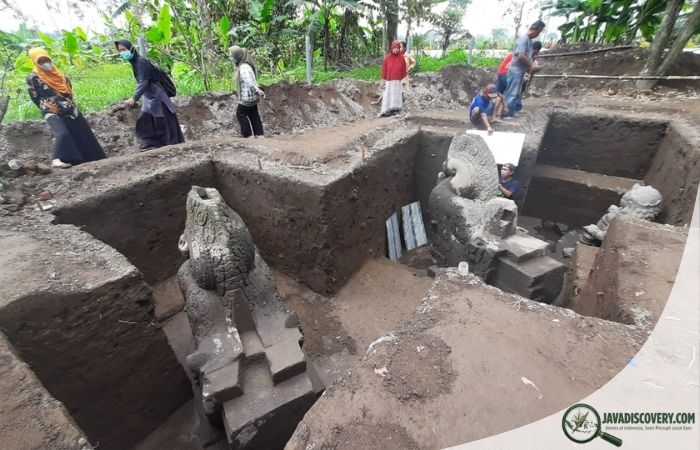
javadiscovery.com – Dusun Puhsul, a quiet settlement in the Adan-Adan village of Kediri, has abruptly transformed into the epicenter of Indonesian archaeology. Beneath the soil of East Java, where modern life hums along agricultural rhythms, an ancient monolith has broken the surface. This is not just another ruin; it is a colossal structure that is forcing historians to rethink the religious and architectural landscape of the region.
A Colossal Guardian in the Soil
The most arresting visual from the excavation site is a monstrous stone makara. In classical Nusantara architecture, these mythical sea creatures serve as the sacred guardians of temple gates. Their size is strictly proportional to the structure they protect, and the makara found in Adan-Adan dwarfs nearly every similar artifact discovered in East Java.
According to local custodians, this singular find hints at the staggering ambition of its ancient builders. While local authorities rightly caution against drawing physical comparisons to Magelang’s Borobudur, the footprint of the Adan-Adan site suggests a sprawling, integrated complex covering at least 800 square meters. It was designed not merely as a single temple, but as a vast religious landscape anchoring the ancient communities at the foot of Mount Kelud.
An Anomaly in Eastern Java
What makes Adan-Adan truly exceptional is its religious alignment. The architectural heritage of East Java is heavily dominated by the tall, slender Hindu temples of the later Singasari and Majapahit empires. Discovering a structure here with pure Mahayana Buddhist roots is an archaeological shockwave.
Dating back to between the 9th and 11th centuries—coinciding with the zenith of the Mataram Kingdom—Adan-Adan provides a rare glimpse into the Buddhist presence in eastern Java long before the rise of the great Hindu empires. The unearthing of Buddha statue heads, stupa fragments, and the distinctive kala ornaments solidifies its identity as an unparalleled historical treasure.
The Sacred Mandala Design
The temple complex was meticulously planned using the Mandala concept, a sacred geometric grid representing the Buddhist universe. This layout indicates a central core sanctuary surrounded by intricate terraces and ancillary structures. When mapped alongside the nearby Tondowongso site just three kilometers away, a picture emerges of a highly advanced metropolitan center.
A Holy Project Frozen in Time
The deep entombment of the Adan-Adan site points to a sudden and violent end. Archaeologists have discovered the pinnacles of stupas resting in the lowest soil layers, suggesting the massive structures collapsed vertically. The prime suspect for this catastrophic destruction is the very mountain that looms over it: Mount Kelud.
Adding a haunting layer to the tragedy, excavators found several statues and ornaments partially carved, left incomplete by the ancient artisans. It is a dramatic snapshot of a sacred project abruptly abandoned.
Whether driven out by the fury of a volcanic eruption or a sudden collapse of political power, the builders of Adan-Adan fled, leaving their colossal masterpiece to sleep for a millennium beneath the ash.