The Power of Loro Blonyo Sacred Wedding Statues of Javanese Homes

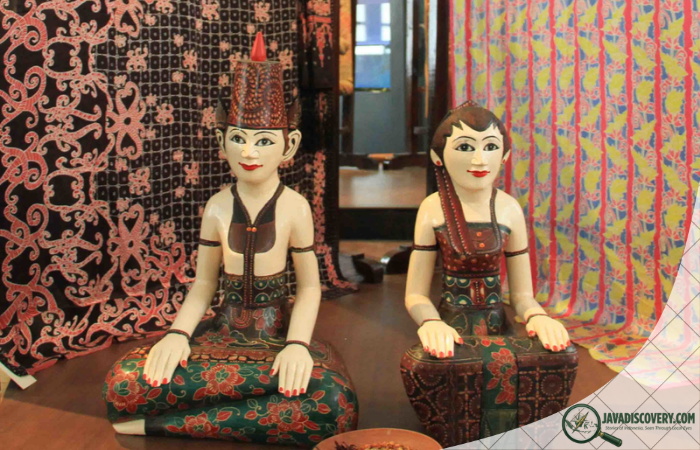
javadiscovery.com – In the quiet, shadowed interior of a traditional Javanese Joglo house, there is a space that breathes with the weight of centuries. Beyond the public veranda and the central living area lies the krobongan, a sacred inner chamber dedicated to Dewi Sri, the goddess of rice and fertility. Within this sanctuary, two wooden figures typically sit in eternal, silent vigil. Carved from teak and painted with meticulous precision, these are the Loro Blonyo, the “inseparable couple.” They are not mere decorations or simple folk art; they are the physical manifestation of the Javanese ideal of cosmic balance, marital harmony, and the prosperity of the household. To understand these statues is to understand the soul of the Javanese family unit.
The Divine Ancestry of the Inseparable Pair
The origins of the Loro Blonyo are intertwined with the very myths that define the agricultural identity of Java. According to ancient lore, the figures represent the goddess Dewi Sri and her consort, Sadono. In Javanese mythology, Sri is the bringer of life, the one who transformed her own body into the first rice stalks to feed the people. Sadono represents the male principle, the guardian of the earth and the provider of structure. Together, they form a duality that is essential for existence: male and female, sky and earth, structure and fertility. Without the union of these two forces, the Javanese believe that the world—and by extension, the home—would fall into a state of “panas” or chaotic heat.
For centuries, these statues were the exclusive domain of the “priyayi” or the Javanese aristocracy. In the grand palaces of Yogyakarta and Surakarta, the Loro Blonyo occupied the “pendaringan,” the place where the family’s rice was stored. Their presence was a prayer in wood, a constant petition to the gods to ensure that the rice granaries never went empty and that the lineage of the house remained unbroken. Over time, the tradition trickled down from the noble courts to the common people, becoming a symbol of aspiration for every Javanese couple seeking a life of “tentrem,” a deep and lasting tranquility.
Anatomy of a Sacred Symbol
The physical appearance of the Loro Blonyo is strictly codified, following the aesthetics of the classic Javanese wedding costume. The male figure, Sadono, sits with his legs crossed in a posture of meditative calm. He is typically depicted wearing a “kuluk” or high hat, a “beskap” jacket, and a batik “jarik” cloth. His expression is one of “sabar”—infinite patience and emotional control. Across from him, the female figure, Sri, sits in the “simpuh” position, her legs tucked neatly beneath her in a gesture of refined humility. She wears the “kemben” torso wrap, an intricate “sanggul” hairstyle adorned with jasmine flowers, and the same matching batik pattern as her husband.
The name “Loro Blonyo” itself reveals the depth of their connection. In the Javanese language, “loro” means two, and “blonyo” refers to the act of rubbing herbal ointments or oils onto the body. This is a direct reference to the “panggih” wedding ceremony, where the bride and groom are anointed with “paboras,” a fragrant yellow paste. By being “blonyo,” the statues are permanently in a state of being wed. They are frozen in the most auspicious moment of their lives, radiating the positive energy of the marriage ritual into the room around them. To look upon them is to be reminded of the vows of mutual support and the “gotong royong” (communal cooperation) that must exist between a husband and wife.
The Language of Batik Patterns
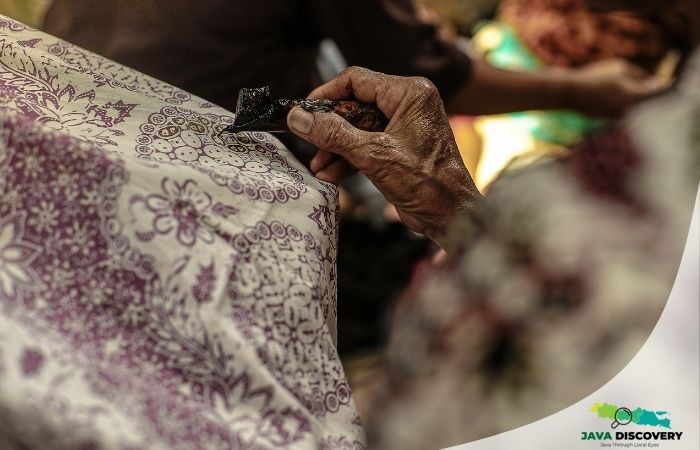
The batik cloth carved into the wood is never accidental. Artisans often choose the “Sidomukti” or “Sido Luhur” patterns for the Loro Blonyo. The word “sido” means “to become” or “to achieve,” while “mukti” means prosperity and “luhur” means noble character. The intricate geometric stars and butterfly motifs on their robes are silent incantations, manifesting a reality where the inhabitants of the house will achieve a high social standing and a wealth that is both material and spiritual. The matching patterns emphasize the concept of “manunggaling kawulo gusti,” the union of the servant and the master, or more simply, the total merging of two souls into one unit.
The Krobongan as a Spiritual Battery
In a traditional Javanese home, the Loro Blonyo are placed in front of the “Sentalan,” a heavy wooden bed that is never actually slept in. This bed is kept perfectly made, draped with fine silks and surrounded by incense burners. It is the “bed of the goddess,” a portal where the ancestors and the divine can rest when they visit the home. The Loro Blonyo act as the guardians of this portal. Their presence ensures that the energy flowing from the spiritual realm into the domestic space is filtered and made benevolent.
During significant life events—a pregnancy, a harvest, or a transition in business—the family will place offerings of “sesajen” at the feet of the statues. These offerings usually include “jajan pasar” (traditional snacks), rose petals in water, and “kopi pahit” (bitter coffee). This is not an act of worship toward the wood itself, but a gesture of “tepo seliro” or mutual respect toward the invisible forces that govern the household’s fortune. The statues serve as a focal point for the family’s gratitude, a physical anchor that prevents the household from being swept away by the stresses of the outside world.
From Courtly Altars to Modern Living Rooms
In the 21st century, the Loro Blonyo have undergone a fascinating evolution. While the strictly religious and spiritual significance has softened in the cosmopolitan centers of Jakarta or Bandung, the statues have seen a massive resurgence as symbols of Javanese cultural pride. Modern interior designers now place stylized, minimalist versions of Loro Blonyo in luxury apartments and boutique hotels. Even in these contemporary settings, the statues retain an aura of dignity. They have become a “cultural shorthand” for the Javanese identity, signaling a connection to the values of the past in an increasingly globalized world.
However, for the traditionalists in the heartlands of Central and East Java, the power of the Loro Blonyo remains unchanged. They are still sought after by newlywed couples who wish to ground their new life in the “ngelmu” or wisdom of their forefathers. An authentic pair of Loro Blonyo, carved from a single piece of heartwood from an old teak tree, is considered a “pusaka” or heirloom. It is believed that such statues carry a “khodam” or spirit guardian that protects the couple from infidelity, financial ruin, and social discord. The craftsmanship required to create them is a form of meditation, as the artisan must capture the exact “wanda” or facial mood that reflects a soul in perfect balance.
The Lesson of the Inseparable Two
Perhaps the most enduring lesson of the Loro Blonyo is the concept of “rukun,” or the absence of conflict. In the statues, the man and woman are equal in their stillness, their eyes cast downward in a display of “andhap asor” (humility). They do not compete for space; they complement it. They remind the Javanese that a successful life is not measured by individual triumph, but by the stability of the union. In a world that often feels fractured, the image of the two figures sitting side by side, century after century, offers a powerful testament to the strength found in togetherness.
As the sun sets over the tiled roofs of Java and the shadows lengthen in the old Joglo houses, the Loro Blonyo remain in their place. The world outside may change, empires may rise and fall, and technology may rewrite the rules of communication, but the need for a “safe” and “peaceful” home remains universal. Through these wooden guardians, the ancient promise of Dewi Sri and Sadono lives on, whispered through the grain of the teak and the scent of the jasmine, ensuring that as long as there is a home in Java, there will be a place for the inseparable two.