Where Mountain Winds Meet Ocean Surges in Southern Malang

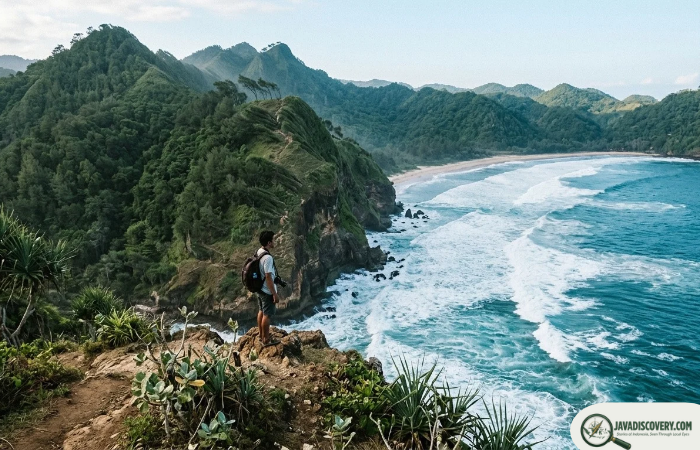
South of Malang’s high volcanic basin, the land drops dramatically toward the raw expanse of the Indian Ocean. Here, the landscape changes from cool apple orchards and pine-covered slopes into a rugged corridor of jagged limestone cliffs, ancient coral terraces, and offshore islets.
This southern coast is defined by its dramatic topography. High waves generated far south in the ocean crash against a natural defense line of uplifted karst formations. These limestone barriers shape one of East Java’s most distinctive coastal ecosystems.
The Jagged Edge of East Java’s Coastal Karst
The southern edge of Malang Regency sits atop a subterranean geological uplift where ancient coral reefs were pushed skyward over millennia. The resulting karst landscape features steep sea cliffs, limestone caverns, and isolated rock pillars rising straight out of the churning surf.
These offshore rock formations, known locally as sea stacks or small islands, act as natural breakwaters. They absorb the main force of massive ocean swells before the water reaches the mainland beaches, creating a dynamic shoreline where quiet sandy coves sit just meters away from roaring ocean spray.
Tides, Islets, and the Indian Ocean Swells
Seasonal ocean currents and daily tidal cycles continuously reshape the southern beaches. Locations such as Pantai Balekambang, Pantai Goa Cina, and Pantai Sendang Biru showcase how geography and water movement interact along this stretch of coast.
During low tide, wide coral flats emerge from the receding water, revealing tidal pools rich with marine life. When high tide returns, violent swells crash against the rocky outcrops, sending plumes of foam into the coastal breeze.
The Sacred Islets and Coral Shelves
At Pantai Balekambang, natural limestone islets sit just offshore, connected to the mainland by narrow concrete walkways. These offshore rocks, shaped by centuries of wave erosion, support small coastal shrines where local residents hold quiet reverence for the sea.
The surrounding coral shelves form shallow coastal basins. As the tide drains away, these natural stone platforms create sheltered pockets of water, offering a calm contrast to the open ocean waves breaking just beyond the reef edge.
Sheltered Waters of Sendang Biru and Pulau Sempu
Further east along the coastline lies Sendang Biru, a busy fishing cove protected from open ocean surges by the mass of Pulau Sempu. This offshore island forms a natural barrier, creating a calm strait where traditional brightly painted fishing boats anchor safely.
Pulau Sempu itself is a restricted nature reserve composed of dense coastal rainforest and limestone karst. At its center lies Segara Anakan, a hidden lagoon filled by seawater flowing through a natural archway in the ocean-facing cliffs, exemplifying the unique micro-ecosystems of Malang’s southern shore.
Living Along the Pandalungan Coastal Horizon
Life along Malang’s southern shore is shaped by the ocean’s unpredictable power. Coastal settlements here reflect the Pandalungan cultural blend—a harmonious mixing of Javanese and Madurese traditions forged through generations of living alongside the sea.
Local fishermen read the ocean tides, wind directions, and sky formations with deep ancestral knowledge. Respecting the unpredictable waters of the Indian Ocean, coastal communities maintain a balanced relationship with the marine environment, finding harmony where the mountain winds finally meet the sea.
Writer: Sari Mahendra