Why East Java Remains One of Java’s Greatest Hidden Treasures

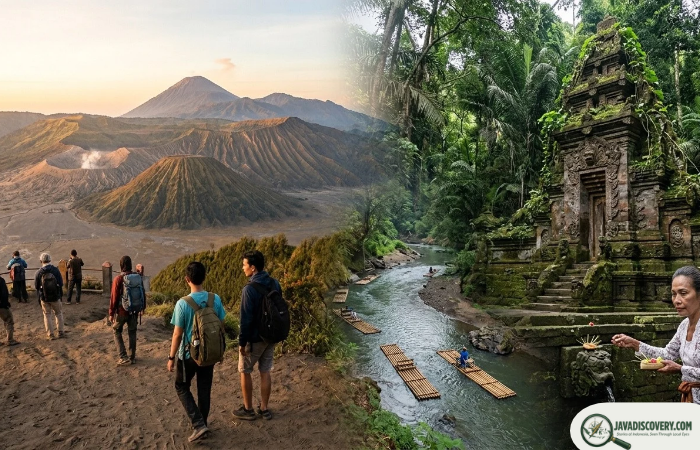
East Java is the kind of place that becomes larger the longer you look at it. On a map, it is one province at the eastern end of Java. On the ground, it is a succession of volcanic highlands, fertile valleys, dry savannas, fishing villages, ancient temples, crowded markets, quiet beaches, and communities whose identities can change noticeably from one region to the next.
For many international travelers, the journey begins with Mount Bromo. Its immense caldera, volcanic sand sea, and cold dawn have become some of Indonesia’s most recognizable landscapes. Yet Bromo is only one chapter in a much longer story.
Beyond it lies an East Java shaped by fire, water, migration, kingdoms, agriculture, trade, and living traditions. It is a region where a journey can move from a volcano before sunrise to an ancient temple by afternoon, then continue toward a coastline where the rhythm of life feels completely different.
East Java Beyond Mount Bromo
Mount Bromo is perhaps the most powerful image associated with East Java. Located within Bromo Tengger Semeru National Park, it sits inside a dramatic volcanic landscape that includes the Tengger caldera, a broad sea of sand, Mount Batok, and Mount Semeru, the highest mountain on Java.
The national park covers roughly 800 square kilometres and contains a remarkable range of volcanic and highland environments. The landscape is not simply a mountain backdrop. It is a geological world where volcanic cones, grasslands, forests, valleys, and lakes exist within a relatively concentrated area.
UNESCO’s Bromo Tengger Semeru Arjuno Biosphere Reserve further illustrates the ecological importance of this mountainous part of East Java. The reserve contains rainforest, savanna, cultivated landscapes, mountain ecosystems, and a considerable variety of plant and animal species.
But the most important reason not to stop the story at Bromo is cultural.
The highlands are home to the Tengger community, whose traditions have developed within this volcanic environment over generations. Their religious practices and relationship with the mountains are distinct, and should not simply be folded into a generic description of Javanese culture.
A Landscape Shaped by Volcanoes and the Sea
Volcanoes are among the great architects of East Java. They have shaped the soil, water systems, agricultural landscapes, settlements, and even the visual character of the province.
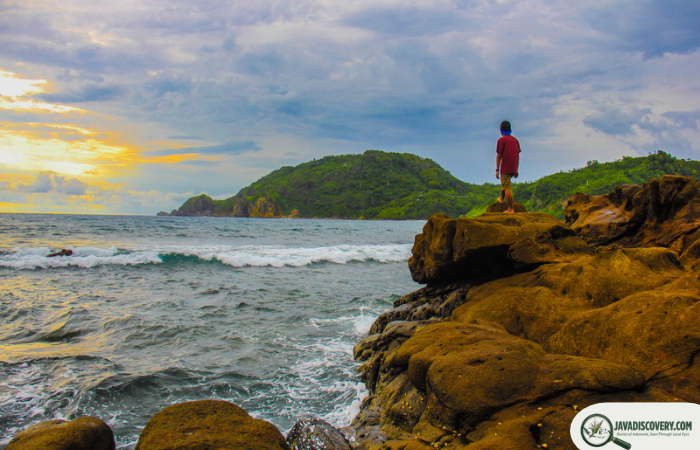
From the volcanic interior, the land eventually descends toward the sea. Along the southern coast, the landscape changes dramatically. Cliffs rise above the Indian Ocean, beaches appear between rocky headlands, and small coastal communities continue to depend on fishing and agriculture.
In areas such as Malang’s southern coastline, visitors encounter beaches that feel very different from the highly developed resort landscapes associated with other parts of Indonesia. Some are reached through winding rural roads, passing plantations and villages before the ocean suddenly appears beyond the trees.
Further west, Pacitan adds another dimension with its karst landscapes, caves, and beaches. To the east, the coastline around Banyuwangi and Situbondo opens toward the Bali Strait and the Java Sea.
This geographic variety is one of East Java’s greatest strengths. A traveler does not have to choose between mountains and the sea. With enough time, both become part of the same journey.
Mount Bromo and the Tengger Highlands
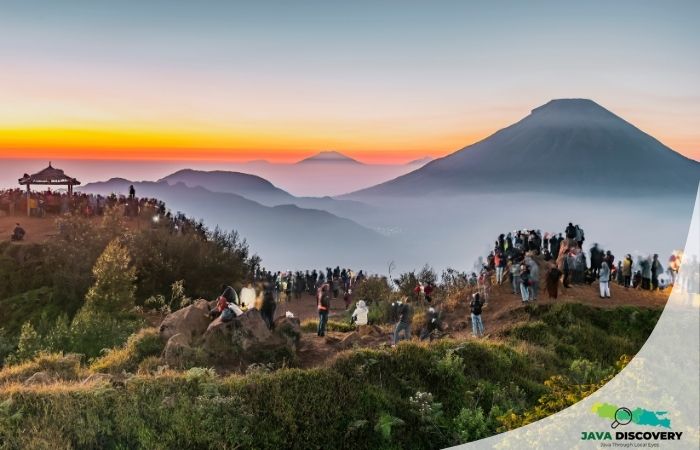
Before sunrise, the temperature around Bromo can be surprisingly cold. The darkness is broken by vehicle headlights, footsteps, and the occasional sound of a horse moving across the volcanic landscape.
Then the horizon begins to change.
Mount Bromo rises from the sea of sand while the silhouette of Mount Batok stands nearby. As the light strengthens, the grey and black volcanic terrain gradually takes on shades of brown and gold.
This familiar scene is often presented as a simple sunrise attraction. Yet the landscape carries a deeper cultural meaning for the Tengger people, for whom Mount Bromo and the surrounding highlands are part of a sacred cultural landscape.
The annual Kasada ceremony is among the best-known expressions of this relationship. During the ceremony, Tengger Hindus make offerings at the crater of Mount Bromo. For visitors, witnessing such a ritual should involve more than taking photographs. It requires understanding that the mountain is not merely scenery but part of a living belief system.
The official national park authorities also regulate visitor activities in the area, including requirements for online entrance tickets and restrictions intended to protect the environment and respect local norms.
The Volcanic Drama of Ijen
Farther east, another volcanic landscape offers a completely different experience.
Ijen is known for its turquoise crater lake and the unusual blue flames that can sometimes be observed in darkness under appropriate conditions. The landscape belongs to the wider Ijen volcanic complex, stretching across the highlands associated with Banyuwangi, Bondowoso, and surrounding areas.
Here the experience is less about a panoramic sunrise and more about the atmosphere of the crater itself: sulphurous air, steep paths, enormous volcanic walls, and the changing light above the crater lake.
Ijen also provides a reminder that volcanic landscapes are working environments, not empty wilderness. Sulphur mining has long been part of the local economy, and miners carrying heavy loads along the mountain paths have become an unmistakable part of the area’s human landscape.
The presence of tourism alongside traditional livelihoods raises important questions about how visitors experience places like Ijen. The mountain can be spectacular, but it is also a workplace, an ecosystem, and a landscape with communities whose lives extend beyond tourism.
The Ancient World of East Java
East Java’s story does not begin with modern tourism.
Across the province are archaeological remains associated with some of the most important political and religious centres in Java’s past. Singhasari, Kediri, and Majapahit are among the historical names that appear repeatedly when exploring the region.
Near Malang, Singhasari introduces visitors to the remains of a kingdom that flourished in eastern Java during the thirteenth century. The surviving temple and archaeological landscape provide a physical connection to a period when political power was shifting across Java.
Farther west, the area around Kediri preserves another layer of historical memory. To the southwest, Blitar is home to Candi Penataran, one of the most significant surviving temple complexes in East Java.
Then there is Trowulan in Mojokerto, widely associated with the Majapahit kingdom. Archaeological remains scattered across the landscape include temples, gateways, water structures, and other features that have helped researchers reconstruct aspects of the ancient settlement.
But ancient Java should not be reduced to a collection of romantic legends.
Historical sources, inscriptions, archaeological evidence, literary works, and local traditions do not always tell exactly the same story. Some popular narratives surrounding ancient kingdoms are based partly on later tradition or interpretation. For that reason, the most interesting approach is often to leave room for uncertainty.
Ruins do not merely tell us what happened. They also reveal how later generations remembered what happened.
A Region of Distinct Cultures
One of the biggest mistakes a traveler can make in East Java is to imagine that the province has one uniform culture.
It does not.
The urban area around Surabaya and Malang belongs broadly to the Arek cultural sphere, known for a direct and egalitarian social character and its distinctive linguistic expressions.
Westward, areas such as Madiun, Ponorogo, Kediri, and Blitar are commonly associated with the Mataraman cultural region, which has stronger historical connections with Central Javanese cultural traditions.
Move toward Jember, Bondowoso, Situbondo, Probolinggo, and parts of Lumajang, and another cultural landscape appears. The Tapal Kuda or Pandalungan region reflects long interaction between Javanese and Madurese communities.
Banyuwangi has yet another identity. The Osing community maintains its own language and cultural traditions, making the easternmost part of Java particularly distinctive.
High in the Bromo region, Tengger culture forms another important identity. And across the sea, Madura should be understood on its own terms, with its own language, traditions, history, and cultural identity rather than being treated as simply another expression of Javanese culture.
For travelers, these differences can be subtle at first. They become clearer through language, food, ceremonies, architecture, music, social customs, and the way people describe their own communities.
From Savanna to Coastal Wilderness
East Java can also surprise visitors with landscapes that seem almost un-Javanese.
In Situbondo, the road follows the northern coast toward Baluran National Park, where savanna, dry forest, wetlands, and coastal ecosystems create a landscape often compared visually with parts of Africa.
The experience is especially striking during the dry season, when grasses turn golden and the horizon becomes broad and open. During wetter periods, the landscape changes again as water returns to low-lying areas and vegetation becomes greener.
The region demonstrates why East Java cannot be understood only through its mountains. Its ecological range stretches from humid highlands to relatively dry northern landscapes and from inland forests to coral-fringed coastal environments.
In Situbondo, the official local tourism platform describes the region through a combination of coast, savanna, forests, wildlife, and local culture. That combination is precisely what makes the northern corridor worth exploring at a slower pace.
Beaches That Tell a Different Story
The southern coastline of East Java is among the province’s most dramatic landscapes.
Waves from the Indian Ocean arrive with considerable force, creating beaches that are beautiful but not always suitable for casual swimming. In many places, the attraction lies instead in the scenery: cliffs, rock formations, forests, fishing boats, and long stretches of sand.
For international visitors, this part of Java offers something increasingly rare: the feeling of discovery.
A beach does not need an elaborate resort to be memorable. Sometimes it is the road through a village, the sound of waves beyond a line of trees, or a small food stall beside a quiet coastal road that becomes the defining memory.
This is especially true around parts of Malang, Trenggalek, Tulungagung, and Pacitan, where the southern coast offers a succession of landscapes rather than one single iconic beach.
Food as a Map of East Java
Food provides another way to understand the province.
In Surabaya, rujak cingur combines vegetables, fruit, rice cakes, and other ingredients with a rich petis-based sauce. Rawon, with its dark broth coloured and flavoured by kluwek, has become one of East Java’s most recognizable dishes.
Malang has its own culinary vocabulary, including bakso Malang and cwie mie. Madiun is associated with pecel, while different areas across the province have their own versions of rice dishes, sambal, soups, snacks, and fermented foods.
The differences are not merely about recipes. They reflect agriculture, trade, local ingredients, migration, and historical connections.
A bowl of food can therefore become a small map of the province.
Why East Java Deserves More Time
There is a temptation to experience East Java as a checklist: Bromo, Ijen, a waterfall, a beach, perhaps a temple, and then onward to Bali.
That approach misses much of what makes the region compelling.
East Java rewards travelers who slow down enough to notice transitions. The change from cool mountain air to humid coastal heat. The difference between an urban market and a village road. The shift in architecture between cultural regions. The sound of a mosque, temple ceremony, traditional performance, or market bargaining in different parts of the province.
It is also a place where nature and culture cannot easily be separated. Volcanoes have shaped agriculture and settlement. Rivers have supported communities. Ancient kingdoms left temples and archaeological landscapes. Trade and migration created new cultural combinations. And tourism now adds another layer to a region that was already changing long before the first visitor arrived.
That is perhaps the real meaning behind the idea of East Java as a jewel in the eastern part of Java. Its value does not come from one spectacular attraction.
It comes from the accumulation of many worlds within one region.
There are mountains where smoke rises into the morning sky, forests where the road disappears beneath green canopies, beaches facing the open Indian Ocean, ancient stones carrying traces of forgotten political centres, markets filled with unfamiliar aromas, and communities whose identities remain deeply rooted in place.
Mount Bromo may be the image that first brings East Java to the world’s attention. But once the journey continues beyond the crater, another East Java begins to emerge.
It is not simply a destination to be photographed. It is a landscape to be read, one mountain, village, temple, coastline, meal, and living tradition at a time.
Writer: Sari Mahendra