Airlangga and the Division of Java’s Kingdom

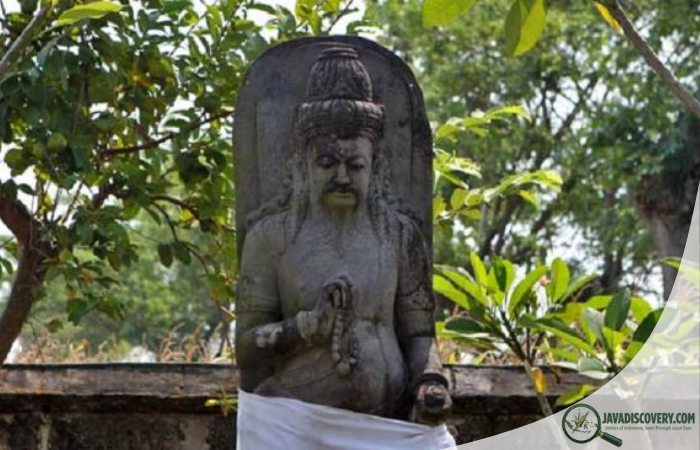
javadiscovery.com – The Brantas River moves slowly through East Java, its brown waters reflecting the heavy tropical sky. Along its banks, farmers bend over emerald rice fields, their feet sinking into warm mud. Few pause to consider that nearly a thousand years ago, this same river witnessed the rise and fragmentation of a kingdom that would shape Java’s political imagination for centuries. In the eleventh century, a ruler named Airlangga stood at the center of that turning point, navigating chaos, exile, consolidation, and ultimately a decision that would divide his realm in two.
A Prince in Exile
Airlangga was born around 990 CE, the son of a Balinese king and a Javanese princess linked to the Isyana dynasty. His early life was tied to the court of East Java, then ruled by Dharmawangsa. But stability proved fragile. In 1016, during what chronicles later called the Pralaya or great catastrophe, a rival warlord attacked the capital. The palace fell. Dharmawangsa was killed. Fire and panic tore through the heart of the kingdom.
Airlangga, still a young nobleman, escaped into the forests with a small group of loyal attendants. For years he lived in relative obscurity, sheltered by hermitages and rural communities. Inscriptions and later texts describe him wandering through mountainous terrain, seeking both refuge and clarity.
In Javanese historical memory, this period of exile is not merely political but spiritual. A ruler tested by wilderness acquires legitimacy through endurance. The forest becomes a crucible where ambition is tempered by humility.
Rebuilding from Ruins
By 1019, Airlangga began consolidating support among regional leaders. East Java at the time was fragmented, its authority dispersed among local lords who commanded irrigation networks and trade routes. The fertile Brantas basin, with its intricate system of canals and rice fields, was both prize and battleground.
Gradually, Airlangga reasserted control. Inscriptions such as the Pucangan inscription recount campaigns against rival chiefs and rebellious territories. Yet conquest alone did not secure his authority. He invested heavily in restoring irrigation infrastructure, understanding that agricultural prosperity formed the backbone of political stability.
Temples were repaired. Trade with Bali and beyond was revitalized. River ports along the northern coast resumed activity, linking Java to maritime routes stretching toward the South China Sea. Airlangga’s court became a center of administrative order after years of disruption.
A Kingdom of Balance
Airlangga’s reign, which lasted until 1049, is often portrayed as an era of reconstruction and balance. He adopted the regnal name Sri Maharaja Rakai Halu Sri Lokesvara Dharmawangsa Airlangga Anantawikramottunggadewa, a title that fused political authority with divine resonance.
Religion during his rule reflected Java’s syncretic character. Shaivism and Buddhism coexisted, intertwined within temple architecture and royal patronage. The king positioned himself as protector of this plural spiritual landscape, reinforcing the idea that sovereignty in Java required alignment with cosmic harmony.
The capital at Kahuripan thrived. Rice harvests stabilized. Markets hummed with traders exchanging spices, textiles, and forest products. Court poets composed kakawin verses celebrating restoration after chaos. Yet beneath the surface of prosperity lay a familiar tension: succession.
The Problem of Heirs
As Airlangga aged, the question of inheritance grew urgent. Sources suggest he had two sons born to different queens. Rival maternal lineages carried competing claims. In a political culture where kinship ties could ignite factional conflict, the potential for civil war loomed.
Javanese chronicles recount that Airlangga considered renouncing the throne to become an ascetic. Whether literal or symbolic, this narrative underscores his awareness of impermanence. A ruler who had survived catastrophe understood how fragile unity could be.
Rather than allow succession disputes to fracture the kingdom violently, Airlangga made an unprecedented decision. He divided his realm into two separate kingdoms: Janggala in the east and Panjalu in the west, the latter often identified with Kediri.
The Division of the Realm
The division around 1045 was not a haphazard split. It followed geographic and economic contours. Janggala controlled key coastal ports, ensuring access to maritime trade. Panjalu governed fertile inland territories along the Brantas basin. In theory, the arrangement balanced resources and reduced rivalry.
According to later tradition, a respected sage named Mpu Bharada played a ceremonial role in demarcating the boundary. Though embellished over time, the story captures an essential truth: the division required moral authority to legitimize it.
Airlangga then withdrew from active rule, reportedly adopting the life of a hermit under the name Resi Gentayu. His retreat reinforced the narrative of a king who prioritized stability over personal dynastic ambition.
Aftermath and Rivalry
Despite its intention to prevent conflict, the division planted seeds of future competition. Janggala and Panjalu developed distinct identities. Over subsequent decades, Panjalu, under the name Kediri, rose to prominence, overshadowing its eastern counterpart.
Literary works flourished in Kediri’s court, including adaptations of Indian epics infused with Javanese nuance. The memory of Airlangga’s reign lingered as a foundational chapter, a moment when unity had been restored before being consciously reshaped.
Historians debate whether the division ultimately strengthened or weakened East Java’s political coherence. Some argue that it allowed regional specialization and cultural vibrancy. Others view it as fragmentation that limited centralized power.
Landscape as Witness
Today, traces of Airlangga’s era survive in temple ruins and inscriptions scattered across East Java. Near Mount Penanggungan, terraced sanctuaries cling to hillsides veiled in morning fog. Carved stones bear faint lines of Old Javanese script, weathered yet persistent.
The Brantas River continues its patient course, indifferent to ancient borders. Farmers adjust irrigation gates much as their predecessors did a millennium ago. The physical landscape remains a silent witness to decisions that once reshaped political destiny.
Legacy of a Divided Crown
Airlangga’s story endures because it intertwines resilience with restraint. He rose from exile to restore order, then chose division to avert bloodshed. In Javanese political thought, legitimacy is not measured solely by conquest but by the capacity to maintain balance.
The division of Java’s kingdom under Airlangga reveals a nuanced understanding of power. Authority could be shared, territory partitioned, ambition moderated. Whether the experiment succeeded fully remains debated, yet its symbolism resonates deeply within Java’s historical consciousness.
As twilight settles over East Java and the call to prayer drifts across rice fields, the past feels neither distant nor abstract. It lingers in river currents and temple stones, in stories passed between generations. Airlangga’s decision to divide his kingdom stands as a reminder that leadership in Java has long been defined not only by expansion, but by the difficult art of choosing where to draw the line.