Mangroves of Demak Rebuilding a Fragile Shoreline

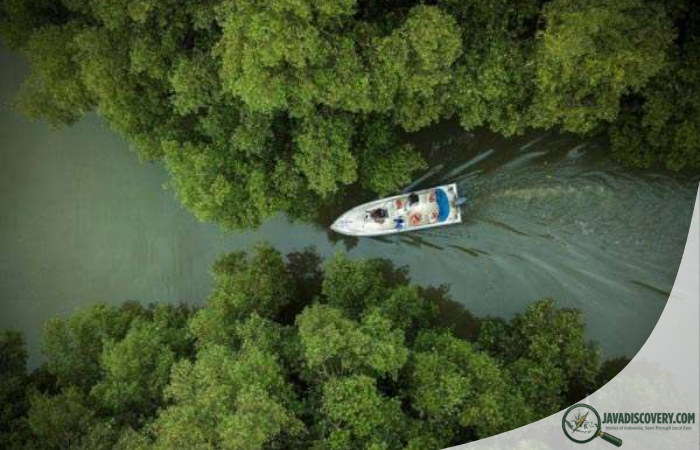
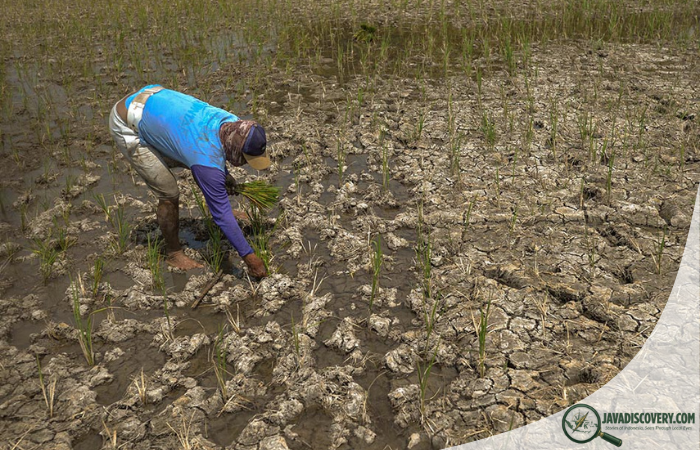
javadiscovery.com – The mud in Demak is warm beneath the surface. Step into it and your feet sink slowly, swallowed inch by inch until balance becomes a negotiation between body and earth. Around you, the Java Sea stretches in a dull silver sheet, the horizon blurred by humidity. In this shifting border between land and water, villagers stand knee deep in brackish tide, pressing slender mangrove seedlings into the sediment. They work quietly, hands coated in brown silt, planting a future that will take years to reveal itself.
A Coast That Slipped Away
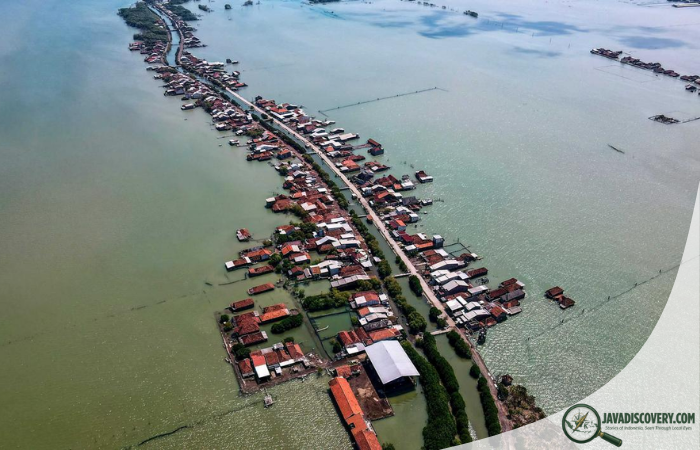
Demak Regency, on the north coast of Central Java, has become one of the most visible frontlines of coastal transformation in Indonesia. Over the past two decades, entire stretches of shoreline have retreated dramatically. Fishponds dissolved. Houses were abandoned. In certain villages such as Bedono and Timbulsloko, the sea advanced hundreds of meters inland, submerging rice fields and cutting roads into fragments.
The causes are layered. Land subsidence due to excessive groundwater extraction lowers the surface gradually. Rising sea levels linked to global climate change push tides higher each year. Coastal development has stripped away natural buffers that once softened the impact of waves. What remains is a narrow, vulnerable plain facing open water.
Yet amid loss, another story has taken root. It grows slowly, branch by branch, leaf by leaf.
The Return of Mangroves
Mangroves once lined much of Java’s northern coast. Their intricate root systems stabilized sediment and reduced wave energy. They formed nurseries for fish, shrimp, and crabs that sustained coastal economies. Over time, many were cleared to create tambak, brackish fishponds that promised higher short term returns.
When erosion intensified and ponds began collapsing into open sea, the protective role of mangroves became starkly clear. In Demak, local communities, environmental groups, and researchers began experimenting with restoration. Rather than relying solely on concrete barriers, they looked to living structures.
At low tide, rows of bamboo stakes now punctuate the mudflats. These permeable barriers, built from locally sourced materials, slow incoming waves and trap sediment. Behind them, mangrove seedlings are planted in careful lines. The idea is simple yet patient. First, calm the water. Then allow the land to rebuild itself.
Planting Against the Tide
On a humid morning in Timbulsloko, Pak Rofiq adjusts his cap and surveys a grid of young mangroves stretching toward the sea. Five years ago, he says, this was open water. “We thought it was finished,” he recalls. “There was nothing to stand on.”
He and other villagers began installing bamboo wave breakers after attending workshops led by coastal engineers and conservationists. The work demanded coordination. Poles had to be aligned precisely to reduce wave force without blocking tidal flow entirely. Sediment accumulated gradually behind the barriers, forming shallow mudbanks.
Once the mud stabilized, they planted mangrove species suited to local salinity and tidal patterns, including Rhizophora and Avicennia. The seedlings, no taller than a forearm, looked fragile against the expanse of sea. Many did not survive the first months. Storm surges uprooted some. Others were buried in shifting silt. Still, enough endured.
Today, sections of coastline that once seemed irretrievable are edged with green. The young forest is uneven, interrupted by channels of tidal water, but it is visible from afar. It signals resistance.
The Science of Living Barriers
Mangroves function as dynamic coastal infrastructure. Their prop roots diffuse wave energy, reducing erosion during storms. The dense network of roots traps suspended sediment, gradually raising the seabed. Leaves that fall and decompose enrich the soil, creating conditions for further growth.
Researchers studying Demak’s restoration efforts observe measurable land accretion in certain pilot zones. Sediment layers thicken behind permeable barriers. Over time, the elevation increases enough to support additional vegetation. The process is not immediate. It unfolds across seasons, shaped by monsoon patterns and tidal cycles.
Unlike concrete sea walls, mangroves adapt. As sea levels rise, healthy mangrove ecosystems can accumulate sediment and grow upward, maintaining relative elevation. Their resilience depends on space to expand inland, a factor complicated by dense settlement patterns along Java’s north coast.
Livelihoods Intertwined with Roots
For coastal communities, mangrove restoration is not solely an environmental project. It is tied to economic survival. In villages where tambak collapsed, incomes fell sharply. Fishermen ventured farther offshore, facing higher fuel costs and unpredictable weather. Younger residents sought work in cities, leaving aging parents behind.
As mangroves return, small fish and crustaceans reappear among the roots. Crab traps set near restored areas yield modest but meaningful catches. Women collect shellfish during low tide, baskets balanced on their hips. The forest becomes both shield and pantry.
Ibu Sulastri, who helps manage a community nursery, tends rows of seedlings in black polybags filled with sandy soil. She waters them using brackish water drawn from a nearby channel. “If we wait for someone else to fix this, we will wait forever,” she says, brushing mud from her hands. Her voice carries neither anger nor optimism, only resolve.
Education and Shared Responsibility
Local schools now incorporate coastal ecology into lessons. Children visit planting sites, learning to distinguish between mangrove species by leaf shape and root structure. They measure seedling growth with simple rulers and record observations in notebooks. The coastline becomes a classroom.
Religious leaders also participate, weaving messages about stewardship into sermons. In a region historically linked to the early spread of Islam in Java, moral language resonates. Caring for the environment is framed as both practical necessity and spiritual duty.
These layers of engagement strengthen collective ownership. Restoration is not imposed from outside but embedded in daily life.
Challenges on Unsteady Ground
Despite progress, obstacles persist. Land subsidence continues in parts of Demak, exacerbated by groundwater extraction and heavy infrastructure. In areas where the ground sinks rapidly, newly formed mudbanks may struggle to keep pace with rising water levels.
Funding is uneven. Some projects flourish under sustained support, while others falter when resources diminish. Monitoring requires technical expertise and long term commitment. Mangroves, once planted, must be protected from illegal cutting and incompatible development.
There are social complexities as well. Not all residents agree on land use priorities. Some prefer rebuilding fishponds if sediment returns, seeing quicker economic gain. Balancing immediate needs with long term ecological resilience demands negotiation and trust.
Moments of Evidence
Late in the afternoon, as tide pushes gently against the bamboo stakes, the restored coastline reveals subtle signs of change. Egrets stand poised among young trees, their white feathers luminous against deep green leaves. Small fish ripple the water’s surface. The air carries a mix of salt and organic decay, the scent of a living wetland.
Pak Rofiq walks along a narrow earthen path that did not exist a few years earlier. It is only a meter wide, fragile and muddy, but it supports his weight. He stops and points to a cluster of mangroves whose roots intertwine like fingers clasped together. “Before, there was nothing to point at,” he says.
A Model Beyond Demak
The experience of Demak has drawn attention from other coastal regions in Indonesia facing similar threats. The combination of permeable structures and community led mangrove planting is studied as a hybrid approach, blending engineering with ecological restoration.
Its success depends not only on technical design but on social cohesion. Where villagers collaborate and maintain structures collectively, sediment accumulates more consistently. Where coordination weakens, barriers break down and young trees are lost.
The lessons are nuanced. Mangroves are not a universal cure. They require suitable tidal ranges, sediment supply, and long term protection. Yet in Demak, they represent a shift in perspective. The sea is not confronted solely with concrete, but engaged with patience.
The Rhythm of Return
As dusk settles over the north coast, the mangrove leaves rustle in a light breeze. The sound is subtle, a dry whisper layered over distant waves. Fireflies flicker above the mud. From a nearby mosque, evening prayers drift across the water, mingling with the hum of insects.
The shoreline remains fragile. Storms will come. Tides will rise. But between the bamboo stakes and the rooted saplings, a new margin forms, neither fully land nor fully sea. It is a space of adaptation.
In Demak, rebuilding the coast does not mean restoring it to a remembered past. The old fields and roads may never return. Instead, communities cultivate a different boundary, one that bends and grows. Each seedling planted in the mud is an acknowledgment of uncertainty and a commitment to endure within it.