The Social Meaning of Helping Without Being Asked

javadiscovery.com — In the golden, dust-moted light of a late afternoon in a village near Magelang, the air is thick with the scent of drying clove and the distant, rhythmic thud of a wooden mallet. An elderly woman struggles to shift a heavy bamboo mat laden with unhusked rice as a sudden, dark bruise of a raincloud gathers over the jagged silhouette of Mount Merapi. Before she can utter a word, two young men passing by instinctively veer off the path. Without a greeting, without an exchange of glances, and certainly without being asked, they take the corners of the mat and pivot it into the shelter of her porch. They nod once, a silent acknowledgement of a duty fulfilled, and continue their walk. This quiet, unsolicited intervention is the living pulse of sambatan—the profound social meaning of helping without being asked. It is an ancient, unwritten code that defines the Javanese communal soul, a silent language of empathy that ensures no individual stands alone against the whims of nature or the weight of hardship. To understand the social meaning of helping without being asked is to touch the very fabric of Java’s resilience, where the boundaries of the self dissolve into the collective “kita” (us).
The Philosophy of Sepi ing Pamrih
At the root of the social meaning of helping without being asked lies the Javanese philosophical pillar of sepi ing pamrih, rame ing gawe. Translated literally, it means “quiet in selfish intent, busy in the work.” In the narrow gangs (alleys) of Yogyakarta or the vast tobacco fields of Temanggung, this is not a suggestion but a way of being. When a neighbor sees a roof being tiled or a drainage ditch being cleared, they do not wait for an invitation. They simply pick up a tool. To ask for help in traditional Javanese culture can sometimes be perceived as a burden to others; therefore, the highest form of social grace is to provide that help before the need is even voiced.
This “unasked” assistance is a manifestation of roso—an intuitive, sensory feeling for the state of one’s environment and the people within it. A Javanese person is taught from childhood to be tanggap ing sasmita—sensitive to subtle signs. A furrowed brow, a heavy sigh, or a lingering gaze at a broken fence are all “signals” that set the social machinery of help into motion. The social meaning of helping without being asked is thus a sophisticated exercise in emotional intelligence, where the goal is to preserve the “gengsi” (dignity) of the recipient by never forcing them to admit they cannot cope alone.
Sambatan: The Architecture of Spontaneous Solidarity
The most formal expression of the social meaning of helping without being asked is the tradition of sambatan. Historically, this referred to the communal construction of a house or the preparation of a large-scale hajatan (feast). While gotong royong is often scheduled, sambatan frequently erupts from a sudden necessity. When a tree falls across a family’s kitchen during a monsoon, the village does not wait for a formal meeting. Within minutes, the sound of saws and the shouting of directions fill the air.
In these moments, the social meaning of helping without being asked acts as a safety net that bypasses the slow bureaucracy of modern life. There is no ledger kept, no bill presented. The only “payment” is usually a glass of sweet jasmine tea and a few pieces of fried cassava shared afterward. This spontaneous solidarity reinforces the Javanese belief that “mangan ora mangan kumpul” (whether we eat or not, as long as we are together). The sambatan culture proves that the social meaning of helping without being asked is the ultimate insurance policy for the “wong cilik” (common people), a system where labor is a gift and presence is the highest form of respect.
“If I wait for my neighbor to ask for help, I have already failed him. In Java, we watch with our hearts. If his burden is heavy, it is my burden too. That is just how the world stays balanced.” — Pak Hardjo, 68, a village elder in Boyolali.
The Quiet Language of the Kitchen
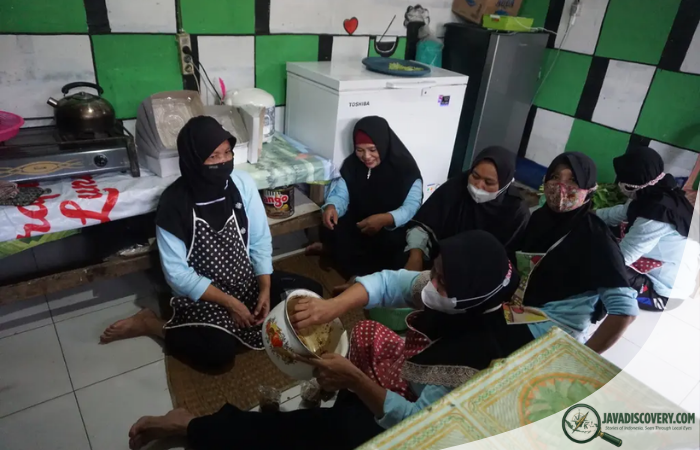
While the men might be seen lifting beams or clearing fields, the social meaning of helping without being asked is perhaps most powerfully felt in the pawon (kitchen). When a woman in the village is preparing for a wedding or a selametan, the neighboring women simply arrive with their own knives and cutting boards. They sit on the floor, peeling shallots and grinding chili paste, their hands moving in a blur of practiced rhythm. This is the “rewang” tradition, a subset of the social meaning of helping without being asked.
In the heat and smoke of the kitchen, the social meaning of helping without being asked becomes a conduit for the transmission of oral history and communal values. As they work, the women discuss the health of the village, the success of the school children, and the nuances of local gossip. This unsolicited labor is the engine of Javanese social life. By helping without being asked, these women are weaving a web of mutual obligation that ensures that when their turn comes to host, the kitchen will be just as full of helping hands. It is a cycle of “ngrumat” (care) that sustains the community’s spirit through the sheer power of presence.
The Modern Struggle: Urban Individualism vs. Traditional Rukun
As Java urbanizes and skyscrapers rise above the ancient banyan trees, the social meaning of helping without being asked faces a significant challenge. In the gated communities of Jakarta or the high-rise apartments of Surabaya, the “walls” are not just made of concrete, but of time and anonymity. The modern reality of busy corporate schedules and digital isolation often leaves little room for tanggap ing sasmita. Many urban Javanese now find themselves in a world where “helping” is something you hire, and “privacy” is valued over “guyub” (togetherness).
Yet, even in these concrete jungles, the social meaning of helping without being asked refuses to die. It simply mutates. In the urban kampungs, neighbors still look out for the safety of each other’s children. When a motorcycle stalls on a crowded street, three strangers will still jump off their own bikes to help push it to the curb. These “micro-acts” of unsolicited help are the remnants of the ancient code, a biological memory of the sawah (rice field) brought into the city. The social meaning of helping without being asked acts as a bridge, allowing the urban Javanese to retain a piece of their “identitas” in a world that often feels cold and transactional.
| Transactional Help (Modern) | Unsolicited Help (Javanese) |
|---|---|
| Requires an explicit request or contract | Driven by intuition and observation |
| Financial compensation is expected | Social bond and “berkah” (blessing) are the rewards |
| Formal and time-bound | Organic, spontaneous, and lifelong |
| Focus on the individual’s need | Focus on the community’s “rukun” (harmony) |
Helping as a Spiritual Practice: Ngudi Kasampurnan
To many Javanese, the social meaning of helping without being asked is not just a social duty; it is a spiritual path toward ngudi kasampurnan (seeking perfection of the soul). In the “Kejawen” spiritual tradition, to help another without being asked is to align oneself with the “Universum.” It is an act of laku—a spiritual discipline that humbles the “ego” (hawa nafsu). By acting before being asked, the helper removes the element of “praise” or “thanks” from the equation, as the intervention feels like a natural extension of the environment.
This spiritual dimension gives the social meaning of helping without being asked its enduring strength. It is believed that by easing the path for others, one’s own path in the “akhirat” (afterlife) or the “moksha” (liberation) will be eased. This cosmic reciprocity ensures that the act of helping is always “ikhlas” (sincere). In the quiet villages of East Java, you will often find people performing “kerja bakti” (communal cleaning) on a sacred graveyard or a public spring with no audience but the trees. This is the purest form of the social meaning of helping without being asked: a service to the unseen, for the benefit of the collective “spirit” of the land.
The Psychology of the Recipient: Accepting Without Shame
A crucial, often overlooked part of the social meaning of helping without being asked is the role of the recipient. In many cultures, receiving unasked help can feel like an affront to independence. However, in the Javanese context, accepting help is an act of “andhap asor” (humility). By allowing others to help without being asked, the recipient provides an opportunity for the helper to gain “pahala” (merit) and reinforces the bonds of the “guyub.”
There is a delicate “etika” (etiquette) involved. The recipient does not gush with over-the-top gratitude, which might make the helper feel “sungkan” (awkwardly respectful). Instead, the help is accepted as a natural flow of life, often acknowledged with a simple “matur nuwun” (thank you) and an invitation to share a meal. This balance ensures that the social meaning of helping without being asked never feels like “charity,” but like “cooperation.” It maintains the equilibrium of the village, ensuring that no one feels superior for giving, and no one feels inferior for receiving.
Conclusion: The Eternal Rhythm of the Island
The social meaning of helping without being asked is the invisible thread that holds the island of Java together. It is a system that values “harmony” over “efficiency” and “empathy” over “ego.” In the faces of the village youth helping an old man cross a muddy path, or the neighbors appearing with food when a family is in mourning, we see the true “soul” of Java. It is a soul that understands that we are all “migrating” through this life together, and that the road is only passable if we carry each other’s burdens.
As the “maghrib” (sunset) call to prayer echoes over the rice fields and the fireflies begin to dance in the bamboo groves, the day ends not with an invoice, but with a sense of “tentrem” (tranquility). The social meaning of helping without being asked has once again proven its worth. It has turned a collection of houses into a “home,” and a group of individuals into a “civilization.” In a world that is increasingly asking “What is in it for me?”, the Javanese people continue to ask, with their eyes and their hearts, “What can I do for us?” It is a journey through time, faith, and humanity that reminds us that the greatest strength is found in the hands that reach out before they are even called.