Bamboo Architects of Tasikmalaya Ancestral Joinery Engineering

javadiscovery.com – A sharp, clean scent of freshly split bamboo, crushed leaves, and damp mountain earth fills the morning breeze sweeping through the highland valleys of Tasikmalaya Regency, West Java. High above the agricultural plains, framed by the distant volcanic peak of Mount Galunggung, the rhythmic tap of wooden mallets against iron chisels reverberates across open-air timber yards. Here, teams of master Sundanese builders, master carpenters (*tukang awi*), and contemporary eco-architects maneuver massive culms of giant bamboo (*Dendrocalamus asper*) with practiced grace. Known for centuries as Java’s undisputed center for bamboo weaving, basketry, and rural carpentry, Tasikmalaya is undergoing a profound structural renaissance. Today, local bamboo architects are merging traditional Sundanese joinery techniques—passed down orally across generations—with modern structural engineering to build awe-inspiring, low-carbon architectural masterpieces that redefine sustainable construction across Indonesia.
The Structural Marvel of Sundanese Bamboo
For the Sundanese people of West Java, bamboo (*awi*) is far more than a simple building material; it is a sacred, highly versatile natural resource embedded deep in regional material culture. The highland climate and fertile volcanic soil of Tasikmalaya nurture over a dozen native bamboo species, each possessing distinct physical properties utilized for specific structural roles:
- Awi Petung (*Dendrocalamus asper*): The undisputed heavyweight champion of tropical construction. Reaching diameters of up to twenty centimeters with wall thicknesses exceeding two centimeters, *Petung* boasts tensile strength comparable to structural steel, making it the primary choice for load-bearing columns, main trusses, and bridge arches.
- Awi Tali (*Gigantochloa apus*): Renowned for its exceptional flexibility, long fibers, and resistance to splitting. *Awi Tali* is split into fine, pliable ribbons used for intricate structural lashings, woven bamboo walls (*gedek*), and curved rafters.
- Awi Wulung (*Gigantochloa atroviolacea*): Naturally striking black bamboo used for interior finishings, decorative columns, and exposed rafters, prized for its natural termite resistance and deep ebony luster.
Ancestral Joinery: Engineering Without Nails
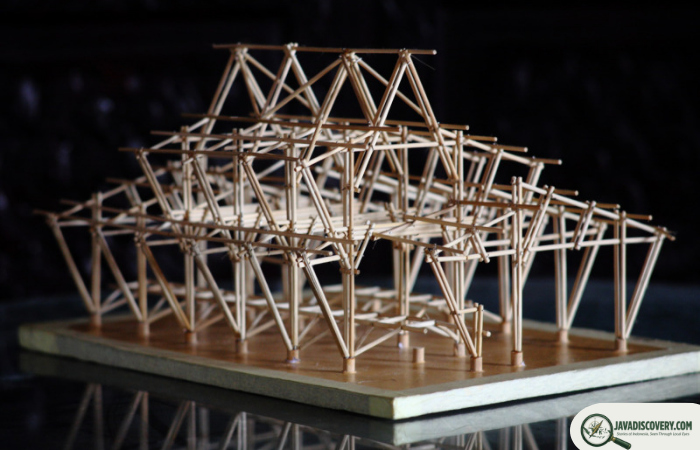
The true genius of Tasikmalaya’s bamboo architecture lies in its reliance on ancient, non-invasive joinery systems. Unlike modern timber construction that relies heavily on rigid steel nails or iron brackets—which slice through delicate bamboo longitudinal fibers and cause long-term splitting—traditional Sundanese joinery works in total harmony with the natural flexibility and tubular hollow geometry of the plant:
- Pasak and Purus (Mortise and Tenon Wood Dowels): Joint connections are secured using hand-carved hardwood pegs (*pasak*) made from dense ironwood or old teak. Driven through pre-drilled nodes, these pegs flex slightly under wind shear or seismic movement, distributing stress evenly across the joint.
- Takikan (Friction Fish-Mouth Joints): Master carpenters carve precise, concave fish-mouth notches into the ends of joining bamboo culms, allowing them to wrap seamlessly around the curved exterior of upright columns. This maximizes contact surface area and prevents slipping under heavy roof loads.
- Ikat Tali Ijuk (Arenga Palm Fiber Lashing): Critical structural nodes are bound tightly with thick, black cords made from *ijuk* (the waterproof, rot-resistant fiber of the sugar palm). *Ijuk* lashings protect the inner wooden pegs from weathering while adding a shock-absorbing buffer that absorbs intense ground vibrations.
Seismic Resilience: Buildings That Dance with the Earth
Sitting along the active Pacific Ring of Fire, West Java is subject to frequent seismic activity. Traditional rigid concrete and brick masonry structures often suffer brittle failure during major earthquakes. In contrast, Tasikmalaya’s bamboo architecture offers extraordinary seismic performance due to its high strength-to-weight ratio and inherent structural elasticity.
When an earthquake strikes, a bamboo structure engineered with traditional friction joints and wooden dowels does not crack or shatter. Instead, it sways, flexes, and absorbs kinetic energy safely—a phenomenon local builders describe as “dancing with the earth” (*menari bersama bumi*). If extreme ground motion exceeds structural limits, lightweight bamboo roofs pose significantly less danger to occupants compared to collapsing concrete slabs.
Boron Curing and Modern Preservation Innovations
Historically, the widespread adoption of bamboo in permanent urban construction was hindered by its vulnerability to powder-post beetles (*Dinoderus minutus*) and fungal decay. Raw untreated bamboo culms contain high concentrations of natural starches and sugars that attract boring insects within months of harvesting.
Tasikmalaya’s modern bamboo architects have solved this challenge by combining traditional harvesting wisdom with eco-friendly chemical preservation techniques:
- Moon-Phase Harvesting Traditions: Following ancestral *pamali* rules, bamboo is harvested exclusively during the waning moon when fluid pressure within the culms is at its lowest, naturally reducing starch content in the wood.
- Natural Borax and Boric Acid Immersion: Harvested culms are immersed in large vats containing natural borate mineral salts. The non-toxic borate solution diffuses deep into the bamboo wall fibers, replacing organic sugars and rendering the culm permanently inedible to insects and immune to rot for decades.
A Global Blueprint for Sustainable Architecture
Today, the bamboo creations of Tasikmalaya are catching the eye of global green building movements. From eco-resorts in Bali and open-air university auditoriums to community pavilions and disaster-resilient housing designs, Tasikmalaya’s craftsmen and architects travel internationally to share their specialized construction knowledge.
By elevating an humble, fast-growing grass into a world-class structural material, the bamboo architects of Tasikmalaya prove that the future of sustainable, low-carbon human habitation is already written in the ancestral wisdom of Java’s highlands.