Gamelan Bronze Founders Wirun Tuning Cosmic Harmonies Java

javadiscovery.com – A wall of intense heat radiates from open pit furnaces in Wirun, a quiet craft village in Sukoharjo Regency, Central Java, just southeast of Surakarta. The deep orange glow illuminates sweat-glistening foundry workers as they lift red-hot crucibles of molten metal out of roaring charcoal fires. In the open-air workshops of Wirun, master bronzesmiths (*empu karawitan*) and teams of blacksmiths forge raw copper and tin into resonant gongs, metallic bars, and circular pots for the traditional Javanese gamelan orchestra. In Javanese culture, casting a gamelan is far more than an industrial metalworking feat; it is a sacred, highly spiritual discipline where raw earth elements are transformed into precise acoustic instruments capable of expressing complex cosmic harmonies.
Spiritual Foundations: Metallurgy as a Cosmic Alignment
The art of casting gamelan bronzes in Wirun carries deep spiritual significance rooted in centuries of Javanese court tradition and philosophy. An orchestra is not merely a collection of musical instruments, but a living sacred entity (*pusaka*) believed to possess a unified spiritual soul:
- The Bronze Ratio (*Gangsa*): High-grade gamelan instruments are cast from a specialized bronze alloy known locally as *gangsa*, composed of approximately three parts copper (*tembaga*) to one part tin (*timah*). This precise ratio provides a warm, lingering resonance and structural resilience under heavy hammer strikes.
- Spiritual Preparation (*Tirakat*): Master founders undergo fasting, silent contemplation, and offer traditional *slametan* feasts prior to major casting days. This ritual purity ensures the safety of the workers facing extreme heat and invites spiritual harmony into the acoustic tone of the metal.
- The Master Tuner (*Penyetel*): While blacksmiths forge the hot shape, the final soul of the instrument lies with the master tuner. Using small tuning hammers and iron rasps, the master listens carefully to the subtle microtonal frequencies (*ombak*) generated by the vibrating metal, adjusting the pitch until it aligns perfectly with Javanese musical scales.
The Forging Process: From Molten Bronze to Resonant Instrument
Creating a large bronze gong (*Gong Ageng*)—the spiritual heart of the gamelan—demands intense physical coordination, rapid teamwork, and total mastery over fire and metal:
- 1. Crucible Melting and Casting (*Peleburan*): In open furnace pits, ingot blocks of copper and tin are melted in ceramic crucibles at temperatures exceeding one thousand degrees Celsius. The molten bronze is poured into heavy clay molds to form thick round blanks (*bakalan*).
- 2. Synchronized Hammering (*Tempa*): The glowing red metal disk is repeatedly pulled from the fire. Teams of four to six smiths swing heavy sledgehammers in rhythmic, rapid succession, flattening and shaping the disk while preserving a uniform thickness across the curved face.
- 3. Shaping the Boss (*Pencet-Pencon*): To create the raised central knob (*pencon*) where the instrument is struck, artisans press and hammer the center of the heated metal over specialized anvils, creating the curved sound node crucial for deep bass vibrations.
- 4. Acoustic Tuning (*Laras*): After cooling, the instrument undergoes tuning. The tuner rasps metal off specific inner surfaces to alter pitch, ensuring the instrument conforms to either the seven-tone *Pelog* or five-tone *Slendro* tuning systems.
Sustaining Java’s Orchestral Soul
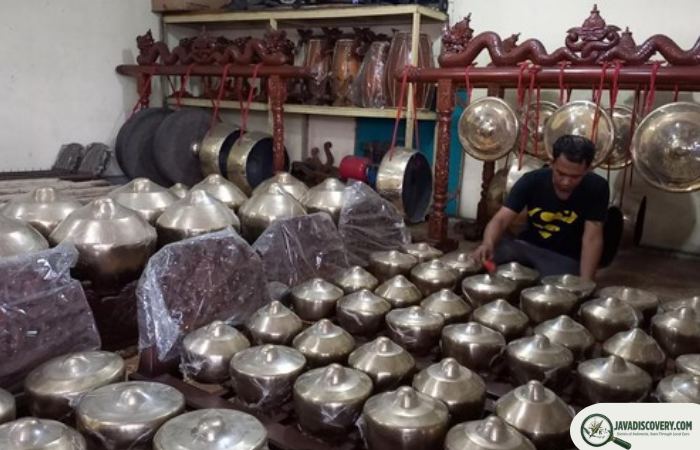
Today, Wirun stands as one of the few remaining centers in Southeast Asia capable of forging complete, hand-hammered bronze gamelan sets. The village’s foundries supply royal palaces, international universities, cultural institutions, and world-music ensembles across North America, Europe, and Asia.
Through their mastery of fire, metallurgy, and pitch, the bronze founders of Wirun ensure that the shimmering, mystical sounds of the Javanese gamelan continue to echo across the world—tuning raw metal into timeless cosmic harmonies.