The Secret History of Tempe, Java’s Vegan Treasure


javadiscovery.com – In the heart of Java, where rice paddies glisten under the morning sun and the rhythm of life moves gently with nature, an ancient culinary marvel quietly fermented into existence — tempe. Long before veganism became a global movement, the Javanese had already discovered this nutritious, plant-based protein, crafted from humble soybeans and the invisible artistry of microbes.
Ancient Origins Hidden in Java’s Villages
Tempe’s story begins centuries ago, in the fertile lowlands of Central Java. Though the exact origin remains shrouded in mystery, historical records suggest that tempe was already being consumed by Javanese communities as early as the 1600s. The Serat Centhini — a vast 19th-century Javanese manuscript that documents food, spirituality, and daily life — mentions tempe as part of the local diet, revealing its deep cultural roots.
Unlike many Asian fermented foods influenced by China or India, tempe is purely indigenous to Java. It arose from resourcefulness — Javanese people sought ways to preserve soybeans and enhance their nutrition, using natural molds that thrive in the tropical climate. Thus was born a dish that transformed simple soybeans into a dense, nutty, and umami-rich cake.
The Science Behind the Magic
At the heart of tempe’s transformation is a living organism: Rhizopus oligosporus, a beneficial mold that binds the soybeans together during fermentation. Traditionally, the process involved wrapping boiled soybeans in banana leaves, left to rest in a warm corner of the kitchen. The leaves themselves, teeming with native spores, became the perfect natural incubator. Within two days, the soybeans fused into a white block — firm, aromatic, and alive with nutrition.
Modern science later confirmed what the Javanese had long understood intuitively: tempe is a nutritional powerhouse. It’s rich in protein, fiber, vitamin B12, and probiotics, making it one of the world’s most sustainable and digestible plant proteins. No wonder it has captured the hearts of health-conscious eaters worldwide.
A Symbol of Javanese Ingenuity
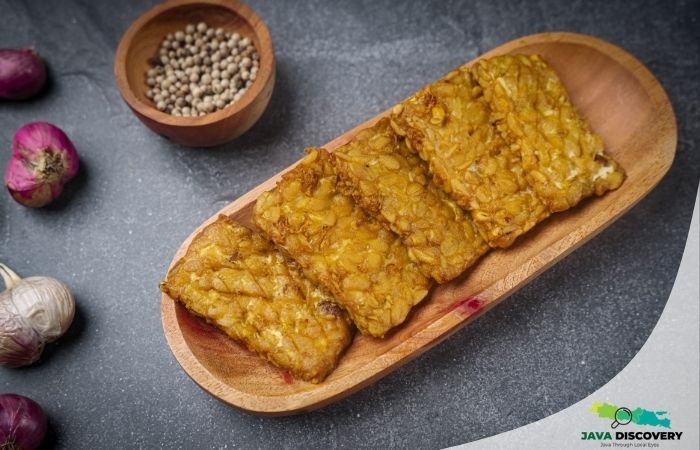
Tempe is more than food — it’s a symbol of Javanese wisdom. It embodies harmony with nature, sustainability, and the balance between tradition and innovation. In many Javanese households, tempe remains a daily staple, fried crisp and golden for breakfast or simmered in sweet soy sauce as tempe bacem.
In rural Java, making tempe is still an art passed down through generations. Families tend to small-scale fermenting houses, their walls fragrant with the earthy aroma of soy and banana leaves. Each batch carries its own character — some lighter, some nuttier — influenced by weather, humidity, and the maker’s touch.
From Local Staple to Global Superfood
In the 20th century, as Indonesia opened to the world, tempe began its quiet journey across continents. Dutch colonials brought it to Europe, and Indonesian diaspora communities introduced it to new kitchens. Today, tempe appears on menus from Amsterdam to Los Angeles, often celebrated as a “superfood” — though to Javanese people, it has always been simply, naturally, good.
Despite its global fame, the soul of tempe remains Javanese. It speaks of patience, simplicity, and respect for the unseen forces that sustain life. Every bite is a taste of Java’s living heritage — a story of humble soybeans transformed by time, nature, and human care.
In a world chasing food trends, tempe reminds us that some of the greatest innovations were born not in laboratories, but in quiet kitchens, where wisdom and nature work hand in hand.