Forest Edges as Cultural Boundaries in Javanese Life

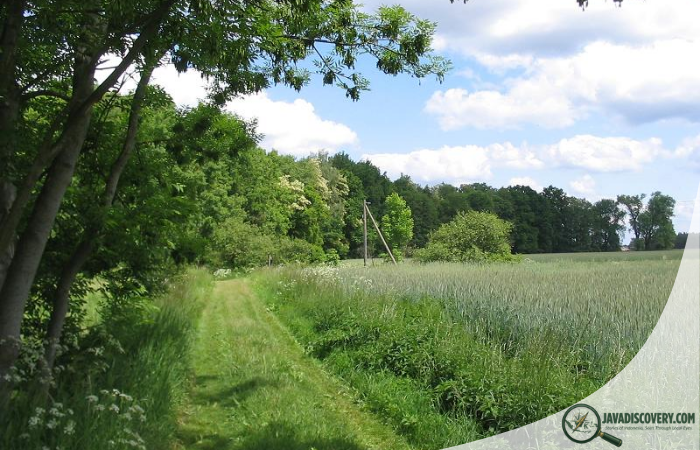
javadiscovery.com – At the edge of many Javanese villages, the land does not end abruptly. Instead, it softens into shadow. Rice fields give way to taller grasses, then to shrubs, and finally to dense forest. The transition is gradual, almost hesitant, as if the cultivated world is negotiating its boundary with something older and less predictable.
These forest edges are not merely ecological zones. They are cultural thresholds. Spaces where daily life meets uncertainty, where the known landscape of the village blends into a realm shaped by different rules. For generations, people in Java have understood these edges not only as physical borders, but as places of meaning, caution, and respect.
To stand at a forest edge is to stand between worlds.

The Meeting of Two Landscapes
The boundary between village and forest is rarely defined by a clear line. Instead, it exists as a transition zone where cultivated land gradually becomes wild.
This zone reflects a shift in control. Within the village, land is managed, organized, and shaped by human activity. Beyond the edge, the forest follows its own patterns.
This distinction influences how space is used and understood.
The edge becomes a point where these two systems meet.
A Zone of Awareness
Moving toward the forest edge often brings a change in behavior. Voices lower, movements become more deliberate, and attention sharpens.
This response is not necessarily conscious. It emerges from a shared understanding that the environment is different beyond this point.
The forest is associated with unpredictability, both in terms of natural conditions and cultural interpretation.
The edge, therefore, is approached with awareness.
Boundaries of Knowledge
Within the village, knowledge is familiar. Paths are known, land ownership is clear, and social relationships are established.
At the forest edge, this certainty begins to fade. The deeper one moves into the forest, the less defined these structures become.
This shift creates a boundary not only of space, but of knowledge.
It marks the limit of what is fully understood and controlled.
Spiritual Associations
In Javanese cultural understanding, forests are often associated with spiritual presence. They are seen as inhabited not only by plants and animals, but by unseen forces.
Forest edges, as points of transition, are particularly significant. They may be regarded as places where interaction between different realms is possible.
Offerings or small rituals may be conducted at these boundaries, acknowledging the presence of forces beyond the visible world.
These practices reflect a respect for the unknown.
Rules of Engagement
Entering the forest is not done casually. There are often informal rules that guide behavior.
These may include speaking softly, avoiding certain areas, or entering only at specific times.
Such practices are not enforced through formal systems, but through shared belief and experience.
The forest edge acts as a reminder of these expectations.
Resource and Restraint
Forests provide valuable resources, including wood, medicinal plants, and food. However, access to these resources is balanced with restraint.
The edge marks a point where extraction must be considered carefully.
Overuse or disrespect is believed to have consequences, both environmental and cultural.
This balance reflects a broader relationship between use and preservation.
Social and Territorial Meaning
Forest edges can also function as territorial boundaries between communities. Different villages may share access to a forest, but recognize certain areas as belonging to specific groups.
These distinctions are often based on tradition and mutual understanding.
The edge, in this context, becomes part of how space is organized socially.
Children and the Edge
For children, the forest edge is often a place of curiosity and caution. It represents both exploration and boundary.
Stories and guidance from elders shape how young people perceive this space.
They learn where it is safe to go, and where limits exist.
Through this process, cultural understanding is passed on.
Changing Landscapes
As development expands, forest edges shift. Land that was once part of the forest may be cleared for agriculture or settlement.
This movement changes the location of the boundary, altering how it is experienced.
In some cases, the cultural meaning of the edge becomes less distinct as the forest recedes.
Yet in other areas, it remains a strong reference point.
Ecological Importance
From an ecological perspective, forest edges are zones of high diversity. They support species from both forest and open land environments.
This richness contributes to the overall health of the ecosystem.
Communities that recognize the importance of these areas may take steps to protect them.
This protection aligns with cultural practices of respect and restraint.
A Threshold in Everyday Life
The forest edge is part of daily life, even for those who do not enter it regularly. It is visible from fields, paths, and homes.
Its presence shapes how space is perceived, providing a reference for orientation and boundary.
It is both near and distant, familiar yet distinct.
Between the Known and the Unknown
Standing at the edge, the difference between the village and the forest becomes clear. Behind lies a landscape shaped by human hands, ahead one shaped by natural processes.
This contrast creates a sense of transition, a movement from certainty to possibility.
The boundary is not fixed, but experienced through perception and understanding.
The Quiet Line
In Java, forest edges are rarely marked by fences or signs. They exist as quiet lines, defined by change rather than declaration.
They guide behavior, influence belief, and shape relationships between people and their environment.
In these spaces, the division between worlds is not imposed, but recognized.
And in that recognition, the forest edge becomes more than a boundary. It becomes a place where culture and nature meet, each defining the other in subtle and enduring ways.