When a Documentary Becomes a National Conversation in Indonesia

javadiscovery.com – In Indonesia, documentary films rarely become headline news.
They are usually screened quietly in campus halls, small communities, art spaces, or discussion forums attended by students, activists, and curious viewers. Most documentaries pass through public life without confrontation.
But Pesta Babi is different.
The documentary, directed by Dandhy Dwi Laksono and Cypri Dale, has triggered an intense national debate even before reaching wider public audiences. In several cities across Indonesia, screenings were reportedly monitored, interrupted, or forcibly disbanded by security personnel and local authorities. Ironically, the attempts to suppress the film only made public curiosity grow larger.
What began as a documentary about Papua has now evolved into something much bigger: a conversation about democracy, criticism, censorship, land, power, and the role of documentary films in Indonesian society.
What Is the Pesta Babi Documentary About?
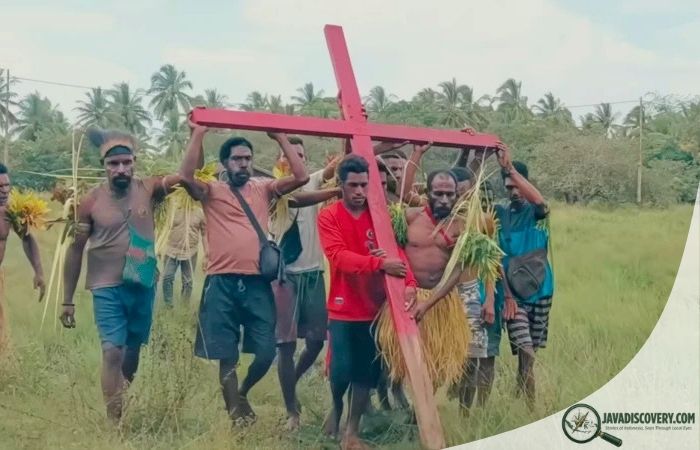
Pesta Babi tells the story of Indigenous communities in South Papua, particularly the Malind, Yei, Awyu, and Muyu peoples, who are facing massive land transformation projects tied to plantations, food estates, and industrial expansion.
The documentary explores how forests and customary lands are being converted into large-scale agricultural and industrial zones connected to national strategic projects.
But the film is not presented as a dry political report.
Instead, it combines testimonies, visual landscapes, investigative findings, and emotional narratives from local communities whose lives are directly affected by environmental destruction and state-backed development projects.
The subtitle of the film, Colonialism in Our Time, immediately placed it into controversial territory.
For supporters of the documentary, the phrase reflects concerns over exploitation and unequal power relations in Papua. For critics, the language is seen as provocative and politically charged.
This tension is exactly what pushed the film beyond the category of cinema and into the center of Indonesia’s public discourse.
Why the Screenings Became Controversial
According to reports from WatchDoc, the production collective behind the film, there have been dozens of incidents involving intimidation, monitoring, or forced cancellation of public screenings.
Some screening organizers reportedly received calls from security officials. Others were asked to submit identities of participants and committees. In several cases, screenings held in campuses and public venues were stopped before discussions could even begin.
Videos circulating online showed security personnel and military members appearing directly at screening venues in places such as Ternate and Mataram.
The reasons given varied.
Some officials argued that the film’s title and narrative could provoke social tension. Others claimed the cancellations were necessary to maintain public order and avoid unrest.
Yet these actions created a paradox.
The more screenings were restricted, the more people wanted to watch the documentary.
Director Dandhy Dwi Laksono stated that requests for community screenings surged into the thousands after reports of intimidation spread online.
Government Responses Show Indonesia’s Internal Contradictions
The reaction from Indonesian officials has not been entirely uniform.
Several ministers and political figures publicly stated that the film should not be banned outright.
Coordinating Minister for Law, Human Rights, Immigration, and Corrections, Yusril Ihza Mahendra, argued that criticism expressed through film is normal within a democratic society. He suggested the public should be allowed to watch and debate the documentary openly.
Meanwhile, Human Rights Minister Natalius Pigai emphasized that film bans should only occur through legal court decisions, not through informal intimidation or forced cancellations.
Even the Speaker of the Indonesian Parliament, Puan Maharani, acknowledged that the issue would be discussed further in parliament because of its sensitivity.
These responses reveal something deeper about modern Indonesia.
The country officially embraces democratic openness after the fall of the New Order regime in 1998. Yet in practice, tensions still emerge whenever films, books, or artistic works challenge powerful institutions, military narratives, or state policies.
Why Papua Remains a Sensitive Subject
To understand why Pesta Babi became so controversial, it is impossible to separate the film from Papua itself.
Papua has long occupied a complicated position within Indonesia’s political landscape.
For decades, the region has experienced armed conflict, military operations, separatist tensions, displacement, and disputes over natural resource extraction. At the same time, Papua remains geographically distant from Indonesia’s political center in Java, causing many stories from the region to receive limited national attention.
The filmmakers argue that mainstream media algorithms and public conversations rarely focus on the humanitarian and environmental crises occurring there.
Through Pesta Babi, they attempt to force audiences to confront realities often ignored in everyday Indonesian discourse.
Whether viewers ultimately agree or disagree with the film’s framing is another matter entirely.
But the documentary clearly touched one of Indonesia’s most sensitive political nerves.
Indonesia’s Long History of Controlling Films
The controversy surrounding Pesta Babi is not happening in isolation.
Indonesia has a long history of film censorship and state control over visual narratives.
During the Old Order era under President Soekarno, certain Western films were restricted because they were considered vehicles of cultural imperialism.
Under Suharto’s New Order regime, film censorship became far more systematic. Scripts and finished films were carefully monitored through state institutions, especially the Film Censorship Board (LSF).
Documentaries critical of government projects, military actions, or social inequality often faced pressure, bans, or informal intimidation.
Even after the Reformasi era opened greater democratic freedoms, controversial documentaries still encountered resistance.
Films related to the 1965 mass killings, East Timor, military violence, religion, race, or LGBTQ themes repeatedly faced public backlash, censorship battles, or restrictions.
What has changed today is not necessarily the existence of pressure — but the way films are distributed.
In the digital era, documentaries no longer depend entirely on cinemas or television stations. Community screenings in campuses, cafés, art spaces, and independent forums allow films to spread horizontally through grassroots networks.
That decentralization also changes the pattern of suppression.
Instead of targeting only filmmakers or official distributors, pressure now often falls directly on local organizers and audiences.
More Than a Film About Papua
Perhaps the most important thing about Pesta Babi is that the debate surrounding it is no longer only about Papua.
It has become a wider reflection on how Indonesian society responds to uncomfortable criticism.
Can controversial films exist without intimidation?
Can difficult political conversations happen openly?
Can citizens watch a documentary and disagree with it without demanding its removal?
Supporters of the film argue that criticism should be answered with discussion, counterarguments, or even alternative documentaries — not forced shutdowns.
Critics worry that emotionally charged narratives may deepen polarization or create instability.
Both positions now collide in public space.
And perhaps that is exactly why Pesta Babi has become larger than the screen itself.
The documentary is no longer merely a film people are trying to watch.
It has transformed into a test of how modern Indonesia negotiates democracy, dissent, art, and power in the digital age.
Sometimes, the most revealing part of a documentary is not only what appears inside the film, but how society reacts when the lights turn on afterward.