Malang’s Oldest Neighborhoods and the Stories They Still Whisper

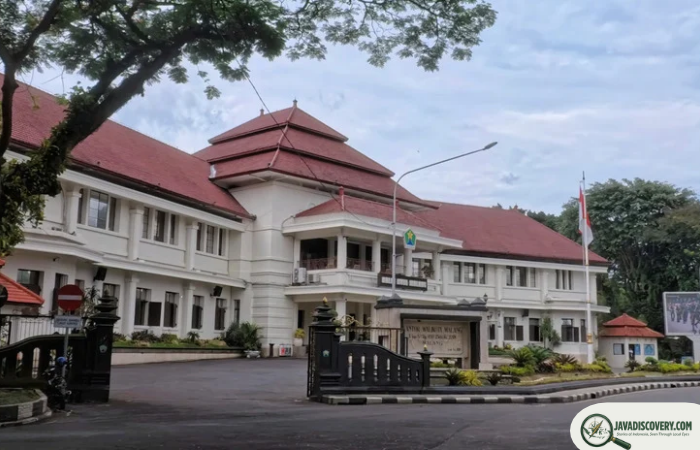
Before the motorbikes crowd the road, the old center of Malang belongs to the early risers. A vendor lifts the shutters of a narrow shopfront. The smell of strong coffee drifts out, mixing with hot oil and fried tempe. An angkot, the small public minibus of Indonesian cities, rattles past under the shade of old trees.
Above the street, rooflines from another era hold the morning light. Behind a gate, a lane no wider than a handcart leads into a neighborhood where families have lived for generations.
Ask which neighborhood is the oldest in Malang and the question has no single answer. The city was not founded once. It was built in layers, by kings, by colonial planners, by traders and by ordinary families, each leaving something behind.
Before the City, a Kingdom on the Dinoyo Plateau
The earliest written clue lies in the northwest of the modern city, in the area called Dinoyo. It is not a building but a stone.
The Dinoyo Inscription and the Kanjuruhan Kingdom
The Dinoyo inscription is usually dated to 760 CE. Historians generally read it as a record of a kingdom called Kanjuruhan, ruled by a king named Gajayana, and of the consecration of a sanctuary linked to the sage Agastya.
The inscription is carved in an old script and a Sanskrit-influenced language. It is one of the oldest written records connected with the Malang area. Scholars connect it with nearby remains such as Badut Temple, though the exact extent and character of Kanjuruhan are still debated.
The origin of the name “Malang” is also uncertain. One theory links it to a sacred-site name found in old sources, Malangkuçeçwara. Others derive it from Javanese words. The city has never settled the question, and perhaps that is fitting.
Singhasari at the City’s Doorstep
Just north of the modern city lies Singosari, long associated with the Singhasari kingdom of the 13th century. Its temples and archaeological sites belong to the wider landscape of Malang, but they sit outside the old city center.
For this story they serve as context. The highlands around Malang were not empty before the Dutch arrived. They were already a stage for kingdoms, rituals and trade.
Alun-Alun and Klojen, Where the Dutch Drew a Town
In the 19th century the Dutch colonial government expanded its presence in the cool highlands of Malang. The climate suited plantations in the surrounding hills, and a town grew to serve them. Malang became a gemeente, a municipality under the colonial administration, in 1914.
At the center was the alun-alun, the town square, a form familiar across Java. Around it the colonial authorities placed their institutions, and nearby stood places of worship that still shape the skyline of the old center.
The Klojen district grew around this core. Its streets were laid out with offices, schools and residences for European and elite residents. The surrounding kampung, the urban villages of ordinary residents, grew in the gaps and edges around them.
The result was a town with sharp contrasts. Wide roads and large houses lay a short walk from lanes where homes stood shoulder to shoulder.
Ijen Boulevard and the Planners’ Garden City
In the early 20th century, Malang became known as a planned and carefully landscaped town. Its tree-lined avenues and residential districts reflected ideas of the “garden city” that were popular in European urban planning.
The architect and planner Thomas Karsten is associated with the planning of several Javanese cities, including Malang, in the 1920s and after. Among the best-known results is the area around Ijen Boulevard, with its broad central strip, mature trees and large villas.
Walk along it today and the effect is calm. Birds nest in the old trees and the traffic noise falls away.
But a planned city is also a statement about who belongs where. The grand avenues were designed with the colonial elite in mind. Many of the town’s other residents lived in neighborhoods the plans treated as secondary.
Pecinan and the Pasar Besar Quarter
Close to the old market, the city’s Chinese-Indonesian community built a trading quarter known as Pecinan, a Chinese district. Shophouses stand in tight rows. Many combine a shop at the front with a family home behind and above it.
Here the rhythm is that of commerce. Shutters rise early, goods are stacked on the pavement and customers bargain in the mixed speech of the market.
The quarter’s spiritual anchor is the Eng An Kiong temple. It is commonly cited as dating to the early 19th century, and it is one of the best-known Chinese temples in the city. Incense smoke curls through red and gold interiors, and offerings sit before the altars.
The Chinese-Indonesian community has been part of Malang’s commercial life for generations. Their shops, family businesses and festivals are woven into the daily life of the old center.
Kayutangan, Celaket, and the Kampung That Outlived the Maps
Kayutangan was once among the main commercial streets of colonial Malang, when it was spelled Kajoetangan. Its older buildings and the narrow lanes behind them have in recent years been the focus of heritage revival efforts, with local residents often playing a central role.
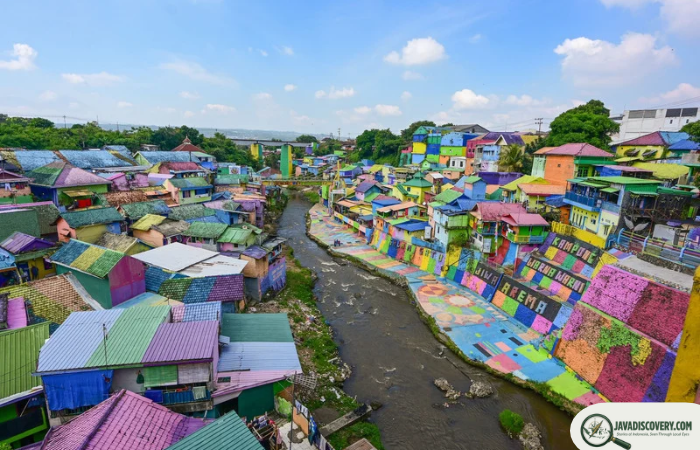
These lanes show a different side of the old city. Inside the kampung, life moves at a human scale. Neighbors greet one another across low walls, children play in the alleys and laundry hangs between houses.
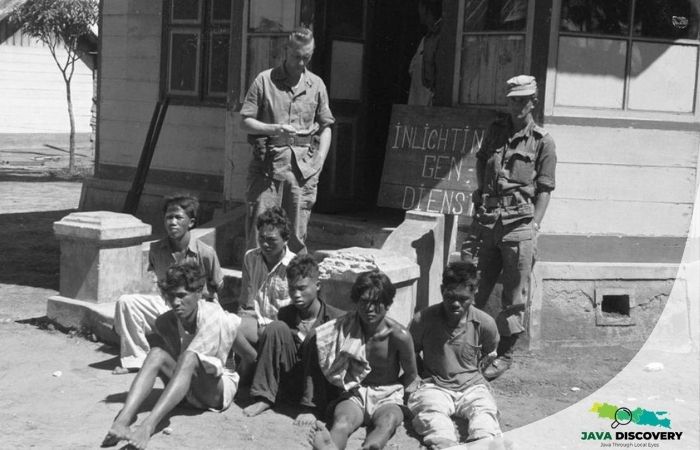
Nearby areas such as Celaket carry their own memories. Like many Malang neighborhoods, they were shaped by the independence struggle of the 1940s, and older residents often remember the period through family stories.
Heritage projects can bring welcome attention and income, but they also raise a question. A neighborhood is a place where people live, not only a place to visit. The most meaningful revivals are those that keep residents at the center.
Kauman and the Arab Quarter, Faith and Trade Side by Side
On the west side of the old square stands the Jami Mosque, the main mosque of the city center. Around such a mosque, a Javanese kauman traditionally formed, a neighborhood of religious scholars and devout families.
The sound of the call to prayer is part of the soundscape here. Through the day, worshippers move between the mosque, small shops and the lanes beyond.
Nearby, families of Arab descent have long been part of the old trading districts of the city. Their roles in commerce, religion and community life are another thread in Malang’s story.
In these streets, faith and trade were never separate worlds. They shared the same lanes, the same markets and often the same families.
Speaking Arek, Speaking Backwards
The people of Malang belong to the cultural world of Arek, the egalitarian and direct culture shared with Surabaya and surrounding areas. It is distinct from the more court-oriented traditions of Central Java, and Malang residents are known for their candid, humorous style of speech.
Malang is also famous for walikan, a way of speaking by reversing words. Malang itself becomes ngalam. According to local tradition, the practice became widely used during the struggle for independence in the 1940s, when reversed words served as a kind of code among local fighters.
Whatever its precise origins, walikan survives in everyday talk, in jokes, on T-shirts and in football chants. A city that speaks backwards for fun is a city that has kept its sense of humor and its sense of self.
Reading the City on Foot
The best way to understand old Malang is slowly. Begin where the day begins, in a market or a coffee stall. Follow a tree-lined avenue, then turn into a lane where the pavement narrows and the voices grow close.
Some of what you see is protected. Some is already fading, replaced by new construction or neglected until it collapses. What remains does so because someone kept it: a family, a congregation, a neighborhood that refused to forget.
Malang’s oldest neighborhoods do not announce themselves. They wait in the shade of old trees and the quiet of narrow lanes, and they ask only that the visitor walk slowly enough to listen.
Writer: Sari Mahendra