How Gandrung Became the Heartbeat of Banyuwangi’s Osing People

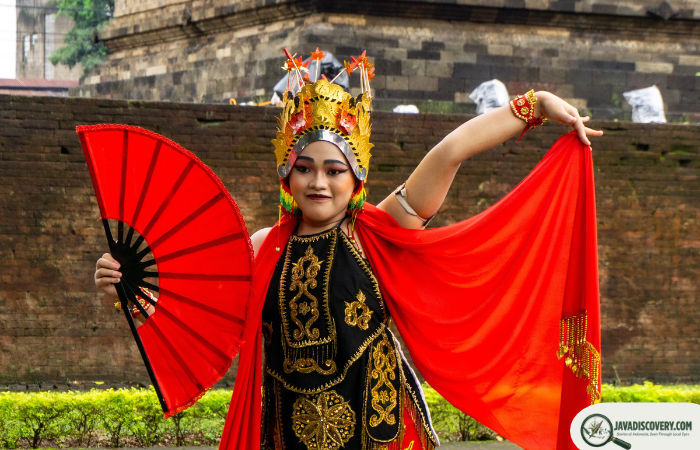
A gandrung performance in Banyuwangi begins with sound before it begins with movement. A violin draws a long, plaintive line through the night air. Over it come the bright, metallic ring of the kluncing (a small triangle) and the steady pulse of the kendang (a double-headed drum).
Then the dancer steps forward, crowned with an ornate headdress, her scarf trailing from one hand. Around her, the audience waits. They know this music. Many of them have known it since childhood.
How did a single dance come to speak for an entire people? To answer that, we have to start with the people themselves.
Who Are the Osing?
Banyuwangi sits at the far eastern tip of Java, facing the Bali Strait. Its culture does not fit neatly into the usual picture of East Java. It is not Mataraman, the western East Javanese sphere that sits closer to Central Javanese court culture. It is not Madurese. It is its own.
The Osing are generally described as the indigenous people of Banyuwangi, and they are a distinct community within East Java. Their identity rests on a shared history, a shared language, and a set of living traditions, of which Gandrung is the most visible.
A Language of Their Own
The Osing speak basa Using, the Osing language, which differs from the Javanese spoken in Surabaya, Solo, or Yogyakarta. For many Osing, speaking it is a quiet act of belonging.
That matters for Gandrung, because the songs that accompany the dance are sung in this language. The music carries the Osing voice as much as it carries a melody.
Heirs of Blambangan
Historians describe Blambangan as the last Hindu-Javanese polity in the eastern part of Java. Its territory covered the area that is now Banyuwangi. Over the eighteenth century it came under growing pressure from the Dutch East India Company (VOC), and its population was scattered and reduced by prolonged conflict.
Many Osing see themselves as the descendants of Blambangan’s people. That sense of inheritance shapes how the community understands its own traditions, Gandrung among them.
Where Gandrung Came From
Ask where Gandrung began, and you will find that the answer lives mostly in oral tradition. Written sources are thin, and the accounts that exist do not always agree. One academic source places the beginnings of the art as early as 1774, yet such dates should be treated as indicative, not settled.
The Meaning of the Name
The word gandrung is commonly glossed as being captivated or enamored, even to the point of obsession. Local interpretations give the word a range of shades, from romantic longing to a deeper devotion, and scholars continue to discuss which reading best fits the dance.
From Male Performers to Women Dancers
According to local tradition, Gandrung was first performed by men. A male performer named Marsan is often remembered in this role, and the male form is generally said to have died out over time.
The turning point in the story is a girl named Semi. In the version most commonly told, Semi fell seriously ill as a child, around the year 1895. Her mother, Mak Midhah, made a vow that if her daughter recovered, she would dedicate her as a Seblang, a ritual dancer. Semi recovered, and the promise was kept.
Semi is widely remembered as the first female gandrung dancer. Her younger sisters are said to have followed her, taking “Gandrung” as a stage name. The details come from community memory, not documents, so they are best read as the story the Osing tell about themselves.
Anatomy of a Gandrung Night
A traditional gandrung performance follows a recognizable order. Sources describe it in slightly different ways, and some break out a short interlude called ngrepen (or rerepen), in which the dancer sings songs requested by the audience. The core structure, however, is consistently described in three parts.
Jejer
The performance opens with jejer, the introductory dance. The dancer appears in her full costume, moving with composed, deliberate grace as she sets the tone for the night.
Today, this opening section has taken on a life of its own. Banyuwangi’s local government has designated the Jejer Gandrung as the district’s official welcome dance, and visitors are likely to see it at official receptions.
Paju
Paju (also written maju) is the heart of the evening. Here the dancer invites members of the audience, traditionally men, to dance alongside her. Songs are performed according to who steps forward, and the atmosphere shifts from watching to taking part.
This is what makes Gandrung feel so communal. The line between performer and audience softens, and the whole gathering becomes part of the dance.
Seblang Subuh
The final part is Seblang Subuh, named after the dawn (subuh). It closes the performance with songs known as seblang-seblang, and its melodies echo the older Seblang ritual tradition. In earlier times the dance is said to have run until the hours before sunrise.
Modern performances are often shorter and are staged at other times of day, but the closing section still carries that older name.
Sound and Costume
The music of Gandrung is built around the violin, which gives the songs their aching, singing quality. Alongside it come the kendang, the kluncing, and other percussion, including gongs, that keep the rhythm alive.
The dancer’s costume is just as distinctive. On her head she wears the omprok, an elaborate crown-like headdress with ornamented detail. Study of its patterns is an academic subject in its own right. A bright scarf, vivid fabrics, and bold makeup complete the picture, and together they make the dancer’s silhouette instantly recognizable.
When she moves under the lights, the headdress glints, the scarf sweeps through the air, and the violin lifts the whole scene into something close to theater.
Gandrung and Seblang, Sacred Cousins
Gandrung is closely related to Seblang, a ritual dance performed in certain Osing villages, such as Olehsari and Bakungan, as part of village ceremonies. Several scholars describe Gandrung as having developed out of Seblang, and the presence of Seblang melodies at the end of a Gandrung performance is often cited as evidence of this link.
The two should not be confused. Seblang is understood as sacred and is tied to ritual, and it is performed only once a year in the villages that keep it. Gandrung, by contrast, is a performance art that people enjoy as entertainment and community celebration.
They are relatives, not twins. One belongs to the world of ritual, the other to the world of the stage.
From Village Stage to Public Symbol
In recent decades Gandrung has moved from the village stage into the public identity of Banyuwangi. By one account, the dance was named a tourism mascot of the regency in December 2000. Another source cites a regent’s decree of 31 December 2002 that established Gandrung as the identity of Banyuwangi. Statues of gandrung dancers now stand in public spaces across the region, and the town is often nicknamed the “City of Gandrung.”
Gandrung is also recognized as part of Indonesia’s intangible cultural heritage, and the regency stages large festivals around it, among them the Gandrung Sewu, a mass performance. Participant numbers and other festival claims usually come from official promotion, so they are best treated as attributed figures.
This visibility brings a real tension. A dance made for a village night is now also a showpiece for officials and visitors. Some performers and observers ask whether the staged version risks flattening what the traditional form once meant.
Songs in the Gandrung repertoire, such as Padha Nonton and Seblang Lukinto, add another layer. One academic study of the colonial period reads such songs as expressions of the Banyuwangi people responding to the pressures of the era. It is an interpretation worth noting, and one that scholars continue to weigh.
Who Carries It Forward
A tradition like this survives only if each generation chooses to learn it. In Banyuwangi, local authorities and cultural groups have organized training for young dancers, so that the next generation of gandrung can step into a role that is both artistic and cultural.
That training covers more than steps. It means learning the songs, the language, and the etiquette of the performance. In effect, it means learning how to be a keeper of Osing memory.
Back under the canopy, the violin sounds again and the dancer lifts her scarf. Whether the stage is a village yard or a festival ground, the audience still leans in, because Gandrung has long meant something more than a dance. It is the way the Osing of Banyuwangi tell the world, and each other, who they are.
Writer: Sari Mahendra