The Day Trips From Malang That Reveal East Java’s Many Faces

Before the sun clears the ridgeline, Malang is already cold enough to make a glass of hot tea feel like a small kindness. Mist drifts between rooftops. Roosters answer motorbike engines. Beyond the city, the dark shoulders of Mount Arjuna, Mount Kawi and the Tengger massif wait for the light.
Few cities in Java sit so close to so many different worlds. Within a day’s reach lie a volcanic caldera, the stone remnants of a thirteenth-century kingdom, apple orchards, misty waterfalls and the long surf of the Indian Ocean.
Malang itself belongs to the Arek cultural sphere, which it shares with Surabaya. Its people are known for egalitarian, direct speech and for walikan, a playful slang that reverses words. In this slang, Malang becomes ngalam and arek becomes kera.
Why Malang Is a Natural Gateway
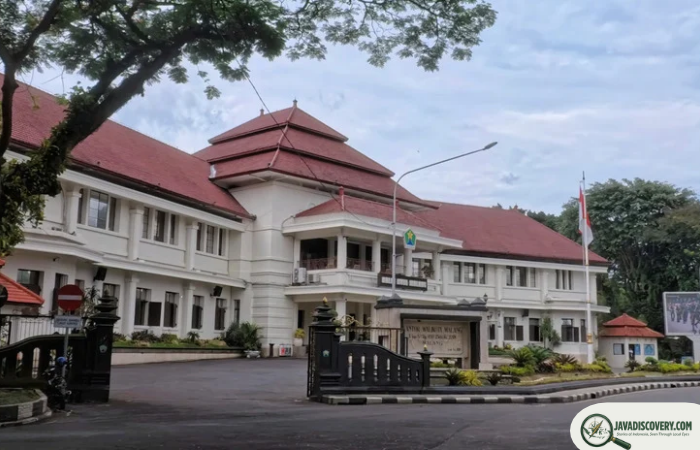
The city sits in a highland basin at roughly 440 metres above sea level, noticeably cooler than the sweltering coast around Surabaya, which is typically about two hours away by road. That altitude shaped Malang’s history. In the early twentieth century, the Dutch colonial administration developed it as a pleasant, planned residential town.
The surrounding landscape is a patchwork of cultures as much as terrain. Arek communities form the heart of the region. On the volcano’s flanks live the Tengger people, who keep their own customs and faith. Toward the Probolinggo side lies the Javanese-Madurese blend known as Pandalungan.
To the west, beyond Mount Kawi toward Blitar and Kediri, begins the Mataraman world, which is closer to Central Javanese court traditions. None of the day trips below crosses into it, which is a reminder that East Java is not one culture but several.
Into the Mountains
Batu and the Highland Orchards
Northwest of Malang, the road climbs into the foothills of Mount Arjuna and the air turns sharp and clean. This is Batu, which became an independent city in 2001 after separating from Malang Regency. It has long been compared to a European hill station, with terraced slopes, flower farms and rows of vegetables.
Batu is best known for its apples. Varieties such as Manalagi and Rome Beauty thrive in the cool climate, and in harvest season the scent of ripe fruit drifts along the lanes. Early mornings belong to farmers and market traders. The viewpoints above town show the whole patchwork of fields falling away into haze.
Mount Bromo and the Tengger Highlands
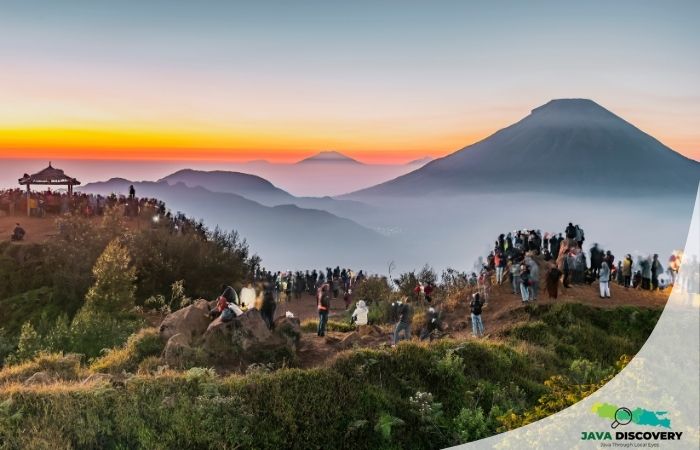
From Malang, the usual route to Bromo runs east through Tumpang, then up through the Tengger village of Ngadas and across the open savanna of Jemplang to the rim of the caldera. Below lies the sea of sand, a pale volcanic plain, with Bromo’s smoking cone beside the neat, ridged silhouette of Mount Batok. Farther south rises Semeru, the highest peak on Java.
Bromo is a realistic day trip from Malang, but a demanding one. Departures usually happen in the small hours of the night, around one or two o’clock, to reach a sunrise viewpoint, with the drive taking roughly three hours. Temperatures at the rim can drop to single digits Celsius, and the wind carries fine dust.
The mountain is also a sacred place. The Tengger people hold a faith with Hindu roots that is distinct from Balinese Hinduism, and they honour ancestors and the mountain itself. Their ritual specialists are called dukun, a word that in the Tengger setting means a priest who leads ceremonies, not a folk healer in the general sense.
The name Bromo is commonly said to derive from Brahma. According to local tradition, the Tengger name comes from Roro Anteng and Joko Seger, a legendary couple whose names are said to be joined in the word. These are community narratives, not documented history, and they are told with different details from village to village.
The best-known ritual is Yadnya Kasada, an offering festival held on the fourteenth day of the month of Kasada in the Tengger calendar. Villagers carry harvest produce and livestock to the crater rim as offerings. The ceremony centres on Pura Luhur Poten, a Hindu temple (pura) standing alone on the sand sea at the foot of the volcano.
Visitors should treat it as a living place of worship. Dress modestly, keep a respectful distance from prayer, ask before photographing people, and never step on offerings. Because Kasada follows the Tengger calendar, its date changes each year in the Gregorian calendar, and access rules and zones inside Bromo Tengger Semeru National Park have changed before, so current conditions are worth checking.
Coban Rondo and the Waterfalls of the Slopes
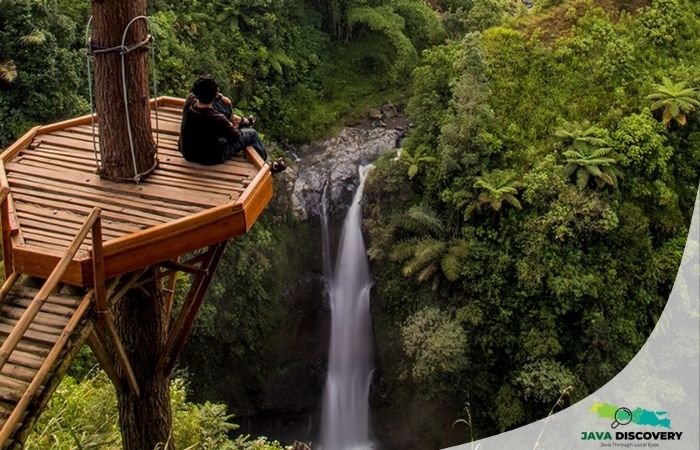
In the cool hills of Pujon, a short drive beyond Batu, a stream drops through forest into a mist-wrapped pool. In the local dialect, a waterfall is a coban. This one is named Coban Rondo, and rondo is the Javanese word for widow.
Local tradition tells of a bride who lost her husband soon after their wedding and wept beside the falls. Versions of the story vary, and none can be confirmed. What can be felt is the atmosphere: wet stone, moss, the steady roar of water and a chill that settles quickly once clouds roll in.
Walking Through Ancient Kingdoms
The Malang plateau was the heartland of the Singhasari kingdom. According to the Pararaton, a chronicle that blends history with legend, the kingdom was founded in 1222 by Ken Arok. The Negarakertagama, a poem written in 1365 at the court of Majapahit, gives a more courtly account of its rulers.
Historians generally accept that Singhasari’s last great king, Kertanegara, was killed in 1292 in a rebellion led by Jayakatwang, and that Raden Wijaya soon afterward founded Majapahit. The details, however, rest on texts written long after the events.
Singosari and the Echoes of Singhasari
On the northern edge of Malang, in the town of Singosari, stands Candi Singosari. A candi is an ancient Hindu or Buddhist temple or shrine of stone or brick. This one is a tall, austere tower, and some scholars note that parts of its carving appear unfinished.
The Negarakertagama states that Kertanegara was honoured in a funerary shrine at Singasari, and many scholars link the temple with him. The identification is widely repeated, though it is not beyond debate.
A short distance away, in a residential area, stand two colossal dwarapala, which are guardian figures once placed at the gateway of a sacred site. Fanged, wide-eyed and gripping clubs, they are among the largest such statues in Indonesia. They are often associated with the same era, though their original setting is uncertain.
Candi Jago and Candi Kidal
Southeast of the city, in the Tumpang district, two smaller temples sit among villages. They lie on the same road as the route to Bromo, so they can be combined with that journey.
Candi Kidal is linked to Anusapati, the second Singhasari king in the chronicles, whose rule is described as ending in violence. Its reliefs tell the story of Garuda freeing his mother from bondage. Some historians read this as a symbolic tribute to the king’s own mother, but that is interpretation, not record.
Candi Jago is associated with the king Wisnuwardhana, whom the Negarakertagama says was honoured at a place called Jajaghu. Its terraces rise in receding steps, and its carved panels show episodes from Indian epics and Javanese-Buddhist tales. The flat, profile figures look strikingly like shadow-puppet characters, a style that marks East Javanese temple art as different from the rounded realism of Central Java.
Candi Badut
Candi Badut is the odd one out. It lies within Malang city itself, tucked among residential streets in the Karangbesuki area. Many scholars connect it with the Dinoyo inscription, a Sanskrit text dated to 760 CE that mentions a ruler named Gajayana and a kingdom called Kanjuruhan.
If that link holds, Candi Badut would rank among the oldest known temple structures in East Java. The dating and attribution are scholarly interpretation, however, and not settled fact. The shrine is modest, yet standing beside it, one senses how long people have been building toward the sacred on this plateau.
Down to the Southern Coast
Malang’s Southern Beaches
Two to three hours south of the city, the road drops from highland to heat and the Indian Ocean appears, loud and wide. The southern coast of Malang is rugged. Limestone cliffs fall into surf, fishing coves tuck behind headlands, and offshore rocks take the full force of the swells.
At Balekambang, a small Hindu temple stands on an islet linked to the shore by a narrow bridge, with waves breaking on all sides. Other beaches, such as Ngliyep, offer broad sand and heavy surf.
Tiga Warna, whose name means “three colours,” is reached on foot through mangrove and coastal forest. It is managed by a local conservation community that grew out of mangrove-restoration efforts, and visitor numbers and waste are typically controlled. Where sunlight meets reef and white sand, the water shifts between green and blue.
The sea here demands respect. Strong currents and rip tides are common on Java’s southern coast, and swimming is often unsafe. Warning flags and local guidance should be taken seriously.
Stories of the City and Its Edges
Kampung Warna-Warni and Kayutangan Heritage
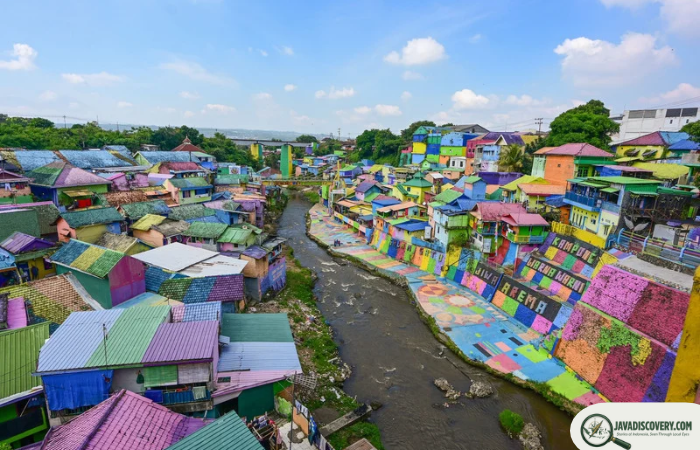
Across the Brantas River from the centre, the houses of Jodipan are painted in bright blocks of colour. A kampung is a neighbourhood, often with a village-like community spirit. This one began around 2016 as a collaboration between university students and residents, and it has since become a community-run attraction.
For a contrast, walk Kayutangan, the old Kajoetangan, along Jalan Basuki Rahmat. Colonial-era shopfronts line the street, which has been revitalised in recent years. Together, the two places show how Malang negotiates its past and present, one through colour and the other through old facades.
Topeng Malangan and Village Craft
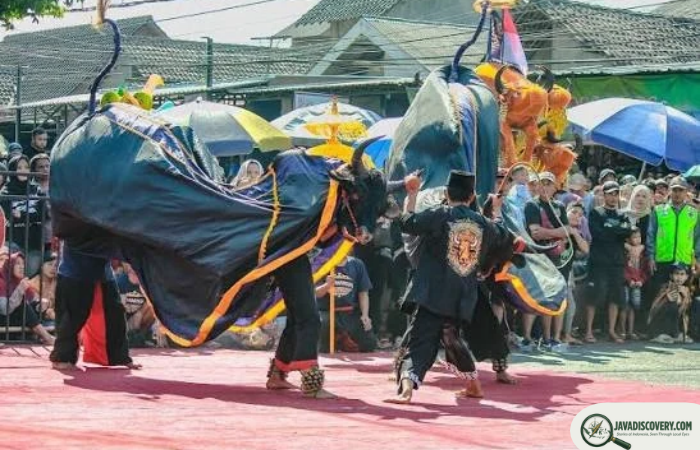
Malang has its own mask tradition. Topeng means mask, and Topeng Malangan is a dance-drama that traditionally tells the Panji stories, tales of Prince Panji and Princess Candra Kirana that belong to East Java’s literary heritage. Mask-carving workshops in the Pakisaji district are known among visitors interested in the craft.
Eating Your Way Through the Day
The food fits the cool air. Bakso Malang is a bowl of meatballs in clear beef broth, often with fried wontons, tofu and noodles, and it tastes best at dusk when the highland chill returns.
Rawon, a signature dish of East Java, is a beef soup coloured nearly black by kluwek, the seed of the Pangium edule tree. It is usually served with bean sprouts, salted egg and sambal. Pecel is steamed vegetables dressed in a peanut and chili sauce, and it is especially associated with the Mataraman west of the province.
In Batu, orchard fruit appears in everything from chips and juice to sweets, the simple edible souvenir of the highlands.
Practical Notes for Planning Your Day
The destinations fall into natural clusters. Tumpang combines Candi Kidal, Candi Jago and the road to Bromo. The north and west link Singosari, Batu and Coban Rondo. The southern coast needs a full day. The city sites, including Candi Badut, Jodipan and Kayutangan, fit into a half day.
The dry season, roughly April to October, brings clearer skies for Bromo and the beaches. The rainy season, roughly November to March, fills the waterfalls but makes roads slippery and sunrise views unreliable. Travel times are approximate and vary with traffic, especially on weekends in Batu.
Dress in layers, since highland mornings are cold. At temples, do not climb on structures or touch carved reliefs, and remember that some sites are still used for prayer. Local drivers and village guides know road conditions and local etiquette far better than any map.
It is rare for a single city to open onto volcanoes, kingdoms and ocean within a day’s reach. Malang does, and in doing so it shows that East Java is a mosaic of peoples and eras, each revealed best by arriving early, walking slowly and listening to the place.
Writer: Sari Mahendra