Why Bantengan Still Roars Through Modern Malang and Java

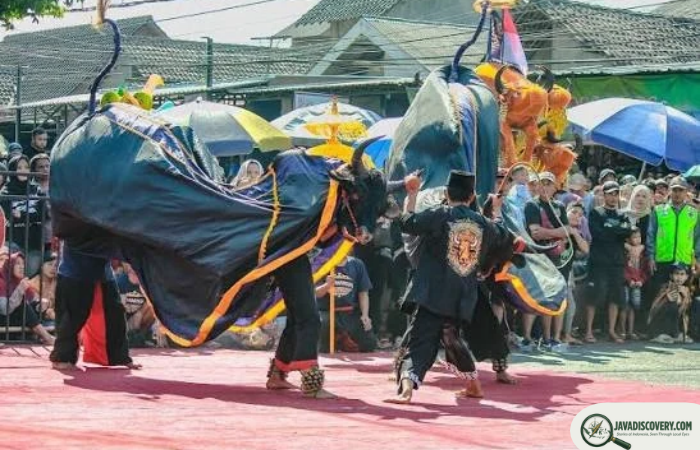
As the music grows louder, a black bull appears in the middle of the crowd.
Its wooden head swings from side to side. The horns catch the light. The figure suddenly lunges forward, sending spectators stepping back before laughter and cheers ripple through the crowd. Behind the spectacle, musicians keep the rhythm moving, while performers, handlers, and villagers remain focused on the performance.
This is Bantengan, one of the most energetic forms of folk performance found in East Java.
For visitors encountering it for the first time, Bantengan can be difficult to classify. It looks like dance, but it also contains theatrical performance, music, physical movement, and, in some communities, spiritual practices. It can be staged during village celebrations, community gatherings, festivals, and other public occasions.
In Malang, the tradition has become particularly visible. Groups perform across the regency, while cultural festivals have brought Bantengan from village spaces onto major public stages. In February 2026, a specific regional tradition, Bantengan Lereng Semeru, received national recognition as an Indonesian Intangible Cultural Heritage.
Yet Bantengan is not simply a museum piece or a performance preserved for tourists. It remains a living tradition, shaped by the communities that continue to perform it.
What Is Bantengan?
Bantengan is a traditional performance from East Java built around the figure of the bull, or banteng. The central character is represented through a large costume and a carved bull head, usually operated by performers who coordinate their movements to create the impression of a living animal.
A typical performance can combine movement, music, theatrical characters, and elements of martial tradition. The exact form varies from one group to another, which is important when discussing Bantengan as a cultural practice.
In Dusun Paras, Poncokusumo, for example, local documentation describes Bantengan as a tradition that was once performed alongside pencak silat. Over time, the martial arts component declined in that particular community, leaving Bantengan as the main surviving performance.
This variation is one of the reasons Bantengan should not be treated as a single standardized dance. Different villages and groups have developed their own ways of performing, organizing, and interpreting the tradition.
The Bull at the Heart of the Performance
The bull is more than a decorative character.
Its physical presence gives Bantengan its distinctive identity. A large head, prominent horns, dark fabric, and the movement of two performers can transform a human body into something that appears animal-like from a distance.
Local examples show that the construction of the bull head can vary. In one community in Poncokusumo, the head is described as being made from wood and covered with goat skin, with horns made from real animal horn. The dimensions and appearance can depend on the group that owns and maintains it.
The result is deliberately dramatic. The head is not designed to imitate a zoological model of a real bull. It is a theatrical object, enlarged and stylized for movement and spectacle.
The symbolism of the bull also varies. It is often associated with strength, courage, resilience, and collective spirit, but these interpretations should not be treated as universal. Some local practitioners describe Bantengan primarily as entertainment and cultural preservation rather than as a performance with a single fixed philosophical meaning.
How a Bantengan Performance Comes Alive
A Bantengan performance is as much about atmosphere as movement.
Music provides the pulse. Traditionally, performances could involve instruments such as drums, gongs, gamelan, and other percussion. In some contemporary groups, amplified sound systems have become increasingly common because they can reach larger crowds and suit modern outdoor performances.
The sound is essential. It announces that something is about to happen long before the bull enters the center of the gathering.
The People Behind the Bull
The bull costume requires coordination between performers.
One performer controls the front section and the head, while another forms the rear of the animal. Their movements must work together. A sudden turn, charge, or shake only looks convincing when both performers respond as one body.
Other participants may also surround the central character, including performers, handlers, martial artists, musicians, or figures associated with the particular group’s performance tradition.
This makes Bantengan a collective art. The most visible figure may be the bull, but the performance depends on many people working together.
When the Bull Charges
One of the most visually striking movements associated with Bantengan is srudukan, a forceful forward movement resembling a charge.
From the edge of the crowd, it can look chaotic. The bull suddenly moves toward another performer or into an open section of the performance space, producing a moment of tension before the action changes direction.
This physical intensity is part of what distinguishes Bantengan from more formal stage dances. The audience is not always separated from the performers by a conventional theatre boundary. In village settings, spectators can stand close to the action, making the experience feel immediate and unpredictable.
For an international visitor, this is one of the easiest ways to understand why Bantengan remains popular. It is not only something to watch. It creates an atmosphere in which the audience becomes part of the event.
The Spiritual Side of Bantengan
There is another layer to Bantengan that cannot be understood simply through its costumes and choreography.
Some Bantengan communities incorporate spiritual practices into performances. These can include offerings, ritual preparation, the presence of a pawang, or trance states sometimes described locally as kesurupan.
However, these practices are not identical everywhere.
In some communities, performers and groups maintain particular forms of preparation or spiritual discipline. In others, the emphasis may be more strongly placed on entertainment and cultural preservation. Local beliefs and customs shape how each group understands the performance.
This diversity is important. Bantengan exists within the wider cultural landscape of East Java, where traditional arts can occupy several spaces at once: entertainment, community identity, ritual, social gathering, and artistic expression.
For this reason, it is better to describe the spiritual dimension as part of certain Bantengan traditions rather than claiming that every performance is a religious or mystical ceremony.
Stories About the Origins of Bantengan
The history of Bantengan is difficult to reduce to one origin story.
Local communities preserve different accounts about how the tradition began. Some stories connect it with older legends and supernatural events, while other explanations emphasize its historical relationship with martial arts and village performance.
In Dusun Paras, for example, a local practitioner told researchers a story connecting the tradition with the legend of Lembu Suro in Kediri. The same local documentation also makes clear that the precise beginning of Bantengan in the village is not known.
This distinction matters.
Traditional stories are valuable because they reveal how communities understand their heritage. They should not automatically be presented as proven historical accounts.
There are also attempts to connect modern Bantengan with older visual representations in East Javanese temples. Such interpretations can be interesting, but a resemblance between an ancient relief and a modern performance does not by itself prove an uninterrupted historical connection.
The safest conclusion is that Bantengan belongs to a long and changing tradition of popular performance in East Java, while the exact development of the modern form differs between regions and communities.
From Village Gatherings to Malang Festivals
For generations, Bantengan has existed close to everyday community life.
In places such as Dusun Paras, performances can be associated with village celebrations and community events. Groups are maintained by local residents, and performances become opportunities for different generations to participate in the same cultural space.
But Bantengan has increasingly moved onto larger public stages.
In September 2024, Kabupaten Malang held the first Kanjuruhan Bantengan Festival in Kepanjen as part of the regency’s anniversary celebrations. The event brought together 33 contingents representing the regency’s 33 districts.
The performers were organized into regional groupings associated with landscapes around Malang, including the slopes of Mount Kawi, Mount Semeru, Mount Tengger, Mount Arjuno, Dorowati, and Kendeng.
The scale was significant. A tradition that normally belongs to villages and community groups was presented as a major cultural performance for a much wider audience.
The same event also demonstrated how diverse Bantengan can be. Different groups arrived with their own stories, characters, movements, and creative interpretations rather than performing an identical choreography.
Bantengan in the Digital Age
The way people encounter Bantengan is changing.
Once experienced primarily by people who happened to live in or visit a village during a performance, Bantengan can now travel far beyond its original setting through smartphones and social media.
A few seconds of a bull costume charging through a crowd can be enough to make someone stop scrolling.
This creates an unusual opportunity for a traditional art. Its visual energy works naturally in short-form video, while digital platforms allow younger audiences to discover performances from communities they may never have visited.
But digital popularity also creates a challenge. A short video usually shows the most spectacular moment: the charge, the costume, the crowd, or an intense performance. The social world behind the spectacle is harder to capture.
Understanding Bantengan therefore requires looking beyond the viral image. Behind each performance are local groups, performers, costume makers, musicians, organizers, families, and audiences who keep the tradition functioning.
Why Bantengan Lereng Semeru Matters
In 2025, Kabupaten Malang began formal documentation of Bantengan Lereng Semeru in Kecamatan Wajak as part of the process toward cultural heritage recognition.
The documentation focused on recording the performance and its distinctive characteristics as part of the cultural life of communities on the slopes of Mount Semeru.
That process reached an important milestone in February 2026.
Bantengan Lereng Semeru was officially recognized as an Indonesian Intangible Cultural Heritage. The certificate was symbolically handed over in Malang on February 22, 2026, alongside recognition for the traditional food heritage known as Kolok Goblok.
The recognition does not mean that every form of Bantengan in East Java suddenly became identical or that one group represents the entire tradition.
Instead, it highlights the cultural importance of a particular regional expression and the communities that have maintained it.
A Living Tradition, Not a Museum Piece
There is a temptation to describe traditional arts as something that belongs to the past.
Bantengan tells a different story.
The instruments can change. Sound systems can replace some traditional musical arrangements. Performances can move from village celebrations to cultural festivals. Young performers can encounter the tradition through social media rather than only through family or neighborhood events.
Yet the central idea remains remarkably physical: people gathering together to create something larger than any individual performer.
The bull needs two bodies to move. The music needs musicians. The performance needs organizers. The crowd gives the spectacle its energy. And the tradition survives because people continue to decide that it is worth performing.
That is perhaps the most important thing to understand about Bantengan in modern Malang.
It is not alive because it has been frozen in time. It is alive because communities continue to change it, perform it, debate its meaning, and pass it to another generation.
When the music begins and the bull finally steps into the crowd, the past does not simply return. It moves forward, carried by the people who keep it alive.
Writer: Sari Mahendra