The Best Historical Attractions in Malang for Curious Travelers

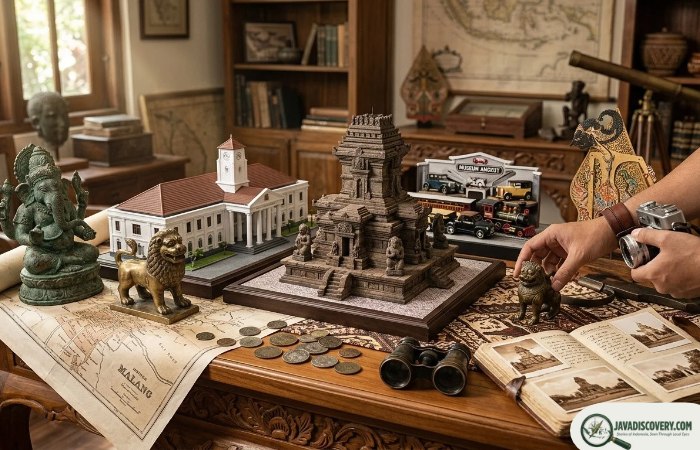
Malang is often introduced through its cool climate, mountain scenery, cafés, and easy access to the highlands of East Java. Yet beneath the modern city lies a much older landscape. Ancient temples stand among villages, colonial boulevards cut through the urban centre, and museums preserve objects connected with kingdoms and the struggle for Indonesian independence.
For travelers interested in history, Malang is therefore more than a pleasant base for exploring East Java. It is a place where different centuries overlap.
The historical attractions around Malang stretch from the early kingdoms of East Java to the Singhasari period, the Dutch colonial era, and the turbulent years surrounding Indonesian independence. Some are within Malang City, while others lie in Malang Regency and are best understood as part of the wider historical landscape of Malang.
Why Malang Is a Living History Book
The story of Malang did not begin with the Dutch colonial period. Long before boulevards, railway stations, and European-style houses appeared, the region was already connected to powerful political and religious centres in East Java.
One of the earliest important references is the Dinoyo inscription, dated to 682 Saka, or 760 CE. The inscription is associated with the historical landscape of ancient Malang and provides evidence of political and religious life in the region during the early period of East Javanese history.
Candi Badut, located in Dau, Malang Regency, is particularly important in this context. The site is connected by scholars with the period represented by the Dinoyo inscription, although interpretations of the relationship between the temple, the inscription, and the ancient kingdom of Kanjuruhan should be treated carefully rather than as a simple, uncontested story. The cultural heritage authority lists Candi Badut as a nationally ranked cultural heritage site.
Several centuries later, the political centre of East Java shifted toward Tumapel, better known through the name Singhasari. Temples around present-day Singosari and Tumpang preserve fragments of that era.
Much later, Malang became a rapidly developing colonial city. The arrival of the railway in 1879 accelerated its growth, while new urban plans transformed the landscape with boulevards, residential districts, public buildings, and commercial streets.
This layered history is what makes Malang especially rewarding for curious travelers. A single day can take you from an eighth-century temple to a nineteenth-century village and a twentieth-century colonial boulevard.
Candi Badut and the Early History of Malang
Hidden in the western part of the Malang area, Candi Badut is easy to overlook. It is smaller and less famous internationally than some of Java’s monumental temples, yet its historical importance is considerable.
The temple stands in Karangwidoro, Dau, Malang Regency. The cultural heritage authority records that the ruined structure was discovered in the early twentieth century and subsequently excavated and restored. The site contains the remains of a main temple, subsidiary structures, and fragments of sculptures and architectural components.
Candi Badut is commonly associated with the eighth-century Dinoyo inscription. The inscription refers to a ruler named Liswa and describes religious activity connected with the worship of Agastya. The relationship between the inscription and the temple has been an important subject in the study of ancient Malang.
For visitors, the appeal of Candi Badut is not simply its age. Its modest scale makes it possible to observe the architectural details at close range and imagine how different the landscape must have looked when this part of East Java was part of an early Hindu political and religious world.
Candi Singosari and the Age of the Singhasari Kingdom
North of Malang City, the landscape changes from urban streets to villages, fields, and the foothills of the mountains. Here stands Candi Singosari, one of the most important historical attractions associated with the medieval history of East Java.
The temple is located in Candirenggo, Singosari, Malang Regency. It is associated with the Singhasari kingdom, which flourished in East Java during the thirteenth century. The Indonesian tourism authority describes the temple as a Hindu monument distinguished by its elegant architecture and finely carved decoration.
Singhasari occupies an important position in the history of Java because it preceded the rise of Majapahit. The political history of the kingdom is closely connected with rulers such as Ken Arok, Anusapati, Wisnuwardhana, and Kertanegara. Some of the narratives surrounding these figures come from later literary traditions, so travelers should distinguish historical evidence from stories preserved in texts such as the Pararaton.
At the temple itself, the stonework provides another way of approaching this history. Rather than reading the monument only as a relic of a vanished kingdom, visitors can look at it as evidence of the religious ideas, artistic skills, and political culture of medieval East Java.
Candi Kidal and the Story of Anusapati
About a short journey east of Singosari lies Candi Kidal, one of the most distinctive ancient temples in Malang Regency.
The temple is associated with Anusapati, the second ruler of Singhasari or Tumapel. The cultural heritage authority explains that literary sources including the Nagarakrtagama and Pararaton connect Anusapati with Kidal, although the two sources differ over the precise date of his death. This is a useful reminder that ancient history is often reconstructed by comparing several sources rather than relying on a single narrative.
Candi Kidal is particularly famous for its Garudeya reliefs. The story concerns Garuda’s struggle to free his mother from bondage and obtain the sacred amerta, or water of immortality.
The reliefs are more than decorative details. They transform the temple walls into a visual narrative. By studying the sequence of figures, travelers can see how mythology and religious ideas were translated into stone by artists more than seven centuries ago.
The temple is also an excellent example of the characteristic vertical proportions and architectural vocabulary associated with East Javanese temples. Its relatively compact form differs noticeably from the grander monumental style associated with Central Java.
Candi Jago and Stories Carved Into Stone
Another remarkable destination in Tumpang is Candi Jago. Its unusual appearance immediately sets it apart from many other temples in Java.
The temple has a religious background combining Shaivite Hindu and Buddhist elements. Its reliefs include the Buddhist story of Kunjarakarna alongside narratives associated with Hindu traditions, including the Arjunawiwaha and Kresnayana. Animal stories and scenes resembling everyday life also appear among the carvings.
For travelers, Candi Jago offers something that a museum cannot easily reproduce: the opportunity to encounter historical storytelling in its original architectural setting.
Standing beside the temple, the carved stone does not feel like an isolated collection of archaeological objects. It belongs to a landscape where religion, literature, politics, and artistic expression once intersected.
Singhasari Museum and the Ancient East Javanese World
Before or after visiting the temples, the Singhasari Museum provides useful context for understanding the archaeological landscape.
The museum houses collections connected with ancient Java, including sculptures of Hindu and Buddhist figures, models of important temples, traditional objects, and other historical materials. Among the sculptures represented in its collection are Ganesha, Durga Mahisasuramardini, Mahakala, Nandi, and Bhairawa. Some displayed objects are replicas because original artefacts are held elsewhere.
This makes the museum particularly useful for travelers who are unfamiliar with the visual language of Javanese archaeology. Instead of encountering a temple without context, visitors can begin to understand the gods, symbols, architectural forms, and artistic traditions that shaped the monuments around Singosari and Tumpang.
Kayutangan Heritage and Colonial Malang
Back in Malang City, the historical atmosphere changes dramatically. The ancient temples give way to narrow streets, old houses, shopfronts, churches, and colonial-era architecture.
Kayutangan is one of the best places to experience this transformation.
The wider Kayutangan area developed along an important north-south route and became one of Malang’s historic commercial corridors. Today, the heritage area combines preserved architecture with an active urban neighbourhood rather than functioning simply as an open-air museum. The city government describes the area as containing old houses, religious sites, culinary businesses, commercial activity, and community life.
Inside Kampung Heritage Kajoetangan, visitors can find houses that retain much of their historic character. The city government has documented dozens of heritage-oriented spots in the kampung, including buildings dating back to the late nineteenth and early twentieth centuries.
The real attraction is the atmosphere. Walk slowly rather than treating Kayutangan as a checklist. Look at windows, rooflines, verandas, drainage channels, shopfronts, and the relationship between old houses and modern businesses.
That mixture is what makes the area historically interesting. The past here is not sealed behind glass. It is still part of everyday urban life.
Ijen Boulevard and the Garden City of Malang
For another view of colonial Malang, walk toward Ijen Boulevard.
The broad boulevard and its tree-lined central spaces reveal a different approach to urban planning. Malang’s colonial development was influenced by the Dutch architect and planner Herman Thomas Karsten, whose work helped shape the city’s garden-city character.
The city government identifies Karsten’s planning legacy as an important reason for Malang’s reputation as a city of gardens. Ijen is one of the clearest surviving expressions of this planning tradition, with wide streets, greenery, and rows of historic houses.
Yet the beauty of Ijen should not obscure the unequal society that created it. Colonial urban planning often separated European residents from Indigenous communities and distributed infrastructure unevenly. The surviving architecture therefore represents both aesthetic achievement and the social hierarchy of the colonial period.
This tension is essential to understanding Malang’s colonial heritage. Historic architecture can be beautiful without being politically neutral.
Alun Alun Tugu and the Memory of Independence
In the centre of Malang stands Alun Alun Tugu, one of the city’s most recognizable public spaces.
The monument and surrounding civic buildings form part of a historic urban landscape that includes Malang City Hall, the railway station, churches, and other colonial-era structures. The city government lists the Tugu area among Malang’s important historical and cultural heritage sites.
The meaning of the space changed after Indonesian independence. What had once belonged to a colonial administrative city became part of the visual identity of an independent Indonesian city.
That transformation is one of the most interesting themes in Malang’s history. Buildings and streets can survive political change, but their meanings do not necessarily remain the same.
Museum Brawijaya and the Story of the Independence Struggle
To understand twentieth-century Malang, the Museum Brawijaya provides another important stop.
The museum represents a very different historical experience from the ancient temples. Here the focus moves from dynasties and religious monuments to the Indonesian independence struggle and the military history of the republic.
It is useful to visit such a museum after exploring the colonial city because the two experiences illuminate each other. The boulevards and buildings of colonial Malang show how the city was physically organized, while the museum introduces the political conflicts that eventually transformed the country.
Together, they help explain why Malang’s history cannot be reduced to picturesque architecture.
Graha Tumapel and the Forgotten Layers of the City
Some of Malang’s historical buildings are less famous than Kayutangan or Ijen, but they can be equally revealing.
Graha Tumapel is one example of the city’s architectural heritage. Its history reflects the changing functions of buildings as Malang developed from a colonial administrative centre into a modern Indonesian city.
Such places are valuable because they encourage travelers to look beyond the most photographed landmarks. Historical Malang is not contained in a handful of monuments. It survives in old institutional buildings, residential streets, religious structures, bridges, railway architecture, and neighbourhoods.
How to Explore Malang’s History in One Day
Travelers with only one day can create a compact historical route by combining several periods.
Begin in the morning at Candi Badut if you want to start with the earliest layer of Malang’s archaeological history. Continue toward the city centre for Kayutangan Heritage, where the atmosphere changes from ancient stone to colonial streets and living neighbourhoods.
In the afternoon, explore Ijen Boulevard and the surrounding historic buildings before continuing toward Alun Alun Tugu. A museum visit can add context to the city’s twentieth-century history.
Travelers with a full day or an additional day should head north toward Singosari and Tumpang. Candi Singosari, Singhasari Museum, Candi Kidal, and Candi Jago can be combined into a deeper exploration of the ancient kingdom landscape.
The exact route depends on opening hours, traffic, and conservation access, so travelers should check current local information before setting out.
Reading Malang Beyond Its Tourist Attractions
The most rewarding way to experience Malang’s historical attractions is to stop thinking of them as isolated destinations.
Candi Badut points toward the early history of East Java. Singosari, Kidal, and Jago reveal the religious and artistic world of the Singhasari period. Kayutangan and Ijen show the transformation of Malang under colonial urban planning. Alun Alun Tugu and museums reveal how those inherited spaces acquired new meanings after independence.
Seen together, these places tell a much larger story. Malang is not a city with a single historical identity. It is a landscape of overlapping eras, where ancient religious traditions, colonial architecture, local communities, and modern Indonesian identity exist side by side.
That is why the best historical attractions in Malang are not necessarily the grandest ones. Sometimes the most revealing experience comes from standing quietly beside an old temple, following a narrow kampung lane, or walking beneath the trees of a colonial boulevard and asking what happened there before the present city arrived.
History in Malang is not locked in the past. It remains visible in stone, streets, buildings, and the everyday landscape of East Java.
Writer: Sari Mahendra