Six Family Friendly Beaches Worth Discovering in South Malang

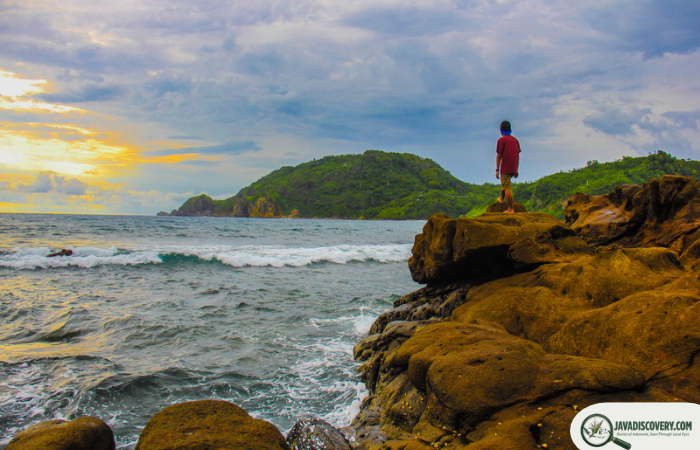
South Malang does not reveal its coastline all at once. Beyond the city, the road begins to climb and bend through villages, plantations, and green hills before the landscape suddenly opens toward the Indian Ocean. Here, beaches appear one after another, each with its own personality.
For international travelers, the beaches of South Malang offer something different from the more developed coastal destinations of Java and Bali. Some are wide and easy to explore, others are framed by rocky islands and steep hills, while several remain closely connected to local communities and traditional ways of life.
Yet there is an important distinction when talking about a “family friendly” beach in southern Java. Family friendly does not necessarily mean suitable for swimming. The southern coast faces the Indian Ocean, and waves and currents can be powerful. Local authorities specifically warn visitors against swimming at some beaches, including Ngliyep and Goa China.
For families, the appeal is often found elsewhere: walking on the sand, watching the waves, exploring coastal landscapes, taking photographs, enjoying a picnic, or simply sitting beneath the trees while children experience the sea from a safe distance.
Why South Malang Is Worth Exploring
South Malang refers primarily to the southern part of Kabupaten Malang, rather than Malang City itself. The coastline stretches along the southern edge of East Java, where forested hills meet the Indian Ocean.
The journey from Malang city can take considerably longer than travelers might expect from looking at a map. Roads wind through rural areas before reaching the coast, and some routes include steep sections and sharp curves. This is part of the experience, but it also means that families should plan the journey rather than treating these beaches as quick urban excursions.
The reward is a coastline that feels remarkably varied. In one direction there may be a broad sandy beach and a Hindu temple standing on a rocky island. Elsewhere, small offshore islets create a maze of turquoise water. Further east, surf culture and fishing communities become more visible.
That variety makes South Malang especially interesting for travelers who want to combine nature with a slower, more observational style of travel.
What Makes a Beach Family Friendly?
A family beach is not simply a place where children can enter the water. In South Malang, a better definition includes accessibility, space, shade, basic facilities, scenic viewpoints, and activities that do not depend on swimming.
Parents should also distinguish between a calm-looking shoreline and genuinely safe water. Waves can appear manageable from the beach while underwater currents remain dangerous. At several South Malang beaches, visitors are advised not to swim because of sea conditions.
Families should therefore follow warning signs, lifeguard instructions, and designated boundaries. Children should remain within close reach of an accompanying adult near the shoreline, particularly when waves are strong.
Six Family Friendly Beaches in South Malang
1. Balekambang Beach
Balekambang is one of the most recognizable beaches in Kabupaten Malang. Its signature landscape is difficult to miss: three offshore islands sit beyond the shoreline, with Pulau Ismoyo carrying the famous Pura Amerta Jati.
The temple gives Balekambang a cultural dimension that goes beyond a conventional beach visit. The site is associated with Hindu religious activity, while the surrounding beach attracts visitors for recreation and coastal scenery. The combination of sand, sea, rocky islands, and architecture has led to comparisons with Tanah Lot in Bali.
For families, Balekambang offers a relatively broad range of things to do. Children can play on the beach, families can walk along the shoreline, and adults can explore the landscape around Pulau Ismoyo while respecting the rules of the sacred temple.
Local government information notes that Balekambang has facilities including parking, camping areas, food stalls, simple accommodation, a prayer room, and other visitor amenities. The same source states that visitors may play in designated coastal areas but should follow safety boundaries established by officials.
The cultural setting is perhaps Balekambang’s greatest advantage for international visitors. A family visit can become an introduction to the religious diversity of Java rather than simply a day beside the sea.
2. Ngliyep Beach
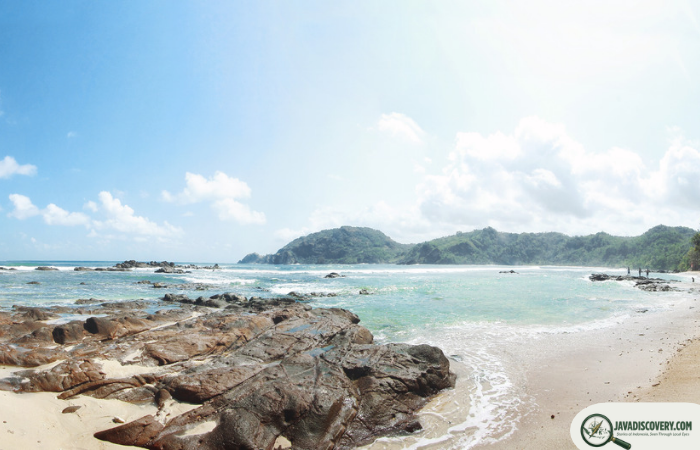
Ngliyep has a different atmosphere. Located in Kedungsalam Village, Donomulyo, the beach is surrounded by steep cliffs, forested areas, and pale sand. Waves crash against the rocky coastline, creating a landscape that feels more dramatic than resort-like.
For families, Ngliyep is better understood as a place for coastal exploration rather than swimming. The Kabupaten Malang government explicitly states that visitors should not swim here because of the dangerous conditions commonly associated with the southern coast.
That does not make the beach unsuitable for families. Instead, it changes the rhythm of the visit. Children can build sand structures, explore the edge of the beach under supervision, and observe the waves. Adults can walk toward viewpoints such as Gunung Kombang, a small rocky area extending toward the sea.
Ngliyep also has a cultural layer. Local traditions have long connected the beach with rituals, including the Labuhan ceremony associated with the Javanese calendar. Such traditions remind visitors that these coastal landscapes are not simply recreational spaces; they can also hold meaning for surrounding communities.
3. Goa China Beach
Goa China is one of South Malang’s most visually striking beaches. Rocky islands rise offshore, while waves converge around the coastal formations. The sound can be surprisingly intense as water moves between the rocks.
The beach is located in Sitiarjo Village, Sumbermanjing Wetan. Older tourism records identify its original name as Pantai Rowo Indah, while the better-known name Goa China became associated with a story about a Chinese hermit who died while meditating in a cave in the area. Because there is no firm official record establishing the precise historical details of that story, it is best treated as a local account rather than settled history.
The natural setting is the real attraction. The coastline combines sand, shallow rocky areas, cliffs, vegetation, and offshore formations. The result is a landscape that rewards observation and photography.
Swimming, however, should not be part of a family’s casual plan here. Kabupaten Malang tourism information warns that visitors are not permitted to bathe in the sea because of strong underwater currents.
For children, the safer experience is to stay on land, explore the beach with an adult, and watch the sea from designated areas. The powerful waves are themselves part of the spectacle.
4. Teluk Asmara
Teluk Asmara feels almost theatrical when viewed from above. Small islands and rocky outcrops surround sections of the coastline, forming sheltered-looking bays that give the beach its distinctive appearance.
The beach is located in Sitiarjo Village, Sumbermanjing Wetan, and is officially listed among Kabupaten Malang’s coastal attractions. Government tourism data records basic facilities including a prayer room, parking, and toilets, with access for cars and some buses.
From higher ground, the arrangement of islands and water creates one of the most recognizable panoramas along the Malang coast. The area has even been promoted locally with the nickname “Raja Ampat of Java,” although such comparisons are best understood as tourism language rather than a geographical equivalence.
For families, Teluk Asmara is particularly attractive for scenery. A visit can involve walking, sitting on the sand, photographing the islands, and enjoying a picnic rather than spending the entire day in the water.
As always on the southern coast, parents should assess sea conditions before allowing children near the shoreline. The presence of beautiful, relatively sheltered-looking coves should not be mistaken for a guarantee of safe swimming.
5. Bajul Mati Beach
The name Bajul Mati comes from the Javanese words associated with a dead crocodile, although different local explanations exist for how the name originated. One traditional account connects the name with a crocodile reportedly found dead in the area; another points to a rock formation whose shape resembles a crocodile.
The beach lies in Gajahrejo Village, Gedangan, around the southern coastal route from Malang. The journey itself is part of the adventure, with mountain roads, curves, and changing views before the ocean finally appears.
One of the area’s visual landmarks is the large bridge crossing the coastal landscape before the beach. It provides a memorable transition between the inland hills and the sea.
At the beach, white sand is framed by rocky formations and small offshore hills. Local tourism information describes several attractive bays and identifies Bajul Mati as a suitable place for camping.
Swimming requires greater caution here. Tourism information has warned that parts of the beach are deep and steep, although calmer water around a river mouth has historically offered a different environment for visitors. Families should still follow current local warnings rather than relying on older descriptions of conditions.
For families who enjoy road trips, photography, camping, and dramatic coastal scenery, Bajul Mati can be more rewarding than a beach chosen purely for swimming.
6. Wedi Awu Beach
Farther east, Wedi Awu introduces another side of South Malang. The beach is part of Desa Wisata Bowele, a coastal tourism area that also includes Lenggoksono and Bolu-Bolu.
The name Wedi Awu is associated with “ash-colored sand,” reflecting the beach’s distinctive appearance. The coastline is surrounded by green hills and has a curved, almost horseshoe-like shape.
Wedi Awu is also known for surfing. Kabupaten Malang’s tourism material describes seasonal waves that can become considerably larger, with some local information recording waves of up to around three metres during the dry season.
This makes Wedi Awu an interesting destination for families with different interests. Parents may enjoy the scenery and relaxed coastal atmosphere while older children or teenagers can watch surfers and learn about a different side of beach culture.
The surrounding Bowele area also offers opportunities to continue the journey by boat toward nearby coastal destinations. In recent years, the area has been promoted as a multi-destination coastal experience combining beaches, boating, snorkeling, and waterfalls.
Wedi Awu therefore works particularly well as part of a longer South Malang itinerary rather than a quick stop.
Beyond Swimming: What Families Can Do
One of the easiest mistakes for international visitors is to judge a tropical beach only by whether it is suitable for swimming. Along the southern coast of Java, the landscape itself can be the main attraction.
Families can walk along the shoreline, look for interesting rocks, photograph fishing boats, watch surfers, enjoy local food, or simply sit beneath coastal vegetation and listen to the waves.
Older children can also use the trip as a natural geography lesson. The coastline shows how waves interact with cliffs, beaches, rocky islands, river mouths, and hills. The journey through rural villages provides another window into everyday life beyond Java’s major urban centers.
At beaches connected with local traditions, the experience can also introduce visitors to the relationship between landscape, belief, and community. Balekambang’s temple and Ngliyep’s ritual traditions are examples of how a beach can hold meanings far beyond recreation.
Understanding the Southern Java Sea
The southern coastline of Java faces the Indian Ocean, and this geography matters. The ocean can produce strong waves, powerful currents, and rapidly changing conditions.
This is why a beach that appears calm in photographs may not be suitable for swimming on a particular day. Families should never assume that clear water or a quiet-looking shoreline means the sea is safe.
At Balekambang, visitors are advised to remain within designated safe areas. At Ngliyep and Goa China, official tourism information specifically warns against swimming. These differences are important when planning a family itinerary.
The simplest rule is also the most useful: treat the sea with respect. Follow signs, listen to local staff, keep children close, and move away from the water when conditions become rough.
Planning a Family Beach Trip from Malang
A South Malang beach trip is best approached as a full-day journey. Distances may look modest on a map, but winding roads and mountainous terrain can make travel considerably slower.
Start early if you want to visit more than one beach. Carry drinking water, sun protection, hats, towels, spare clothes, and suitable footwear. A small first-aid kit is also sensible for families traveling with young children.
Check the weather before leaving and allow extra time for the return journey. Coastal weather can change quickly, while roads through the hills require concentration, particularly after rain.
It is also worth carrying cash, as smaller coastal destinations may not have the same payment infrastructure found in Malang city. Facilities vary from beach to beach, so travelers should not assume that every destination will have restaurants, changing rooms, or extensive visitor services.
Most importantly, do not leave children unsupervised near the sea. The southern coast rewards curiosity, but it also demands caution.
One Coast, Six Different Experiences
The six beaches of South Malang show why the region deserves more than a quick day-trip label. Balekambang combines coastal scenery with living Hindu heritage. Ngliyep offers cliffs, forest, and a quieter relationship with the sea. Goa China turns powerful waves and offshore rocks into a dramatic natural theatre.
Teluk Asmara is shaped by islands and sheltered-looking bays, while Bajul Mati brings together beaches, rocky formations, hills, and the atmosphere of a coastal road trip. Wedi Awu adds surfing culture and links naturally with the wider Bowele landscape.
None of these beaches needs to imitate Bali to be memorable. Their character comes from the landscape of southern Java itself: long roads through villages, green hills descending toward the ocean, fishing communities, religious traditions, powerful waves, and beaches that remain closely tied to the natural world.
For families, perhaps the greatest lesson of South Malang is that a beach day does not have to end in the water. Sometimes the most memorable moments come from watching the waves from the sand, discovering a temple beyond the shoreline, sharing food beneath the trees, or simply following the road until the green hills give way to the wide Indian Ocean.
Writer: Sari Mahendra