Forgotten Arab Quarters of Ampel Pekalongan Trade Scholarship Architecture

javadiscovery.com – Along the bustling northern littoral of Java—the historic Pesisir—coastal cities have long acted as porous cultural borders where maritime traders, religious scholars, and local populations met to forge new civilizations. While Chinese enclaves and European colonial squares often dominate studies of coastal urban history, another foundational community shaped the commercial and spiritual spine of Java: the Arab diaspora, predominantly originating from the Hadramaut region of Yemen. Concentrated within the labyrinthine alleyways of Surabaya’s Ampel district and the coastal batik hub of Pekalongan’s Arab quarter (*Kampung Arab*), these immigrant merchant networks bridged the Western Indian Ocean with the archipelago. For centuries, these quarters functioned not merely as residential enclaves, but as powerhouse centers of Islamic jurisprudence, maritime trade, and distinct hybrid architecture.
Exploring the historic Arab quarters of Ampel and Pekalongan reveals an enduring legacy of trans-oceanic commerce, scholarly transmission, and architectural syncretism that continues to pulse beneath the surface of modern coastal Java.
Hadramaut to the Pesisir: Maritime Trade and Migration Networks
Long before the formal establishment of Dutch colonial administrative boundaries, Hadrami traders sailed on seasonal monsoon winds (*musim timur* and *musim barat*), anchoring their dhows in the shallow roadsteads of Surabaya and Pekalongan. Integrated seamlessly into the maritime trading networks of the Indian Ocean, these families settled permanently along Java’s northern coast:
- The Spice and Textile Conduits: Hadrami merchant houses established thriving import-export businesses, connecting Java’s agricultural hinterlands with global trade routes spanning Singapore, India, and the Red Sea. They specialized in textiles, Arabian perfumes, beads, and maritime provisions.
- Assimilation and Autonomy: Under the Dutch colonial *Wijkenstelsel* (quarter system), the Hadhrami community—classified alongside other Middle Eastern and South Asian populations as *Vreemde Oosterlingen* (Foreign Orientals)—was legally mandated to live within designated urban sectors, fostering tight-knit, highly organized neighborhood enclaves.
Ampel Denta: The Spiritual Sanctuary of Surabaya
In Surabaya, the Ampel quarter (*Kampung Ampel*) grew outward from the sacred nucleus of Sunan Ampel’s 15th-century mosque and tomb. As one of the revered *Wali Sanga* (Nine Saints of Java) who popularized Islam across the island, Sunan Ampel turned the district into an early center of Islamic learning:
- Center of Scholarship (*Pondok* and *Majelis*): Ampel evolved into a magnets for religious scholars (*sayyid* and *sheikh* families bearing lineages tracing back to the Prophet Muhammad). Madrasas and study circles (*majelis taklim*) attracted students from across Southeast Asia seeking instruction in Arabic grammar, jurisprudence (*fiqh*), and Sufism.
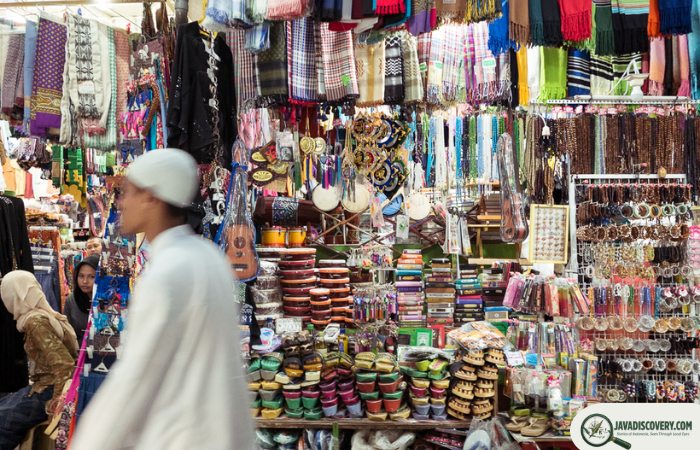
- The Living Bazaar: Encircling the historic mosque, the narrow alleyways of Ampel teem with an intoxicating sensory mix of frankincense, attar oils, Middle Eastern spices, Arabian carpets, and traditional Javanese street food—preserving a vibrant marketplace atmosphere that has endured for centuries.
Pekalongan’s Kampung Arab: Architecture, Batik, and Elite Patronage
Farther west along the Pesisir, Pekalongan’s Arab quarter developed a distinct architectural and economic character closely tied to the city’s legendary textile industry:
- Indies-Hadrami Vernacular Architecture: The grand courtyard houses (*ndalem*) of Pekalongan’s wealthy Arab merchant families—such as the Al-Atas and Al-Idrus clans—showcase a stunning synthesis of styles. High ceilings, louvered teak windows, and massive Tuscan columns merge with traditional Javanese roof structures and intricate Islamic geometric tilework.
- Patronage of Batik Pekalongan: Arab merchant families played a pivotal role in financing and distributing *Batik Pekalongan*, particularly the vibrant, multicultural *Batik Pesisiran* styles. They collaborated closely with Peranakan Chinese and indigenous Javanese artisans, commissioning bold color palettes and floral motifs that reflected global maritime trade tastes.
Guardians of Tradition in a Modernising Landscape
As modern urban expansion, container shipping ports, and highway developments reshape Java’s north coast, the historic Arab quarters of Ampel and Pekalongan face the dual challenges of preservation and commercial modernization. Yet, within their shaded courtyards, ancient manuscript libraries, and bustling alley markets, the descendants of Hadrami voyagers maintain an unbroken chain of faith, commerce, and cultural identity.
The forgotten Arab quarters of Ampel and Pekalongan stand as living monuments to Java’s cosmopolitan past—reminding us that the island’s history has always been deeply intertwined with the wider world of the Indian Ocean.