Inlands Nieuwjaar and the Native New Year of Old Batavia

javadiscovery.com – In colonial Batavia, the arrival of a new year did not always mean January first. Long before fireworks and midnight countdowns became familiar sights, the city lived by overlapping calendars, shaped by faith, culture, and colonial power. One Dutch newspaper called this indigenous way of marking renewal Inlands Nieuwjaar — the Native New Year.
The term appeared in reports written by European journalists who tried to make sense of a celebration that did not follow the Gregorian calendar. What they observed was not a single night of revelry, but a long, communal journey toward spiritual renewal.
When New Year Did Not Mean January First
According to Het Volk, in its February 2, 1935 edition, indigenous Muslims in Batavia did not treat January 1 as a meaningful transition. The turning point of the year arrived after Ramadan, when fasting ended and the month of Syawal began.
For European residents, New Year celebrations centered on city halls, clubs, and private parties. For the indigenous population, renewal was tied to religious discipline, patience, and collective restraint. In this contrast, Inlands Nieuwjaar emerged not as a calendar event, but as a lived experience.
Ramadan Nights and the Sound of the Beduk
The weeks leading up to Inlands Nieuwjaar were marked by fasting during daylight hours. For four weeks, people refrained from eating and drinking until darkness fell. As sunset approached, the heavy beat of the beduk echoed from mosques across kampungs.
The sound signaled permission to eat. Children stopped playing and ran home, shouting with excitement. Streets remained lively late into the night. Vendors sold fruit, sweets, and snacks, their voices overlapping in the humid air. Men gathered in relaxed conversation after breaking the fast, while women fed children and exchanged stories.
Young men added noise and energy with firecrackers or by striking the beduk repeatedly. These nights formed the emotional buildup toward Lebaran, the moment Europeans labeled Inlands Nieuwjaar.
Colonial Eyes and Sleepless European Nights
Dutch journalists viewed these vibrant nights through a very different lens. In their accounts, European residents lay awake with aching heads and tired eyes, disturbed by what they described as the monotonous and endless pounding of drums.
What indigenous communities experienced as warmth and togetherness appeared, to colonial observers, as disorder. These complaints reveal more than annoyance. They expose a cultural gap in how time, celebration, and public space were understood in Batavia.
Pawnshops, Cash Advances, and Early THR
As Inlands Nieuwjaar drew closer, economic activity intensified. Pawnshops filled with people redeeming jewelry that had been pledged throughout the year. Others pawned belongings again, simply to secure enough money for the celebration.
Cash was essential. Workers, djongos, and baboe asked employers for advances, a practice that closely resembles today’s Tunjangan Hari Raya. Colonial newspapers noted that Dutch households often granted leave so servants could return to their communities and take part in the festivities.
Arab residents of Batavia continued their usual role as moneylenders, providing loans that allowed celebrations to proceed, while deepening economic dependence in the process.
Dressing New and Becoming New Again
On the day of celebration, Batavia transformed visually. People appeared in new clothes, bright fabrics, and freshly acquired jewelry. Dutch writers likened indigenous residents to peacocks displaying their finest colors.
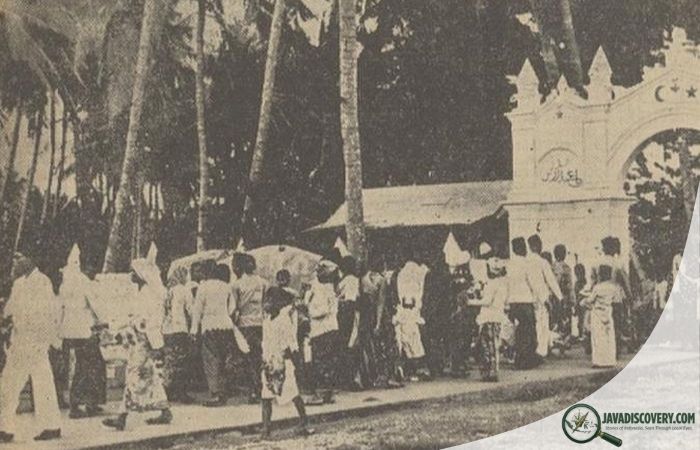
After the Id prayer, families walked through neighborhoods, visiting relatives and neighbors. Handshakes were accompanied by greetings of Slamatan baroe, a phrase understood as returning to a purified state.
Footwear became a minor struggle. Many preferred to walk barefoot, carrying sandals or shoes by hand. Children often looked uncomfortable in footwear forced upon them for the occasion.
Pilgrimage to Luar Batang and Habib Hoesin
For many Muslims in Batavia, Inlands Nieuwjaar also meant pilgrimage. A popular destination was the sacred grave at Luar Batang, associated with Habib Hoesin bin Ali bin Abu Bakar Al-Aydrus, a respected Islamic preacher from Yemen.
Colonial records describe Habib Hoesin as a figure so influential that even the VOC feared him. When he was once imprisoned, indigenous detainees made him their imam, unsettling authorities enough to release him.
Pilgrims arrived in striking attire. Dutch observers complained of vivid colors and glittering jewelry, especially worn by women, which they felt overwhelmed the senses.
After the Celebration Ends
The splendor did not last. Once Inlands Nieuwjaar passed, new clothes disappeared from daily wear. Jewelry returned to pawnshops. The city slipped back into its familiar rhythm.
Only afterward did some colonial observers realize that Inlands Nieuwjaar was never truly a New Year in the European sense. It was not about counting years, but about spiritual completion.
Inlands Nieuwjaar Was Never About the Calendar
For indigenous Muslims in Batavia, Lebaran marked renewal through faith, discipline, and social bonds. January first remained a European celebration, confined to colonial spaces.
Inlands Nieuwjaar, as recorded in Dutch newspapers, stands today as a reminder that Batavia contained multiple worlds at once. Each followed its own sense of time, meaning, and rebirth — often misunderstood, yet deeply rooted in everyday life.