Silat as Philosophy Not Just Martial Art

javadiscovery.com – Before dawn in a village on the slopes of Mount Merapi, the air hangs cool and faintly scented with damp soil and clove cigarettes. Roosters announce the first blue hints of morning. In a narrow courtyard framed by banana trees, a group of men and boys stand barefoot on packed earth. Their movements are slow at first, almost meditative. A hand rises like mist from a riverbank. A foot slides back, toes grazing the ground. There is no shouting, no display of aggression. Only breath, rhythm, and a silence that feels intentional.
The Quiet Courtyards of Central Java
To an outsider, what unfolds in these courtyards might resemble martial arts training. And it is. The discipline is known across Indonesia as pencak silat, often shortened simply to silat. Yet in Java, particularly in rural Central and East Java, silat is rarely framed as sport or spectacle. It is a way of shaping the inner self, a philosophical path disguised as combat.
In villages around Yogyakarta and Surakarta, silat schools operate quietly, sometimes attached to pesantren or family compounds. There are no neon signs or tournament posters. Students arrive in sarongs or loose black trousers, greeting their teacher with a bowed head and a soft handshake that brushes the elder’s hand to their own forehead. The gesture carries more weight than any punch. It signals humility, the first lesson in a discipline where ego is considered more dangerous than any blade.
Rooted in Kingdoms and Courts
Silat’s history in Java stretches back centuries, intertwined with the island’s shifting political and spiritual landscapes. During the era of the Majapahit kingdom, warriors trained not only for battlefield survival but for service to courtly codes of honor. Later, under the Mataram Sultanate, martial practice absorbed layers of mysticism and etiquette that reflected Javanese court culture.
Unlike some martial traditions that emphasize domination, Javanese silat evolved alongside an aristocratic ethic known as alus, a refinement of conduct that values restraint, subtlety, and emotional control. To strike wildly was to reveal one’s inner chaos. To move with economy and calm was to demonstrate mastery over the self.
Many elders recount stories of court guards who trained in silence before sunrise, believing that the stillness of early morning sharpened intuition. Physical technique was inseparable from spiritual discipline. A fighter who lacked inner balance was considered incomplete, no matter how powerful his kicks.
Movement as Moral Language
On the surface, silat techniques can appear fluid and almost dance-like. Hands trace arcs in the air. Bodies pivot low to the ground. The practitioner seems to flow rather than collide. This aesthetic quality is not accidental. In Java, beauty and ethics are often intertwined.
Pak Suroto, a silat teacher in a village near Klaten, explains it while watching his students practice a sequence of defensive forms.
“Your body reveals your heart,” he says quietly. “If your movement is rough, your intention is rough. If your movement is controlled, your mind is controlled.”
Students are taught that each gesture contains layered meaning. A parry is not merely a block but an act of redirection. Instead of meeting force with force, the practitioner yields slightly, guiding an opponent’s energy away. The philosophy echoes broader Javanese social values, where confrontation is often avoided and harmony preserved through subtle adjustment.
Breath, Prayer, and Inner Power
As the sun rises higher, the training shifts. The group forms a circle. Eyes close. Breathing deepens. This is the moment when silat crosses from physical exercise into spiritual cultivation.
In many Javanese schools, particularly those influenced by Sufi traditions, practitioners integrate quiet recitations and meditative breathing. The aim is not supernatural power in a cinematic sense but heightened awareness. They speak of tenaga dalam, inner energy, as something cultivated through discipline, patience, and moral clarity.
The philosophy aligns with Javanese mysticism, where the universe is seen as layered and interconnected. A fighter who seeks to harm out of anger disrupts that balance and ultimately weakens himself. Strength arises from alignment, not aggression.
Older practitioners recall that during the colonial period, silat groups often doubled as networks of resistance. Yet even then, teachers insisted that violence was a last resort. The deeper battle was against fear, greed, and arrogance.
Silat in Village Life
In rural Java, silat is woven into everyday rhythms. During wedding celebrations, young men sometimes perform choreographed sparring demonstrations to the beat of traditional drums. Movements are exaggerated, almost theatrical, yet always grounded in respect. Spectators cheer softly, appreciating not only technical skill but the grace of execution.
Children grow up hearing proverbs associated with martial training. “Defeat yourself before defeating others,” one saying goes. Another reminds students that the sharpest weapon is a calm mind.
Women, too, increasingly participate. In a pesantren outside Kediri, teenage girls train in a courtyard bordered by hibiscus flowers. Their laughter punctuates the air between drills. For them, silat offers both self-defense and a sense of confidence rooted in discipline rather than bravado.
The Psychology of Restraint
At its core, Javanese silat teaches restraint. This mirrors the broader cultural emphasis on emotional moderation. Anger is seen as a crack in the surface of harmony. A silat practitioner learns to feel the surge of adrenaline without surrendering to it.
During sparring sessions, teachers observe not only technique but temperament. A student who strikes too hard may be asked to sit out and reflect. “Why did you rush?” the teacher might ask. “What were you trying to prove?”
These questions reach beyond the courtyard. In village disputes, elders sometimes encourage young men trained in silat to mediate conflicts rather than escalate them. Their training is expected to cultivate wisdom, not intimidation.
Symbols and Rituals
Before major training milestones, some schools conduct simple rituals. Incense curls upward in thin white streams. A bowl of water is placed at the center of the training space. Students dip their fingers into it, touching their foreheads as a reminder of clarity.
The symbolism is understated but profound. Water represents adaptability. Incense signifies intention rising toward the unseen. These rituals reinforce the idea that silat is not merely physical conditioning but ethical formation.
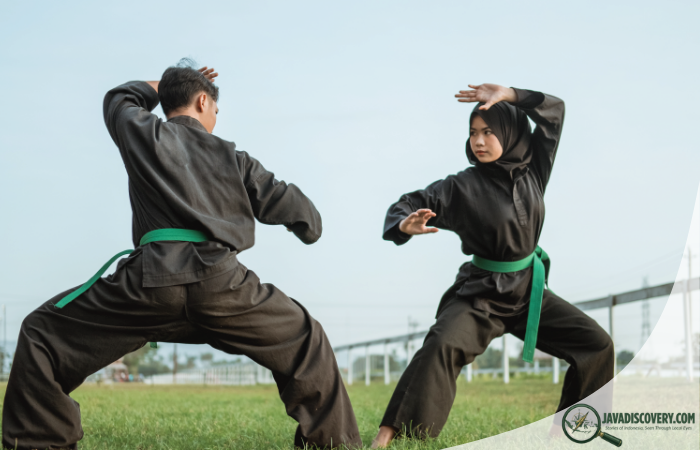
Even attire carries meaning. The traditional black uniform, common in many Javanese schools, symbolizes humility and the unknown depths of knowledge. A sash tied at the waist is earned gradually, each level reflecting increased responsibility rather than superiority.
Between Tradition and Modernity
Today, silat occupies multiple worlds. On international stages, it appears as a competitive sport with timed rounds and standardized scoring. In urban gyms in Jakarta and Bandung, it is marketed as fitness training. Yet in rural Java, the philosophical core remains intact.
Teachers express cautious optimism about modernization. They appreciate broader recognition but worry that spectacle can overshadow substance. “If it becomes only about medals,” Pak Suroto says, “the heart will disappear.”
Still, he acknowledges that change is inevitable. Some of his students record training sessions on smartphones, sharing clips with friends. The digital age intersects with ancient forms. What matters, he insists, is whether the inner teachings survive the translation.
A Philosophy in Motion
As dusk settles over the village, the courtyard empties. The earth bears faint imprints of bare feet. Crickets begin their evening chorus. A final prayer is offered, voices low and steady.
In Java, silat endures not because of its capacity for violence but because of its insistence on balance. It is a philosophy carried in muscle memory, transmitted through quiet gestures and patient correction. Each movement is a sentence in an unspoken moral language.
To practice silat here is to engage in a dialogue with oneself. The opponent is often a mirror. The strike is a test of intention. The block is an act of understanding. In the end, victory is measured not by who falls but by who remains composed.
Under the shadow of volcanoes and the sweep of monsoon skies, Javanese silat continues its quiet evolution. It teaches that power without restraint is hollow, and that the deepest battles are fought within. In its slow, deliberate movements, one finds not just a martial art but a philosophy of living.