Tol Probowangi Ready to Transform East Java Travel

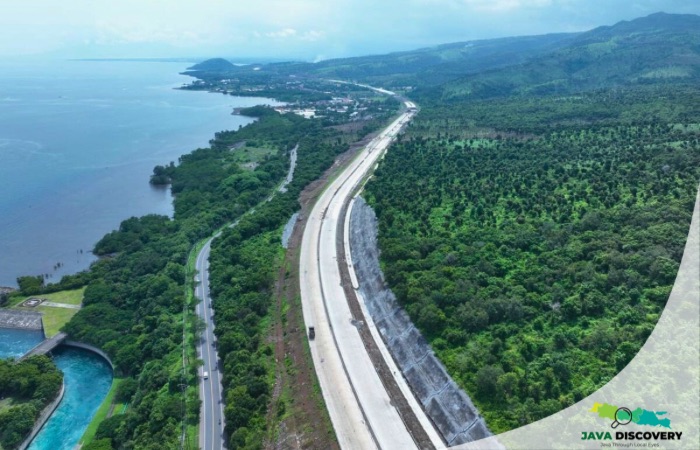
javadiscovery.com – The Tol Probowangi project is entering a decisive moment. As the year-end holidays approach, a key segment of the Probolinggo–Banyuwangi toll road is expected to open in a limited-use scheme. When fully operational, this 175-kilometer corridor will cut travel time across East Java’s eastern flank from five hours to just two. For residents, travelers, and the regional economy, this marks the start of a major shift in how the eastern part of Java connects, moves, and grows.
Tol Probowangi Prepares for Limited Opening During the Holiday Season
The Indonesian government plans to open the Gending–Paiton segment of the Tol Probowangi during the 2025 Christmas and 2026 New Year (Nataru) travel period. The section has already passed its Function and Operation Feasibility Test (ULFO), completed on 22–24 October 2024. With peak-season mobility on the horizon, officials emphasize that safety, road readiness, and public accessibility are the top priorities.
Wilan Oktavian, Head of the Toll Road Regulatory Agency (BPJT), confirmed that all supporting facilities must meet strict operational standards. The segment is expected to provide early benefits to travelers navigating East Java’s busy holiday flow. “Quality and safety must be ensured, as this route will support a surge of public mobility during Nataru,” he stated.
Rapid Progress in Phase I Construction
Phase I of the toll’s development covers three major segments. Two of them—Gending–Kraksaan and Kraksaan–Paiton—are fully completed structurally and are only awaiting operational certification. The third segment, Paiton–Besuki, has reached more than 85 percent progress, signaling that the entire first phase is approaching readiness.
Completed Segments: Gending–Kraksaan and Kraksaan–Paiton
These two segments form the backbone of the initial opening. Once certified for full use, they will anchor integration with later phases and provide smoother transitions along East Java’s northern coastline.
Paiton–Besuki Nears Final Stages
With more than 85 percent of construction completed, the Paiton–Besuki segment is closing in on operational readiness. Once connected, the three Phase I segments will open the door to a continuous toll corridor stretching deeper into Situbondo and toward Banyuwangi.
Supporting infrastructure in Phase I includes three toll gates—Kraksaan, Paiton, and Situbondo Barat—and three interchanges, ensuring road users have clear access points and improved traffic distribution.
Probolinggo–Banyuwangi Travel Time Cut to Two Hours
Perhaps the most transformative promise of the Tol Probowangi is the dramatic reduction in travel time. The current five-hour drive along arterial roads, often slowed by trucks, markets, and dense settlements, is expected to shrink to just two hours once the entire toll is open. This efficiency is poised to lift logistics, tourism flows, agricultural distribution, and everyday mobility in East Java’s eastern districts.
The Expanding Role of the Trans East Java Toll Network
The rise of Tol Probowangi coincides with the strengthening of East Java’s broader toll network, led by PT Jasamarga Transjawa Tol (JTT). Several key toll roads now shape the daily rhythm of mobility, from commuters to logistics and long-distance travelers. These include Ngawi–Kertosono, Surabaya–Gempol, Gempol–Pandaan, Pandaan–Malang, and the strategic Gempol–Pasuruan segment—better known as Gempas.
Gempas as a New Economic Corridor
Among these corridors, Gempas stands out for its strategic importance. It shortens the Surabaya–Pasuruan journey from more than two hours to around one, reshaping commuting patterns and opening new economic opportunities. According to JTT Corporate Secretary Ria Marlinda Paallo, Gempas has evolved beyond a mobility route. It is now a catalyst for industrial growth, tourism access, and regional competitiveness.
Tourism Benefits: Easier Access to East Java’s Natural Icons
The growing toll network has immediate implications for tourism. Improved connectivity brings flagship destinations—such as Purwodadi Botanical Garden, Taman Safari Prigen, Candi Jawi, and the Bromo–Tengger–Semeru highlands—closer to visitors from major cities. Smoother travel boosts small businesses, hospitality sectors, and creative industries across Pasuruan, Probolinggo, and Lumajang.
Maintenance and Digital Integration for Safer Travel
JTT continues refining its toll management through routine maintenance and digital services. Travoy 4.5, Dynamic Message Signs (DMS), and Jasa Marga’s official information channels support safer and more predictable travel. These systems are especially vital during peak holiday seasons, when traffic volumes multiply.
A New Future for East Java Connectivity
As Tol Probowangi moves closer to full operation and the Trans East Java network grows more integrated, East Java stands on the threshold of an infrastructural shift. Faster travel, stronger logistics arteries, and improved tourism access all point to a new chapter of regional development. These toll roads are not merely structures of asphalt and concrete—they are pathways linking communities, markets, and opportunities across the eastern end of Java.
The opening of Tol Probowangi marks the beginning of a more connected East Java, where movement becomes smoother, economies grow bolder, and the island’s eastern landscapes feel closer than ever before.