Java Traditional Games and the Ancient Art of Javanese Play

javadiscovery.com – Under the amber glow of a waning tropical sun, the dust rises in fine, golden clouds over a village square in Central Java, where the air smells of parched earth and blooming jasmine. Here, the silence of the approaching dusk is shattered not by the digital pings of a handheld device, but by the rhythmic slap of bare feet against packed clay and the cacophonous, melodic chanting of children engaged in a ritual as old as the volcanic peaks on the horizon. This is the world of dolanan tradisional—traditional Javanese games—a fading symphony of physical movement, social cohesion, and ancestral wisdom that once defined the upbringing of every child on the island long before the silicon age arrived.
The Vanishing Playground: Ancient Rhythms of Javanese Childhood
To walk into a rural Javanese hamlet, or kampung, during the late afternoon is to witness a theater of human interaction that is rapidly becoming a relic. In the shadow of a sprawling banyan tree, a group of young girls assembles a chain made of hundreds of interlocking rubber bands. They are preparing for Lompat Tali, a game of agility that transcends mere exercise. To the casual observer, it is skipping rope; to the Javanese child, it is a graduated test of courage, beginning at the ankles and rising until the “rope” is held high above the heads of the tallies, requiring the jumper to propel themselves into the humid air with the grace of a dancer and the precision of an athlete.
There is no plastic here, no high-definition screens, and no solitary isolation. Every game requires a partner, a team, or a neighborhood. The materials are harvested from the land: bamboo offcuts, smooth river stones, fallen seeds from the sawo tree, or simply the dirt beneath their feet. In this landscape, play is the primary vehicle for gotong royong—the Indonesian concept of mutual cooperation. Through these games, children learn the intricate social hierarchy and communal harmony (rukun) that are the bedrocks of Javanese philosophy.
The Architecture of the Earth: Congklak and the Philosophy of Giving
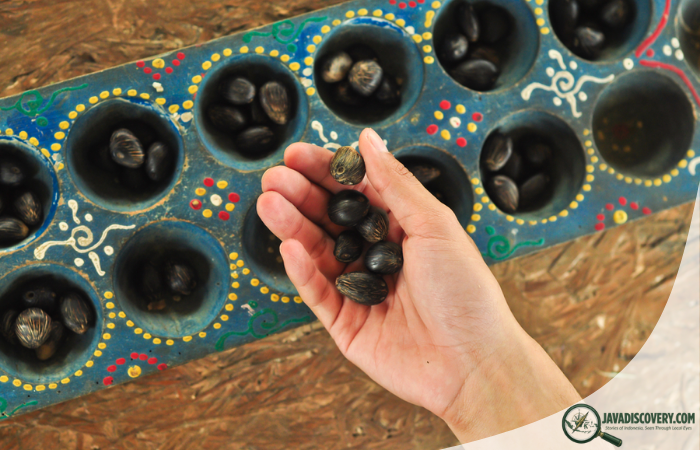
Perhaps the most sophisticated of these pastimes is Congklak. It is a game played on a wooden boat-shaped board with two rows of small circular pits and two larger “storehouses” at either end. The sound of the game is distinctive: the rhythmic clack-clack-clack of cowrie shells or dried seeds being dropped into wooden hollows. It is a game of mathematical strategy, but its roots dig deeper into the spiritual soil of Java.
As the children sit cross-legged on a hand-woven bamboo mat, they move seeds in a clockwise direction. The rules dictate that one must deposit a seed into every hole passed, including one’s own storehouse, but skipping the opponent’s. It is a lesson in the flow of life and resources. In Javanese belief, Congklak teaches that wealth and luck must be shared to keep moving; if you hoard your seeds in one place, the game stops. It reflects the agricultural cycles of the island—planting, harvesting, and storing—reminding the players that today’s harvest must sustain the village through tomorrow’s lean months. The focus is never on the individual’s greed, but on the continuous movement of the seeds, symbolizing the breath of the universe.
The Bamboo Engineers: Egrang and the Art of Balance
Across the clearing, a group of boys competes in a test of verticality known as Egrang. They mount tall bamboo stilts, fashioned from the sturdy bambu petung variety, with small footrests lashed securely about half a meter from the ground. To watch a skilled Egrang walker is to see a masterclass in equilibrium. They navigate the uneven terrain of the village with long, clattering strides, their bodies swaying like the coconut palms above them.
The construction of the stilts is a rite of passage. A child must learn to select the right bamboo—neither too young and supple nor too old and brittle. They must learn the knots required to keep the footrest from slipping under their weight. When they finally rise above the crowd, the perspective shifts. Egrang is not merely about height; it is about finding one’s center in an unstable world. In a culture that values emotional restraint and “level-headedness,” the stilts serve as a physical metaphor for the Javanese ideal of manunggaling kawula gusti—the search for balance between the physical and the spiritual realms.
Shadows and Spirits: The Nocturnal Magic of Hide and Seek
As the sun dips below the horizon and the Maghrib call to prayer echoes from the local mosque, the games do not always end; they merely change shape. This is the hour of Petak Umpet, the local iteration of hide-and-seek, but played within the deep, velvet shadows of a Javanese night. The “it” player stands against a tree, eyes closed, shouting numbers into the dark, while others vanish into banana groves or behind stacks of hay.
In the Javanese context, the dark is never truly empty. Folklore tells of spirits like the Genderuwo or Wewe Gombel who frequent the shadows. Playing at dusk adds a layer of thrill and ancestral fear. Children learn to navigate the darkness without terror, trusting their senses—the scent of damp moss, the sound of a rustling leaf, the cool draft of air from an open doorway. They become attuned to the environment in a way that no digital simulation could replicate. They learn the geography of their home not by sight, but by touch and intuition.
The Geometry of the Soil: Gobak Sodor
On a larger patch of ground, often a cleared harvest field, the high-energy game of Gobak Sodor takes place. A rectangular grid is scratched into the dirt with a stick. One team defends the lines, moving only horizontally or vertically, while the other team tries to run through the gauntlet without being touched. It is a game of lightning-fast reflexes and intense teamwork.
The defenders must communicate with silent nods and hand signals, closing gaps before the “invaders” can slip through. There is a raw, percussive energy to Gobak Sodor. The sound of heavy breathing, the shouts of triumph, and the sight of sweat-streaked faces under the tropical sun exemplify the vitality of Javanese youth. It is a battle of wits and physical prowess where the prize is not a high score, but the fleeting, glorious respect of one’s peers. It reinforces the idea of the “gatekeeper”—a common theme in Javanese mythology where sacred spaces are guarded by formidable protectors.
Natural Artifice: The Kelereng Obsession
Then there are the Kelereng (marbles). While the glass spheres may be manufactured, the way they are played in Java is entirely organic. A small circle is drawn in the dust, and the “stakes” are placed in the center. Players use their middle finger and thumb to flick their “striker” marble with startling velocity. The precision required is immense; a champion marble player can hit a target the size of a fingernail from three meters away.
The collection of marbles is a child’s first experience with currency and trade. Marbles with rare swirls of color or those that have survived many battles become legendary. They are kept in small cloth pouches or recycled tin cans, rattling like treasure as the children walk. Through Kelereng, children learn the nuances of negotiation, the bitterness of loss, and the discipline of practice. It is a quiet, focused game that contrasts with the boisterousness of the field games, requiring a stillness of breath and a steady hand that mirrors the focus of a traditional batik artist or a woodcarver.
The Sonic Landscape: Cublak Cublak Suweng
Not all games are about running or competing. Some are communal riddles set to song. Cublak Cublak Suweng is a traditional game from Central Java, often attributed to Sunan Giri, one of the Wali Songo (Islamic saints). Children sit in a circle, one face down in the middle. The others pass a small stone or seed behind their backs while singing a rhythmic, haunting nursery rhyme. The song itself is a coded message about looking for true happiness in the heart rather than in worldly greed.
The lyrics, “Cublak-cublak suweng, suwenge teng gelenter…” create a hypnotic atmosphere. When the song ends, the child in the middle must guess who holds the stone. It is a game of poker faces and subtle body language. It teaches children to look beyond appearances and to sense the hidden truths in the people around them. In the Javanese worldview, reality is often veiled, and one must develop a “sixth sense” (roso) to navigate the complexities of social life.
The Inevitable Shift: The Digital Silence
The arrival of the smartphone has changed the acoustic and social landscape of the Javanese village. In many places, the afternoon “dust clouds” have settled. The village square, once a theater of movement, is now often occupied by rows of children sitting on stone walls, their faces illuminated by the blue light of screens, their thumbs moving in tiny, repetitive motions. The communal chant has been replaced by the solitary sounds of digital explosions and synthesized soundtracks.
This shift is more than just a change in hobby; it is a fundamental alteration of how the Javanese child relates to their environment and their community. When a child plays Egrang, they are physically bonded to the bamboo—the very material that builds their houses and fences. When they play Gobak Sodor, they are learning the boundaries of their neighbors. When they sit in a circle for Cublak Cublak Suweng, they are absorbing the musical scales and philosophical underpinnings of their ancestors. The digital world, by contrast, is placeless. It does not smell of rain-soaked earth or feel like the rough bark of a mango tree.
A Cultural Resurgence
However, there is a growing movement across Java to reclaim these traditions. In cities like Yogyakarta and Bandung, “Traditional Game Festivals” are becoming popular. Elders are being invited back into schools to teach the art of making Layangan (traditional kites) or Gasing (wooden spinning tops). These tops, carved from dense hardwoods and spun with a handmade string, are marvels of physics, capable of spinning for minutes at a time in a humming, blurred dance.
Preserving these games is not merely an act of nostalgia; it is an act of cultural survival. It is about ensuring that the next generation of Javanese people retains the ability to cooperate, to innovate with natural materials, and to find joy in the presence of others. The games are a repository of the Javanese language, as many of the chants and terms used in play are found nowhere else. They are the living DNA of a civilization that has always prioritized the group over the individual.
Conclusion: The Spirit of the Play
As night finally falls over the island, and the crickets begin their own rhythmic symphony, one might still find a pocket of the old world. In a remote corner of the Special Region of Yogyakarta, or perhaps in the highlands of East Java, the ghost of the old playground remains. A forgotten bamboo stilt leans against a wall; a circle for marbles is still visible in the dirt; a group of children, resisting the pull of the screen for just one more hour, runs through the moonlight, their laughter echoing off the volcanic stones.
These traditional games are the soul of Java in motion. They are the tangible links to a past where the world was wide, the materials were raw, and the only limit to a child’s afternoon was the setting sun. While technology continues its relentless march, the memory of the clack-clack-clack of the Congklak board serves as a reminder that the most meaningful connections are often those made in the dirt, under the trees, and face-to-face.