The Village That Refused to Move Beneath Mount Merapi

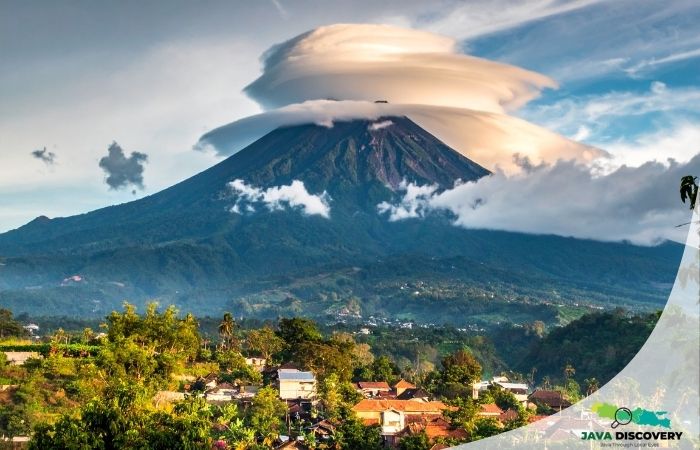
javadiscovery.com – In the heart of Central Java, where the land breathes fire and the clouds carry ash, stands Mount Merapi — a mountain both feared and revered. Its name, meaning “Mountain of Fire,” is not mere poetry. Merapi is among the most active volcanoes on Earth, erupting with both fury and rhythm, shaping lives and landscapes for centuries. Yet, beneath its smoldering slopes lies a story that defies logic — a story of a village that refused to move, bound by faith, tradition, and a deep sense of belonging.
The Fire Mountain and Its Keeper
Long before modern seismographs began tracing Merapi’s tremors, the mountain was seen as a living entity — unpredictable yet sacred. Local legend speaks of the spirits who dwell within it, guarding the invisible border between the mortal world and the unseen realm. For generations, one family held the sacred duty to maintain that balance: the spiritual guardians of Merapi.
The most famous among them was Mbah Maridjan, the late juru kunci — or gatekeeper — of Mount Merapi. Appointed by the Sultan of Yogyakarta, his role was not scientific but spiritual: to communicate with the spirit of the volcano, to perform rituals, and to ensure harmony between man and nature. When government officials urged him to evacuate during Merapi’s violent eruptions, he calmly refused. “My duty,” he said, “is to stay where I belong.”
In 2010, when the volcano unleashed one of its most devastating eruptions in modern history, Mbah Maridjan was found lifeless in his home, in a position of prayer. To many, he died a hero; to others, a symbol of stubborn fatalism. But to the people of Kinahrejo, his village beneath Merapi, he remained the soul of their mountain.
Kinahrejo: A Village Between Faith and Fire
Kinahrejo sits just six kilometers from Merapi’s crater — far within the zone most scientists consider uninhabitable. Its people are farmers, craftsmen, and keepers of ancient beliefs. For them, Merapi is not a monster to escape but a protector, a giver of life. Its eruptions destroy, yes, but they also renew the land, leaving behind the richest volcanic soil in all of Java. Crops flourish, and the cycle of life continues.
When disaster struck in 2010, much of Kinahrejo was buried under ash and pyroclastic flow. The government declared the area unsafe and urged resettlement. Yet, within months, many villagers returned — rebuilding homes from the rubble, erecting shrines for those lost, and resuming their lives beneath the smoking peak. “We were born here,” one villager said, “and this is where our ancestors sleep. If Merapi takes us, so be it.”
The Ash Museum: Memory Etched in Stone
Today, Kinahrejo stands partly as a living village and partly as an open-air museum. Visitors who come to see “Museum Sisa Hartaku” — literally, “The Museum of My Remaining Belongings” — are greeted not by grand exhibits but by remnants of lives abruptly halted. Burned motorcycles, melted glass, deformed kitchen utensils, and clocks stopped at the exact moment the eruption struck. Every item tells a silent story of loss and endurance.
The museum is managed by the very villagers who survived the eruption. It is not merely a memorial but an act of defiance — a declaration that life continues. Tourists are welcomed with gentle hospitality and guided by locals who narrate their own survival stories, often with calm acceptance rather than sorrow. In their tone, one senses a profound philosophy of impermanence — a Javanese wisdom that everything in life, even tragedy, is part of a larger balance.
Science Meets Spirituality
Mount Merapi is closely monitored by volcanologists from the Merapi Volcano Observatory, equipped with modern instruments that measure gas emissions, tremors, and temperature changes. Yet, despite all this data, eruptions remain unpredictable. For the villagers, scientific warnings and spiritual messages are not in conflict — they coexist.
Before an eruption, elders might sense unusual signs: restless animals, a strange quiet in the forest, or the scent of sulfur thickening in the air. To them, these are the mountain’s way of speaking. Modern scientists call it “natural observation.” In truth, both sides are seeking the same thing — to understand the language of Merapi.
The New Generation of Guardians
After Mbah Maridjan’s death, his son Asih assumed his father’s sacred role. Unlike his father, he embraces a dialogue between tradition and modernity. While he still performs rituals to honor the spirits of the mountain, he also works closely with disaster authorities to coordinate evacuations when danger looms. To him, faith does not mean blind defiance, but devotion balanced with wisdom. “My father taught me courage,” he once said, “but the mountain also teaches humility.”
This evolution reflects the changing face of Java itself — where ancient beliefs intertwine with modern science, where spiritual understanding meets geological reality. And through that intersection, the people of Merapi find harmony in paradox.
Lessons from the Mountain
The story of Kinahrejo is more than a tale of a stubborn village. It is a mirror of human resilience — of the eternal tension between fate and free will, tradition and progress, fear and faith. The villagers’ decision to stay under the shadow of Merapi may seem irrational to outsiders, but to them, it is an affirmation of identity. The mountain gives them not only land but meaning.
When you stand on the ridge overlooking Merapi at dawn, the mist parts slowly, revealing the slopes scarred by fire yet covered in green again. Farmers move like tiny silhouettes across the fields, planting seeds into soil born from ash. Somewhere among them are the descendants of those who refused to move — quietly tending their crops, living, loving, and believing under the gaze of their restless god.
In the heart of Java, where mountains breathe and people endure, Mount Merapi reminds us that life and destruction are not opposites, but partners in the eternal dance of existence.