The Hermit Whose Prayers Shook the Heavens Above Mount Arjuno

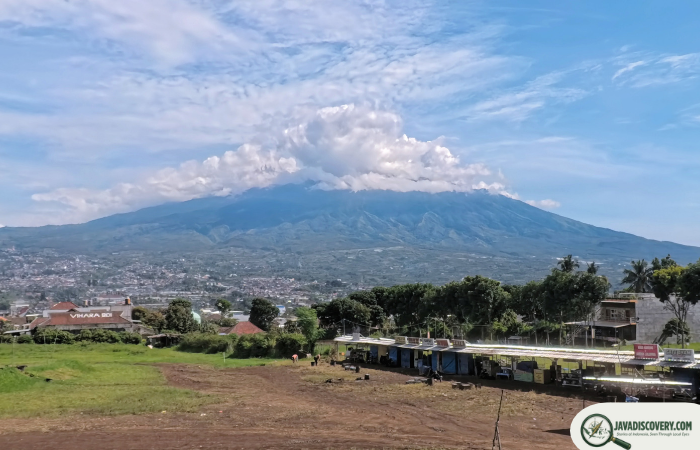
Before dawn on the slopes above Batu, the air is thin and cold, and cloud spills slowly off the ridgelines. Farmers’ lights flicker in the valleys below. Above them, a dark cone rises against the last of the stars.
This is Mount Arjuno, one of the tallest peaks in East Java. According to a story told across the region, it was once far taller, until two unlikely servants of the gods cut it down.
A Mountain Above the Arek Highlands
Mount Arjuno reaches about 3,339 metres above sea level, making it the second-highest mountain in East Java after Semeru. It rises on the borders of Batu City, Malang Regency and Pasuruan Regency, and is managed within the Raden Soerjo Grand Forest Park.
Its neighbour Welirang, at about 3,156 metres, stands on the same ridge. Together they form the Arjuno-Welirang volcanic complex, often called a “twin” volcano. Welirang is known for sulfur deposits around its fumaroles.
The slopes on the Batu and Malang side lie in the Arek cultural region, whose people are known for a direct, egalitarian manner and a dialect of their own. Geologists explain the height of the mountain through volcanic history. Storytellers explain it through a hermit.
The Prince Who Was Never Satisfied
The hermit in the story is Arjuna, one of the five Pandawa brothers of the wayang tradition. Wayang is the Javanese shadow-puppet theatre that reshaped the Indian epic Mahabharata into a vast body of local storytelling.
In the tale, the Pandawa are the sons of King Pandu by two wives, Kunti and Madri. Kunti bore Yudistira, Bima and Arjuna. Madri bore the twins Nakula and Sadewa.
One retelling describes Arjuna as an incarnation of Indra, the god of war. The more common wayang account makes Indra his divine father. The two versions differ, and the story survives in both.
Arjuna was the mightiest of the brothers, yet he was not content. Wanting still more power, he set out to meditate on a mountain slope west of Batu.
What Tapa Means in Javanese Tradition
Tapa, or bertapa, is ascetic meditation: a period of withdrawal, fasting and concentration, undertaken to gain inner strength or spiritual power. Wayang heroes often turn to it when ordinary strength is not enough.
The Peak That Would Not Stop Rising
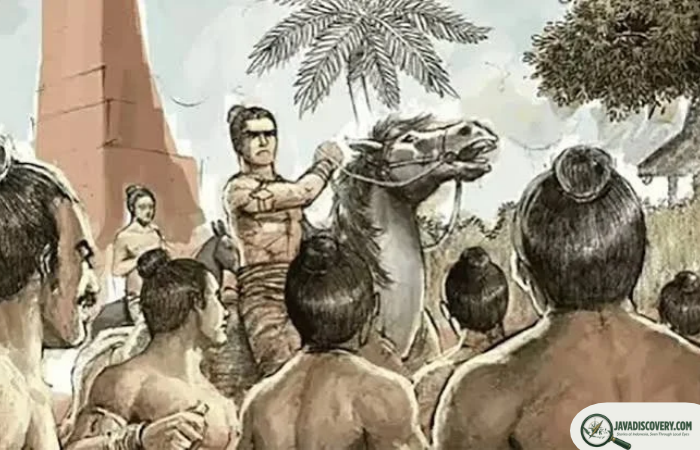
Arjuna sat cross-legged on a great boulder and gathered every thought into a single point. His concentration was so deep that a bright light began to glow from his body.
Then the summit beneath him began to rise. It climbed and kept climbing until it touched the sky and shook Kahyangan, the heavenly realm of the gods.
The Gods Send Beauty, Then Demons
Alarmed, the gods sent Batara Narada to find the cause. In wayang, Batara is an honorific for a god. Narada found Arjuna and asked him to stop, but Arjuna refused. He feared that stopping would leave his power incomplete.
Batara Guru, the chief god in this tale, tried temptation next. He sent seven of the most beautiful bidadari, or celestial nymphs. They failed, and Arjuna did not move.
Force came next. Batara Guru sent dedemit, a class of spirits in Javanese belief, to disturb the meditation. Arjuna defeated them easily, and they returned to report their failure.
Two Servants End the Ascetic’s Quest
Batara Guru then remembered Semar, the guardian-servant of the Pandawa, who lives among humans. Narada was sent to ask for his help.
Semar agreed and brought Togog with him. In wayang, Semar and Togog are among the punakawan, the comic yet wise servant figures. Togog is usually shown attending the antagonist side.
The two climbed to the slope and began meditating at its edge. With the power they held, they sliced off the towering summit and hurled it toward the southeast. The crash woke Arjuna.
He found the two servants before him. They told him that his meditation now threatened the realm of the gods. Semar added that nobody doubted Arjuna’s strength.
The rebuke worked. Arjuna understood his error and left the mountain, and the story says the peak where he had meditated became Mount Arjuno.
The Severed Summit Called Gunung Wurung
The piece Semar and Togog threw away is said to have become Gunung Wurung. The retelling does not say which summit on the map carries that name, and this article does not guess.
That gap is typical of legends like this one. They explain a feature of the land and rarely fix it to precise coordinates.
Why a Volcano Needs a Story
Science can date rock and trace the lava that built Arjuno-Welirang. It cannot say why a mountain feels like a presence, or why a community would want the answer to be a person.
This legend supplies one. Even the strongest of the Pandawa needed to hear that power without limits disturbs the world around it. The lesson is delivered by two humble servants, not by a warrior or a god.
The next time cloud lifts off Arjuno at first light, the shape of the summit may look less like an accident of volcanoes than a decision made by a hermit, and unmade by those who loved him.
Writer: Sari Mahendra