Italian Architects of Batavia Renaissance Influence West Java Colonial Structures

javadiscovery.com – When picturing the architectural heritage of early Batavia (modern-day Jakarta) and the surrounding hinterlands of West Java, imagery of Dutch gables, red-tiled roofs, and Northern European canal houses usually dominates the historical narrative. However, beneath the dominant Dutch colonial aesthetic lies a lesser-known, highly influential design layer: the classical proportions, fortified layouts, and spatial principles introduced by Italian architects, military engineers, and stonemasons serving the Dutch East India Company (VOC) during the 17th and 18th centuries. Drawn to the East Indies by lucrative commissions or imperial military contracts, these Italian builders brought Renaissance humanism, Mannerist fortifications, and Vitruvian geometry directly to the swampy river estuaries of Java.
Exploring the legacy of Italian architects in Batavia unveils how Italian Renaissance design theory adapted to the tropical climate and defensive requirements of early West Java.
From the Mediterranean to the Tropics: The Italian Military Engineers
During the early 17th century, Italian military engineers were renowned throughout Europe as the undisputed masters of trace italienne (star fortification design). As the VOC struggled to secure its hold over Batavia against naval assaults from the British and land sieges from the Mataram Empire and Banten Sultanate, the Company eagerly recruited Italian fortification experts:
- The Geometry of Kasteel Batavia: Early plans for Batavia’s central citadel—Kasteel Batavia—and its surrounding city walls incorporated classic Italian Renaissance geometric proportions. Featuring bastions angled precisely to eliminate blind spots for crossfire, the fortress mirrored the bastion designs perfected in Italian Renaissance treatises by architects like Francesco di Giorgio Martini and Sebastiano Serlio.
- Sluices and Hydraulic Planning: Italian engineers, trained in the canal and river management traditions of Venice and Lombardy, assisted in designing Batavia’s early water gates, sluice systems, and defensive moats (*grachten*), attempting to control the silting waters of the Ciliwung River.
Renaissance Principles in Early West Javan Estates
Beyond urban fortresses, the influence of Italian architectural theory extended into the rural land grants (*landhuizen*) established across West Java, from the Batavia suburbs (*Ommelanden*) into the cooler foothills of Bogor and Depok:
- Symmetry and Classical Orders: Early colonial country manors abandoned cramped, narrow Dutch medieval timber layouts in favor of open, symmetrical Italian villa plans. High ceilings, central axial hallways (*corridors*), and open loggias (*galerij*) borrowed heavily from Andrea Palladio’s famous Venetian country villas.
- Adaptation to Tropical Climate: The Italian villa concept proved remarkably suited to Java’s tropical heat. Deep colonnaded verandas served as thermal buffers, shading interior rooms from intense equatorial sun while allowing monsoon winds to circulate freely—a design fusion that laid the groundwork for the later Indische Empire style.
The Decorative Arts: Italian Stonemasons and Marble Interiors
In addition to master architects, Italian artisans and stonemasons contributed significantly to Batavia’s civic and religious monuments during the Dutch Golden Age:
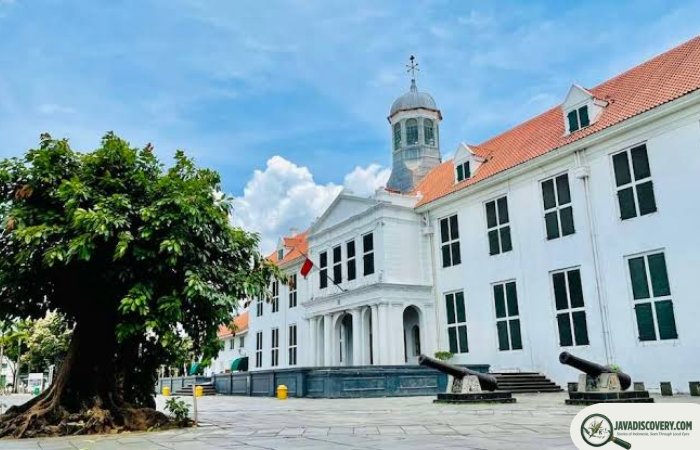
- Carved Stone Portals and Altars: Public buildings like the early Batavia City Hall (*Stadhuis*, now the Jakarta History Museum) and private merchant mansions featured classical stone architraves, pediments, and carved doorways executed by or under the direction of Italian craftsmen.
- Carrara Marble and Terrazzo: Wealthy VOC burghers imported genuine Italian Carrara marble tiles as ballast on European ships. Italian tile setters installed these cool, polished stone floors in grand reception halls across Batavia and country estates in West Java to signal immense wealth and European sophistication.
Legacy: The Subtle Classical Spine of West Java
While tropical humidity, earthquakes, and modern urban redevelopment demolished many of 17th-century Batavia’s earliest structures, the design DNA introduced by Italian architects left a permanent mark. The emphasis on grand symmetry, porticoed entryways, and balanced spatial geometry influenced generations of Dutch and indigenous master builders across Java.
Tracing the Italian Renaissance influence across West Java serves as a vivid reminder that early Batavia was never an isolated Dutch outpost, but a cosmopolitan melting pot shaped by artistic and technical ideas from across the globe.