Stone Inscriptions of Tarumanagara West Java Sanskrit Riverbed Decrees

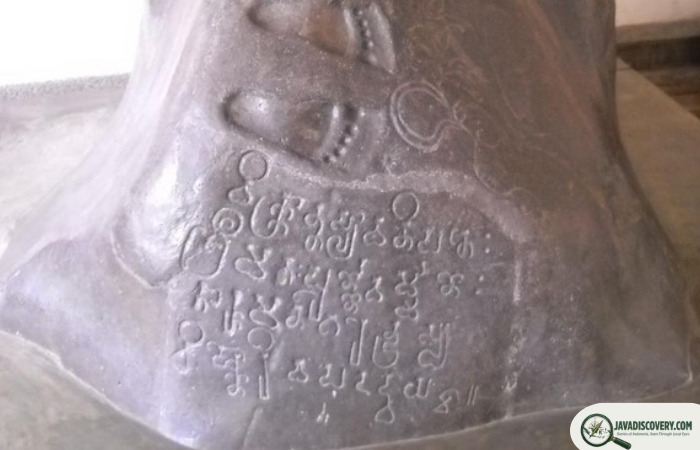
javadiscovery.com – Long before the rise of Central Java’s monumental stone temples or East Java’s maritime empires, the river valleys of West Java witnessed the dawn of written history in the Indonesian archipelago. During the 4th and 5th centuries CE, the kingdom of Tarumanagara flourished along the alluvial plains stretching from modern Bogor and Bekasi to the coastal shores of Jakarta. At the helm of this early Hindu polity was King Purnawarman, a visionary ruler who immortalized his royal decrees, hydraulic feats, and martial triumphs not on fragile palm leaves, but directly onto massive river boulders (*prasasti*). Inscribed in classical Sanskrit verse using the archaic South Indian Pallava script, these riverbed rock inscriptions represent West Java’s oldest surviving written documents, offering an extraordinary window into early statecraft, sacred river geography, and Vedic religious assimilation.
Deciphering the stone inscriptions of Tarumanagara reveals how an ancient kingdom harnessed hydraulic engineering and divine kingship to transform the landscape of early Java.
The Epigraphic Landscape: Boulders in the Sacred Waters
Unlike later Javanese inscriptions carved onto portable stone stelae or royal copper plates (*pascat*), Purnawarman’s decrees were carved directly onto living volcanic boulders anchored in active riverbeds and mountain streams. This deliberate placement served both a practical and cosmic purpose:
- Prasasti Ciaruteun: Discovered at the confluence of the Ciaruteun and Cisadane rivers in Bogor, this famous boulder features four lines of Sanskrit verse accompanied by a prominent pair of deeply carved footprints (*pada*). The inscription explicitly compares King Purnawarman’s footprints to those of Lord Vishnu (*Vishnupada*), sanctifying the monarch as a living incarnation of the divine preserver whose step conquers and protects the realm.
- Prasasti Kebon Kopi (Tapak Gajah): Located near Ciaruteun, this stone displays a pair of massive elephant footprints framing a Sanskrit line. The text equates the royal war elephant *Airavata*—the mount of the Vedic thunder god Indra—with Purnawarman’s own military mount, projecting supreme martial authority over surrounding chieftaincies.
- Prasasti Jambu and Muara Cianten: Perched atop high ridges and river junctions in the hilly interior of Bogor, these inscriptions reinforce the king’s invincibility in battle and his role as the paramount sovereign (*rajadhiraja*) of West Java.
The Tugu Inscription: Ancient Hydraulic Engineering in Bekasi
While the mountain river boulders proclaim divine authority and martial glory, the Prasasti Tugu—discovered in North Jakarta/Bekasi—records one of the most remarkable civil engineering accomplishments of the ancient world. It provides the earliest written record of large-scale water management in Southeast Asia:
- The Chandrabhaga and Gomati Canals: The inscription records that in his 22nd regnal year, King Purnawarman commanded the digging of a massive canal named *Gomati*, measuring 6,122 rods (approximately 11 to 12 kilometers), completed in just 21 days. This followed an earlier channel project along the *Chandrabhaga* River (likely the linguistic ancestor of modern *Bekasi*).
- Dual-Purpose Infrastructure: Designed to channel seasonal monsoon floodwaters safely out to the Java Sea, the canal system simultaneously provided gravity-fed irrigation for lowland rice cultivation and created a navigable inland waterway connecting inland royal settlements directly to coastal trade routes.
- Vedic Consecration Rituals: Upon the canal’s completion, King Purnawarman celebrated with a grand Brahmanical ritual (*yajna*), gifting 1,000 decorated cows to local priests (*brahmanas*)—a ceremony reflecting the deep integration of Indian Vedic ritual purity with indigenous Javanese water veneration.
Sanskritisation and Indigenous Kingship
The Tarumanagara inscriptions demonstrate a sophisticated synthesis between imported Indian political concepts and West Javanese coastal culture. Rather than a result of foreign conquest, the adoption of Sanskrit and Pallava script points to an active intellectual exchange led by local rulers:
- Courtly Sanskrit Literature: The precise Sanskrit meter used in the inscriptions (primarily *Anustubh* and *Sardulavikridita*) reveals that 5th-century West Javanese courts employed highly educated scholars capable of composing classical Sanskrit poetry according to rigorous Indian prosody standards.
- Local Adaptation: By carving Sanskrit decrees onto sacred natural river stones, Purnawarman skillfully blended the Hindu concept of *Chakravartin* (universal ruler) with ancestral Sundanese beliefs regarding the spiritual energy (*kesaktian*) anchored in rivers, mountains, and stone monoliths.
Preservation and Legacy of West Java’s Earliest Records
Today, the stone inscriptions of Tarumanagara are preserved within protected site museums and national heritage archives, attracting epigraphers, historians, and visitors from around the world. They stand as enduring monuments to a time when West Java was an active, sophisticated participant in the global maritime trade networks of the Indian Ocean.
More than fifteen centuries after Purnawarman’s stonemasons chiseled their final verses into river boulders, the decrees of Tarumanagara continue to speak—a timeless testament to the power of water, faith, and the written word in shaping the dawn of Java.