Through Teak and Pine to South Malang’s Quiet Bantol Beach

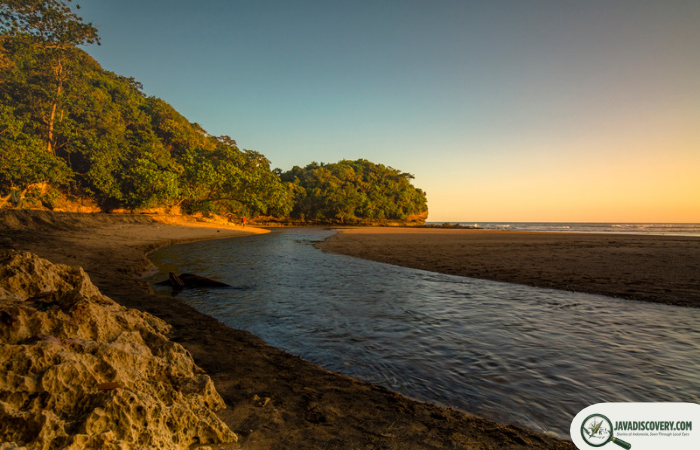
The road to Bantol Beach announces trees before it announces the sea. Travelers describe a forest corridor of teak and pine, a stretch of green that feels like a small expedition, and then the trees open onto a shore few people have written about at length.
Bantol lies in Desa Banjarejo (desa, a village), Kecamatan Donomulyo (kecamatan, a district), Kabupaten Malang (kabupaten, a regency), on the Indian Ocean coast of East Java. It is a small cove with pale brown sand, a reef offshore and cliffs of coral rock, and it is quieter than most of its famous neighbors.
A Road Through Teak and Pine
A village profile places Banjarejo about 50 kilometers south of Malang city centre. From the village centre, one local description puts the beach roughly 10 kilometers and about 20 minutes away, on a road of packed earth and makadam, a surface of compacted crushed stone.
Those figures come from a general description, not a measured survey, and a rocky forest track changes with the seasons. Anyone planning a visit should treat the distances as approximate.
The route has a working life of its own. A regional travel listing reports that the road also serves trucks hauling timber and fruit, and that residents of Banjarejo agreed to widen it and lay a stone surface. The way to Bantol was shaped as much by forest and farm as by tourism.
Banjarejo, at the Edge of the South Coast
Banjarejo’s own village profile offers an origin story. During the conflict between Mataram and the Dutch, it says, displaced families fled to the southern Malang area then known as Wonolopo. They carried out babad alas, the clearing of forest to open a settlement, and named it Wonokerto.
The same profile says the name Banjarejo reflects settlements arranged in rows, along with a hope that the community would prosper. This is the village’s account, and it has not been checked against archival records, so it is best read as local tradition.
Bantol is one of several beaches in Donomulyo, a district whose coastline also holds Ngliyep and Modangan. Many beaches along this stretch of South Malang are known for big surf, which is part of what makes a sheltered cove stand out.
The Beach Behind the Reef
Reports from the area describe a beach of whitish-brown sand, with cliff and reef rock framing the water. The waves are said to be gentle because reef rock offshore breaks the swell before it reaches the shore.
That shelter gives Bantol its character. The sea arrives softened, and visitors can wade or sit at the water’s edge in a way that is not possible on many exposed beaches nearby.
The Natural Pool
The detail that sets Bantol apart is a pool-like lagoon. Hollows in the reef rock fill slowly with seawater, creating a shallow basin that families with small children favor. Small caves and sculpted rocks nearby draw photographers.
Calm water inside the reef does not remove the ocean’s risks. The April 2025 report notes there were no lifeguards at the beach, and the open Indian Ocean lies just beyond the reef.
What “Hidden” Really Means
Bantol is often called a hidden gem, but it is not invisible. The beach has an Instagram presence and appears in regional roundups of lesser-known coasts. Its quiet is a matter of degree, with fewer visitors than the famous beaches nearby but not none.
It is also a working shoreline. A regional listing notes that the site suits anglers after fish and lobster, a reminder that this coast belonged to fishers and villagers long before it became a destination.
Much of the seclusion comes from the road itself. A forest track of stone and earth slows everyone down, and a slow arrival filters the crowds.
Visiting Without Spoiling It
As of the April 2025 report, the beach had a parking area, a small food stall, a public toilet and a few simple lodgings. The same report advises visitors to bring their own drinking water and snacks.
We could not verify entry fees, opening hours or the current state of the road. Conditions at small village beaches change quickly, and the Banjarejo village office or the district tourism office is the right source for up-to-date details.
Quiet places stay quiet through small habits. Carrying out every piece of litter, keeping to the shallows and giving the reef rock room to stay intact all help a village beach that has no lifeguard and little infrastructure.
At Bantol, the sea does not arrive with a roar. It comes through a gap in the trees and settles behind a reef, a reminder that some of the south coast’s best moments depend on how slowly you get there.
Writer: Sari Mahendra