The Simplicity and Depth of Baduy Daily Life

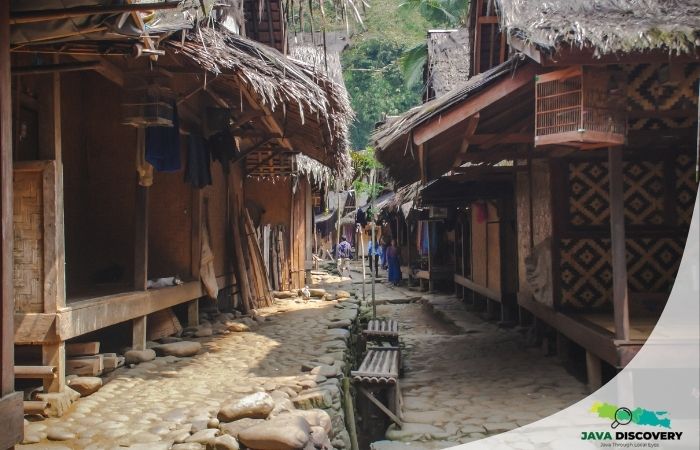
javadiscovery.com – Tucked away in the rolling green hills of Lebak, Banten, lies one of Java’s most remarkable enclaves — the land of the Baduy. Shielded by forested mountains and guided by ancient wisdom, the Baduy people live a life that appears simple from the outside but is deeply spiritual and philosophically rich at its core.
The Land and the People
The Baduy, or Kanekes people, inhabit the Kendeng Mountains in the province of Banten, far from the chaos of modern Java. Their villages, surrounded by terraced fields, bamboo forests, and rivers, are divided into two groups: Baduy Dalam (Inner Baduy) and Baduy Luar (Outer Baduy). While the Inner Baduy strictly forbid contact with outsiders and modern conveniences, the Outer Baduy act as a bridge — preserving core traditions while cautiously interacting with the outside world.
Simplicity as a Way of Life
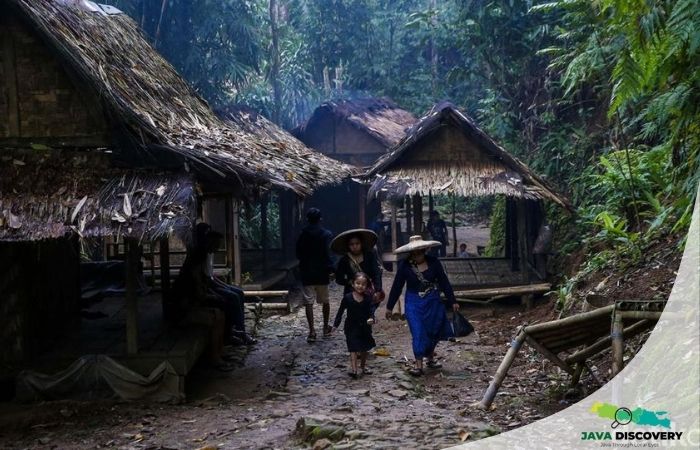
Life in Baduy unfolds in a rhythm shaped by nature. The people wake with the sunrise, tend to their fields, weave fabrics, and walk barefoot through the hills. Their houses, built from bamboo and palm thatch without a single nail, stand as testaments to harmony with the earth. They reject plastic, electricity, and motorized transport — not out of limitation, but by choice.
For the Baduy, simplicity is not a lack of progress. It is a form of wisdom — a way to stay humble and connected to the natural world. In their silence lies an unspoken lesson: that happiness and peace come not from possession, but from presence.
Sacred Rules and Spiritual Harmony
Every aspect of Baduy life follows pikukuh karuhun, the sacred ancestral law that dictates how they should live in balance with nature and one another. They are forbidden from cutting down trees recklessly, mining the earth, or polluting water sources. The forest, in their belief, is not a resource but a living ancestor — a guardian that sustains and must be protected.
Electricity, machines, and modern tools are considered distractions from the natural order. The Baduy believe that purity of life brings spiritual strength, and simplicity keeps them close to Gusti Allah — the Divine.
The Social Fabric of the Community
In a world without written laws, the Baduy rely on collective wisdom and respect. Decisions are made through consensus, guided by the Pu’un — the spiritual leader who embodies both moral and communal authority. Daily life revolves around mutual cooperation, known as gotong royong, ensuring that no one is left behind.
There are no police, no written constitutions, and no political debates — only trust, responsibility, and shared purpose. This quiet order stands as a reminder that civilization can flourish without noise or complexity.
Encounters with the Modern World
Despite their isolation, the Baduy are not entirely cut off from the modern world. The Outer Baduy occasionally welcome respectful visitors and sell woven cloths and handmade crafts to sustain their community. Yet every interaction is guided by firm boundaries. Cameras and electronic devices are strictly prohibited within the Inner Baduy territory, preserving their sanctity from the reach of modern eyes.
Visitors often describe their experience as humbling — a journey not only into another culture but into the very essence of what it means to live meaningfully.
Reflections on a Lesson from the Baduy
To see the Baduy is to see the mirror of what humanity once was — and perhaps, what it still needs to be.
In their quiet forests and barefoot paths lies a philosophy the modern world is slowly forgetting: that peace is found not in progress, but in balance. The Baduy people, with their timeless restraint and profound humility, remind us that simplicity can be the deepest form of wisdom — and that true richness is measured not by what we own, but by what we understand.
Through the Baduy, we are reminded that to live simply is to live fully — in harmony with oneself, with others, and with the earth that sustains us.