How the Majapahit Empire United the Archipelago

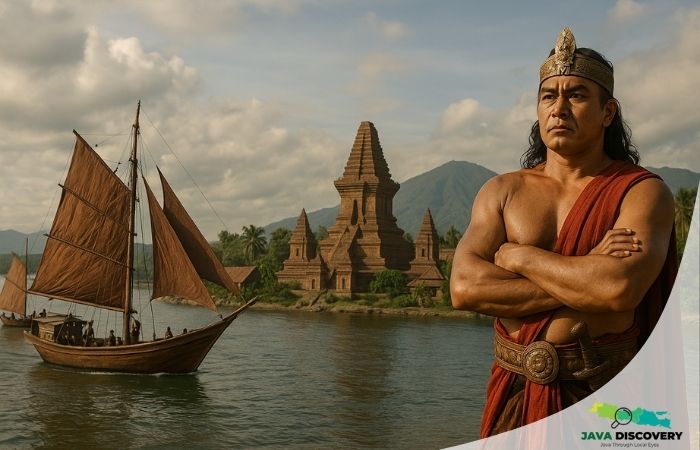
javadiscovery.com – Long before the word “Indonesia” existed, a vast constellation of islands scattered across the equator thrived with independent kingdoms. Each had its own ruler, language, and belief system. But in the heart of Java, a dream emerged—a vision to unite these islands under one spirit, one destiny. That dream would become the Majapahit Empire.
The Dream of a Unified Nusantara
Before Majapahit’s rise, the archipelago was a mosaic of maritime kingdoms—Sriwijaya in Sumatra, Kediri and Singhasari in Java, and countless coastal polities engaged in trade and rivalry. Yet amid this diversity, the idea of a “Nusantara”—a connected island world—began to take shape. It was not merely political; it was civilizational. The seas that separated the islands were also the threads that bound them together.
The Rise of Majapahit
The story began in 1293, when Raden Wijaya, a noble descendant of Singhasari, turned a foreign invasion into an opportunity. After defeating Kublai Khan’s Mongol troops with strategic cunning, he established a new capital in East Java, naming it Majapahit—after the bitter *maja* fruit found near the Brantas River. From this humble beginning grew one of the greatest empires Southeast Asia had ever known.

Gajah Mada and the Oath of Unity
No figure embodied the Majapahit dream more than Gajah Mada, the empire’s legendary prime minister. In the 14th century, he declared his famous Sumpah Palapa—a vow not to taste spices or rest until the entire Nusantara was united under Majapahit’s rule. It was a statement of both ambition and destiny.
Under his leadership, Majapahit expanded its reach far beyond Java. Through military expeditions and strategic diplomacy, it gained influence over Bali, Sumatra, Kalimantan, Sulawesi, the Malay Peninsula, and even parts of the Philippines. Yet, it wasn’t just conquests that defined Gajah Mada’s success—it was the art of alliance, the power of persuasion, and the shared cultural identity that began to weave the islands together.
Trade, Diplomacy, and Cultural Integration
Majapahit’s strength lay not only in its armies but in its ships. From Trowulan, the empire’s capital, fleets sailed to distant ports, exchanging spices, textiles, ceramics, and ideas. Trade routes became arteries of connection, carrying both wealth and cultural values across the seas. The court of Majapahit was a cosmopolitan world, where Javanese nobles mingled with envoys from Champa, China, and India.
This fusion of influences nurtured a distinctive culture—Hindu-Buddhist in foundation, yet deeply rooted in local traditions. Literature like Nagarakertagama and Sutasoma celebrated tolerance and unity, reflecting a society that saw harmony as its highest virtue.
The Symbolic Unity of Nusantara
Majapahit’s true achievement was not only territorial expansion but the creation of an identity. The concept of Nusantara—first articulated during this era—imagined the islands as one interconnected realm. In Sutasoma, Mpu Tantular wrote the phrase that would centuries later become Indonesia’s national motto: Bhinneka Tunggal Ika—“They are different, yet they are one.”
Through this idea, Majapahit transcended the boundaries of geography and politics, offering a vision of unity that still defines Indonesia today.
The Legacy of Majapahit Today
Though the empire eventually declined in the 15th century, its legacy endures. In the ruins of Trowulan, red-brick temples and ancient waterworks whisper of its grandeur. In the Indonesian coat of arms, the Garuda still carries the words Bhinneka Tunggal Ika—a direct echo of Majapahit’s philosophy.
The Majapahit Empire may have faded into the mists of time, but its dream lives on—in the unity of a nation built on thousands of islands, languages, and hearts, all bound by one timeless idea: the spirit of Nusantara.