The Man Who Planted Hope on Mount Lawu’s Slopes

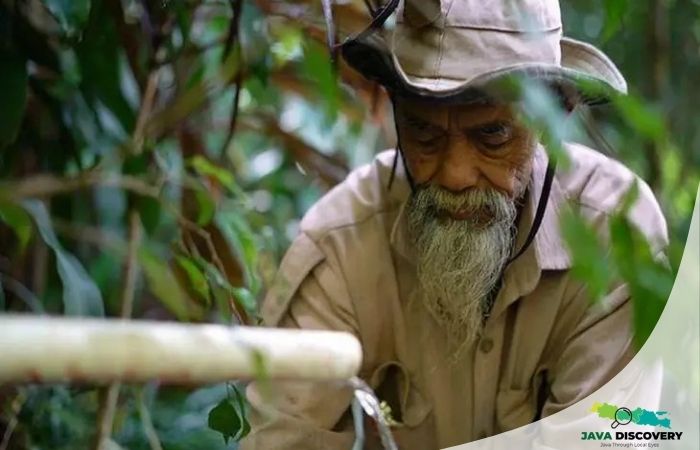
javadiscovery.com – “People used to call me crazy for bringing banyan saplings to the village,” recalled Sadiman, a humble farmer from the southern slopes of Mount Lawu. “They believed spirits lived in those trees.”
Planting Banyan Trees for Water
Among countless species he could have chosen, Sadiman devoted his life to planting beringin — the banyan tree — believing it could restore the region’s water sources. For him, this was not superstition, but science and experience. “Banyan and ficus trees can store water,” he said, understanding their deep ecological value.
The banyan’s vast network of hanging and fibrous roots allows it to absorb rainwater and release it slowly into the ground. This natural reservoir effect transforms the soil into a living sponge, vital for sustaining life in dry, degraded lands.

“If I don’t plant banyan trees,” Sadiman thought, “this land will turn to dust.”
The Sacred and the Spiritual
In Javanese belief, the banyan tree is more than a plant — it is a sacred being. Many believe spirits dwell beneath its shade, making people fearful of disturbing it. Yet such reverence has a deeper meaning: respect for nature’s mystery and power.
Across Java, ancient rituals still take place under the shade of banyan trees. Offerings and prayers symbolize harmony between the human and unseen worlds — a reflection of the Javanese philosophy that nature, humanity, and spirit are one continuum.
Memories of a Vanished Stream
Sadiman’s environmental calling was born from memory. As a boy, he played near clear springs that gushed from the forest. But deforestation and the great fire of 1964 turned the once-green hills barren. “In the rainy season, floods; in the dry season, no water,” he said.
In 1996, driven by desperation and faith, he began planting banyan saplings on parched hillsides. To buy them, he sold his goats. “People laughed at me,” he smiled. “Trading goats for trees sounded mad.” But he kept planting — quietly, patiently, for decades.
Today, over 15,000 banyan and ficus trees flourish across 250 hectares of Mount Lawu’s southern flank. Springs have returned. Rivers flow again. Villages that once queued for water now irrigate their fields freely.
“He was once called crazy,” said Warto, a villager. “Now we call him wise. Because of him, we have water again.”
From a Wanderer to a Guardian of the Mountain
Born in the 1950s, Sadiman’s early life was shaped by poverty. After finishing primary school, he delayed further study to work and later wandered to Surabaya, Lampung, and even Central Kalimantan. Everywhere he went, he saw the same story — water scarcity and dying land.
When he finally returned to Wonogiri in 1991, the hills were dry, and life was hard. He worked as a pine sap tapper for just 125 rupiah per kilogram of resin. Yet his time in the forest taught him something vital: pine trees shed dry leaves that don’t enrich the soil. They didn’t bring back water.
Observing that banyan trees always grew near natural springs, he realized the connection — where there is banyan, there is life. “Rather than exploiting trees,” he said in Javanese, “better to make them thrive.”
Passing the Torch
Now an old man, Sadiman no longer climbs alone. Young villagers like Srianto have joined him, continuing his legacy. While many youths leave for the cities, they choose to stay — to plant, water, and nurture the forest.
“People say, ‘Why follow the old man?’” Srianto laughed. “But I’ve seen his work. Because of him, we have water. I want to continue that.”
On the slopes of Mount Lawu, what began as a lonely mission has become a movement — proof that one man’s persistence can revive not only the forest, but the spirit of a community.