Gua Butha Bondowoso’s Cultural Soul Through Ijen Geopark

javadiscovery.com – When people hear the name Bondowoso, they often picture steep coffee terraces reaching into fog or the blue fires that linger at the rim of Kawah Ijen. But crouched in the teeth of Hyang’s limestone escarpments there is a different kind of vastness—a quiet interior carved in stone, older than the coffee harvest and even the volcano’s breath. This is Gua Butha: not merely a cave but a carved chronicle of spiritual practice, a folded chapter of Majapahit-era contemplation brought into the light again by Ijen Geopark.
The first impression: stone that speaks
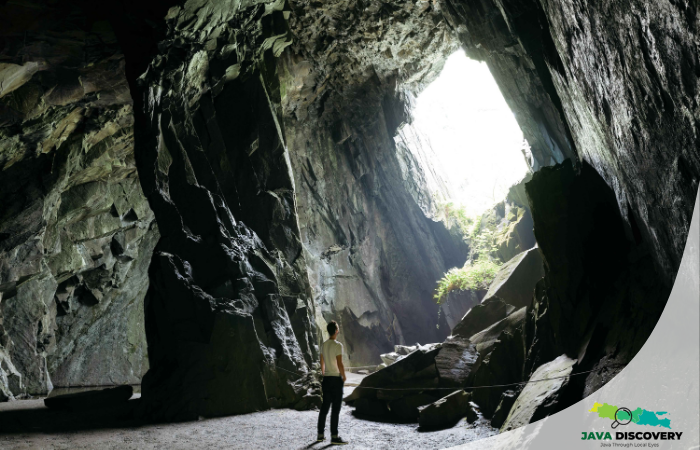
Climb past tea-stained ridgelines and a thin track where mountain wind combs through thorny shrubs, and the cliff opens like a throat. The air shifts—the metallic smell of rock, the faint sourness of lichen, and a cooler hush as if the stone itself is inhaling. From a distance you see a face hewn directly into the cliff: a giant Kala whose eyes are carved wide and unblinking, its mouth a raked aperture. For villagers who live under these cliffs, the first sight of Kala is less spectacle than summons—an immediate sense that this place has an order of its own.
More than a monster
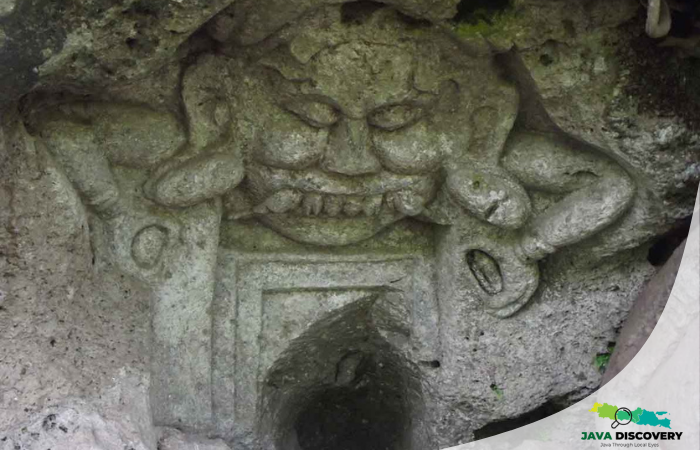
Kala often frightens modern imagination; to unfamiliar eyes it is grotesque, a guardian from a different grammar of belief. But in the language of Java’s older temple architecture Kala is a secular sentinel—a guardian of thresholds who consumes impurity before it can cross into a consecrated ground. The Kala at Gua Butha reads not as malevolence but as ritual hospitality: a baritone that says, “Enter with reverence.”
Carvings, context and a date in stone
Inside the sheltered folds beyond Kala’s teeth, the cliff face is a gallery. Petal-like lotus buds, seated figures with knees drawn under them, and linear incisions that arrange space like a script—these reliefs speak of disciplined solitude. At Sumber Canting a carved inscription bears a Saka date that researchers link to 1394 CE. That single number anchors the site to the late Majapahit horizon, a moment when volcanic kingdoms still cast shadows across Java and when ascetic practices threaded into everyday life.
The presence of lotus iconography, meditative postures, and other Buddhist motifs suggests that Gua Butha was not an accidental shelter but a deliberate pertapaan, a place chosen for renunciation and concentrated practice. The sculpture placement, the direction the figures face, and the little niches cut into the rock indicate a choreography of devotion designed for one or a few practitioners rather than a mass congregation.
Topography as spiritual grammar
Why hide sanctity so high in a 70-degree rock face? The choice is instructive. Access that is hard to negotiate protects the interior life of the place. To reach the cave by the older, unmodified routes is to undergo a physical pruning—the world’s noise narrows into a single attentive body. The steepness, the leaden weight of clouds on the ridge, the distant clatter of a goat—these are more than obstacles, they are part of a ritual syllabus. The path itself becomes a preliminary practice.
Most remarkable, given the region’s often brittle soil, is a perennial spring at the base of the cave’s recess. In the dry season local guides still point to a trickle that refuses to fail. For the meditator of old, water in a barren place is more than resource; it is metaphor—life found within austerity, a living echo of the inner resources cultivated in solitude.
Voices of Bondowoso: guardians of story
The awakening of Gua Butha from local memory into broader recognition has not come from museums but from people who live next to the rock. I spoke with Pak Suyono, a farmer from Desa Jirek Mas, as the afternoon sun leaned gold across the slopes.
“My grandmother used to say we must not shout near the Kala,” he told me, squinting at the carved face. “She said the stone remembers. For us it was always a place to pass quietly. Now the world comes to listen.”
Nearby, a young woman from Kelompok Sadar Wisata—who has become one of the site’s interpreters—described how villagers are learning to hold the line between protection and exposure. “We want people to know the story,” she said, “but the story must not be sold like merchandise. The rock is older than our curiosity.”
Local stewardship and fragile preservation
That tension—between revealing and preserving—has shaped how Ijen Geopark has chosen to present Gua Butha. Unlike high-traffic sites dressed for mass visitation, the geopark proposes a restrained approach: controlled access, trained local guides, and small-group visits focused on education and research. This is not a marketing ploy but a curatorial judgment. The reliefs are weathered; minor vandalism scars some panels; lichen colonizes the edges of ancient chisels. Without careful mediation, the very act of looking can accelerate loss.
Gua Butha inside a living landscape
Cultural heritage does not exist in a vacuum. Around Gua Butha the landscape is layered—coffee gardens scenting the lower slopes, scrubby pasture where grasshoppers chatter, patches of secondary forest holding the slow wood-scent of moss and earth. Mountain weather arrives in theatrical waves: a sunlit morning can dissolve within an hour into a cloud that draws a thin veil over the Kala. People here live with both the practical routines of farming and a certain attentiveness to the land’s stories.
Ijen Geopark’s inscription into the UNESCO Global Geopark network has been a reframing device. It asks viewers to consider geodiversity and biodiversity alongside cultural diversity. For Bondowoso this framing allows Gua Butha to be seen not as an isolated curiosity but as a node in a larger ecology of meaning—where geology, water, ritual practice and local memory make a composite heritage.
The archaeology of silence
Walking the slabbed corridors of the site, I found silence to be as much an artifact as any relief. The absence of constant human noise is a field condition that preserves perceptual nuance: the tick and sway of a cicada, the distant bleat of a goat, the breath of wind through a fern. To document a meditative site is to account for the way silence itself shapes practice—how it narrows attention and consecrates the body’s minute sensations.
Archaeologists have cataloged tools of devotion—small hollows that once held offerings, recessed seats worn by repeated posture, lines of soot from past ritual fires. These elements narrate acts of attention stretched across generations. They suggest that Gua Butha’s power lay not in conspicuous splendor but in the patient accumulation of individual labor and devotion.
Between the archive and the present
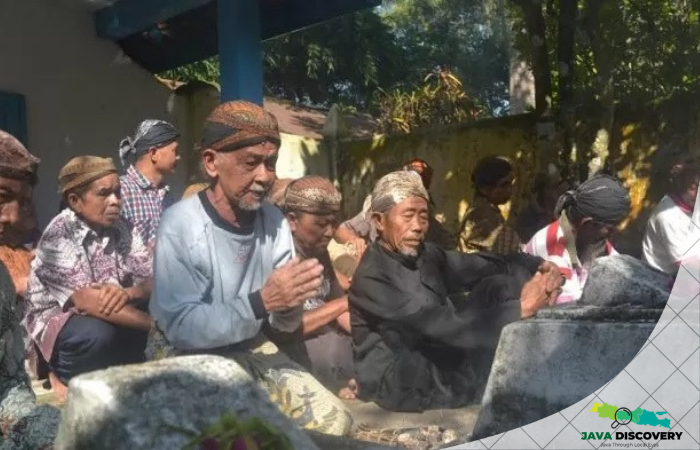
One of the more poignant discoveries is how present-day ritual and memory interweave with older inscriptions. Some villagers still use the site for quiet prayer; others make a brief stop with offerings of simple rice cakes and flowers, gestures that reanimate rather than replicate past rites. Such practices are not a reenactment of Majapahit liturgy; they are contemporary threads in an ongoing relationship with a place that resists total assimilation into the calendar of tourist spectacle.
Preserving complexity
The geopark’s stewardship model leans on layered involvement: local communities as custodians, researchers as interpreters, and visitors as students rather than consumers. This model recognizes that preserving Gua Butha is not merely about protecting stone from decay. It is about guarding a mode of inhabiting a place that privileges humility, slowness and a measured curiosity.
Here, every step taken by a visitor is an ethical choice. How loud will our footsteps be? What intentions do we carry? Gua Butha’s Kala seems to demand such reflection. It is not a gate that excludes but a threshold that asks the heart to thin—an ancient practice still legible in the rock.
What Gua Butha teaches today
If Ijen Geopark has given Gua Butha a wider stage, the cave’s true lesson is quieter. It reminds us that cultural landscapes are palimpsests—layers of meaning scraped and rewritten over centuries. It shows how ritual practices were attuned to the wildest reaches of the island, and how the human impulse to seek silence and refine attention can leave marks as durable as basalt.
In Bondowoso, where coffee steals the headlines and the blue fire of Ijen captures imaginations, Gua Butha returns us to fundamentals: the centrality of place in shaping belief, the ways stone can hold memory, and the responsibility of the living to care for what was once entrusted to them. For those who come, the cave does not offer spectacle so much as a proposition—to listen, to slow, and to learn from a site that has been teaching for more than six hundred years.