Wayang Kulit The Shadow Theatre That Teaches Life in Java

The Night When Shadows Begin to Speak
javadiscovery.com – As dusk settles over a Javanese village, the air changes texture. The heat of the day loosens its grip, replaced by the faint coolness of evening and the smell of damp earth. Somewhere nearby, a rooster calls out of habit, confused by the glow of oil lamps being lit one by one. People drift toward an open pavilion, bringing woven mats, snacks wrapped in banana leaves, and a readiness to sit for hours. Tonight, shadows will speak.
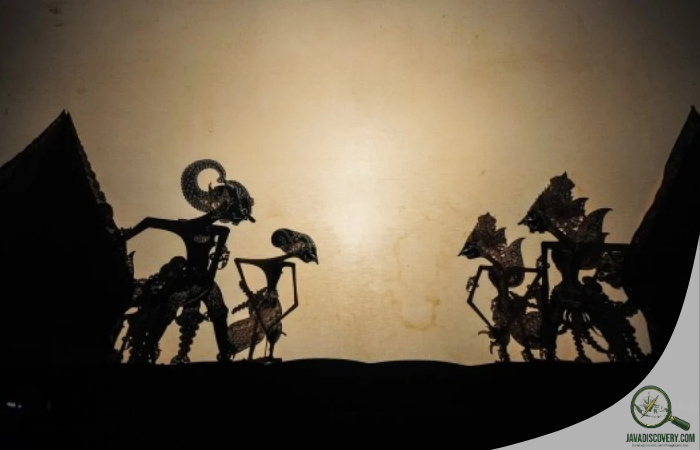
At the center of the space stands a white cotton screen, stretched tight and glowing softly from a single lamp behind it. This is the kelir, the boundary between the visible and the unseen. Behind it, leather puppets are arranged carefully, their elongated limbs and intricate perforations catching the light even before the story begins. This is Wayang Kulit, Java’s shadow theatre — an art form that has endured for centuries not because it entertains, but because it teaches.
Wayang Kulit is not consumed in fragments. It unfolds slowly, patiently, over the course of a full night. Children fall asleep and wake again. Elders listen with half-closed eyes. Laughter rises, then silence, then the metallic shimmer of a gamelan gong marking a turn in fate. The stories told here are ancient, but their lessons are intimate, directed not at kings or heroes alone, but at anyone living a human life.

Leather, Light, and the Language of Symbols
The puppets themselves are made from water buffalo hide, cured, carved, and painted by hand. Each figure takes weeks to complete. Tiny holes punched into the leather are not decorative accidents; they are deliberate channels for light, shaping shadows that ripple with movement and meaning. Gold leaf glints at the edges. Reds, blacks, and whites are chosen not for realism, but for symbolism.
In Wayang Kulit, appearance is moral language. Noble characters have refined features: narrow eyes, slender noses, downward gazes. They move slowly, with restraint. Rough characters — giants, demons, volatile warriors — are wide-eyed, sharp-toothed, and loud in both form and motion. The audience understands these cues instinctively. No explanation is needed.
The puppets do not face the audience directly. Instead, they face inward, toward the light, toward the dalang, the puppet master who animates them. What the audience sees is not the object itself, but its shadow — a reminder that truth, in Javanese philosophy, is often indirect.
The Dalang as Storyteller, Philosopher, and Witness
Seated cross-legged behind the screen is the dalang, alone and central. He manipulates dozens of puppets, cues the musicians, narrates the story, voices every character, and interprets ancient texts in real time. His hands move constantly, tapping wooden boxes, shifting figures, signaling transitions. His voice changes texture and pitch, becoming king, clown, god, and monster within seconds.
Traditionally, the dalang is more than a performer. He is a moral interpreter, a cultural historian, and often a quiet social critic. In the middle of an epic drawn from the Mahabharata or Ramayana, he may insert commentary about current events, local concerns, or human weaknesses. The audience laughs, but the message lands.
Becoming a dalang requires years of study — memorizing stories, mastering vocal techniques, learning philosophical frameworks, and understanding ritual protocols. Some dalang describe their role not as controlling the story, but as listening to it, allowing it to move through them.
Stories That Mirror Human Struggle
At the heart of Wayang Kulit are stories of conflict — not only between good and evil, but within the self. Heroes hesitate. Villains express doubt. Gods make mistakes. The most celebrated characters are not flawless, but thoughtful.
Figures like Arjuna embody inner discipline and restraint, while Bima represents physical strength tempered by loyalty. Their struggles are not abstract. They face moral dilemmas recognizable to anyone: loyalty versus truth, power versus humility, desire versus duty.
Interwoven with these epic figures are the punakawan, the clown-servants unique to Javanese Wayang. Semar, Gareng, Petruk, and Bagong are humorous, awkward, and deeply human. They speak in everyday language, joke about hunger and hardship, and offer wisdom disguised as foolishness. Semar, in particular, is both servant and divine presence — a reminder that truth often arrives in humble forms.
Sound as Emotional Architecture
Wayang Kulit is inseparable from the gamelan orchestra that accompanies it. Metallophones, drums, gongs, and flutes weave a sonic landscape that guides emotion more than action. A slow, low gong signals reflection. Rapid rhythms announce battle or chaos. The music breathes with the story.
Singers, often women, enter with elongated, floating melodies that stretch time. Their voices carry melancholy, longing, and calm in equal measure. Even listeners unfamiliar with the language feel the emotional contour. The sound does not explain; it envelops.
The dalang listens constantly, adjusting pacing to the mood of the music and the audience. In this way, Wayang Kulit remains a living performance, never identical from one night to the next.
Ritual, Spirituality, and Cosmic Balance
Beyond entertainment, Wayang Kulit holds ritual significance. Performances are often held to mark life transitions — births, marriages, harvests, or communal rites. Certain stories are chosen for their symbolic alignment with the occasion.
The performance space itself reflects a cosmological map. The screen divides the seen from the unseen. The lamp represents divine light. The dalang sits at the axis, mediating between worlds. Nothing is accidental.
In Javanese belief, life is about maintaining balance — between desire and restraint, chaos and order, the individual and the community. Wayang Kulit dramatizes this balance not through sermons, but through narrative consequence. Actions echo. Choices matter.
Colonial Shadows and Cultural Survival
During the colonial period, Wayang Kulit became a quiet vessel of resistance. While overt political speech was dangerous, allegory was safe. Stories of unjust rulers and moral decay resonated deeply. The dalang’s commentary became sharper, though still veiled.
Despite pressures from modernization, religious reform, and shifting entertainment habits, Wayang Kulit endured. In some regions, performances adapted, shortening duration or incorporating new themes. In others, tradition remained fiercely protected.
What allowed Wayang Kulit to survive was not rigidity, but depth. It continued to offer something modern life often lacks: a space for reflection, ambiguity, and collective listening.
Wayang Kulit in Contemporary Java
Today, Wayang Kulit exists in multiple forms. Some performances are staged for festivals or cultural preservation. Others remain deeply local, tied to village calendars and family histories. Younger dalang experiment cautiously, introducing contemporary references while respecting narrative structure.
Audiences have changed, but the core experience remains. Even now, people sit for hours, allowing the slow rhythm to recalibrate their attention. In a world of rapid consumption, Wayang Kulit insists on patience.
Its relevance lies not in nostalgia, but in its refusal to simplify life. It acknowledges contradiction, honors doubt, and suggests that wisdom emerges through endurance.
When the Lamp Finally Goes Dark
As dawn approaches, the final scene resolves. The puppets are returned to their places. The lamp is extinguished. Shadows dissolve into morning light. People stand, stretch, and begin to talk quietly about what they heard.
No conclusion is announced. No moral is underlined. Yet something lingers — a line of dialogue, a gesture, a pause before a decision. Wayang Kulit does not instruct directly. It leaves space for interpretation.
In that space, life continues, slightly altered by the memory of shadows that once spoke truth through silence.