Natural Boundaries Between Villages in Javanese Landscapes

javadiscovery.com – At first glance, the transition from one village to another in rural Java is almost imperceptible. There are no gates, no walls, no signs announcing arrival or departure. A footpath continues uninterrupted, rice fields stretch in quiet continuity, and houses appear in familiar forms. Yet for those who live there, the boundary is clear. It is understood, remembered, and respected, even when it cannot be easily seen.
These boundaries are rarely drawn by straight lines or artificial markers. Instead, they are shaped by the land itself. A narrow river winding through the fields, a cluster of old trees standing at the edge of cultivation, a subtle change in elevation or soil. These natural features define the limits of one community and the beginning of another.
In Java, boundaries are not only spatial divisions. They are part of a relationship between people, land, and memory.

The Landscape as a Divider
Natural boundaries emerge from the physical characteristics of the environment. Rivers, ridges, forests, and irrigation channels create divisions that are both practical and recognizable.
These features are not chosen arbitrarily. They are part of the landscape long before administrative systems formalize them.
Villages develop around these features, growing within spaces that are naturally defined.
Over time, these divisions become embedded in local understanding.
Rivers as Living Borders
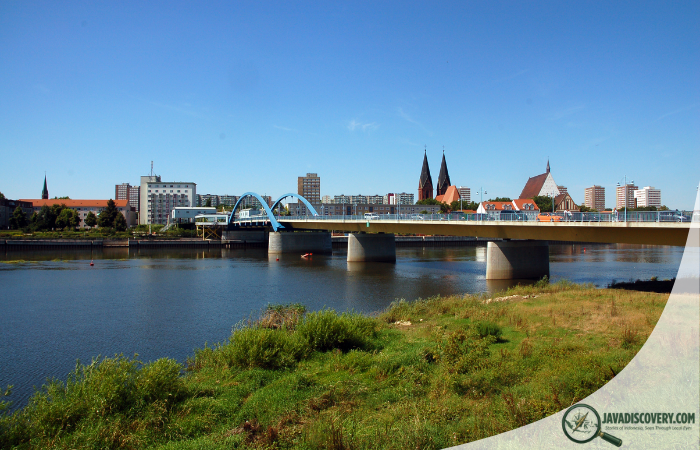
Rivers are among the most common natural boundaries between villages in Java. Their flowing water creates a clear physical separation.
Crossing a river often marks a transition, even if the distance is short. Bridges or stepping stones become points of connection between communities.
At the same time, rivers are shared resources. They provide water for irrigation, support ecosystems, and serve as gathering places.
This dual role creates a boundary that separates while also connecting.
Trees and Sacred Markers
In some areas, large trees stand as boundary markers. These are often species that live for generations, their presence extending far beyond the lifespan of individuals.
Such trees may carry cultural or spiritual significance. They are not cut down, and their location becomes fixed in collective memory.
A single tree or a small grove can indicate where one village ends and another begins.
These markers are subtle yet enduring, rooted both physically and culturally.
Paths, Fields, and Invisible Lines
Not all boundaries are defined by prominent features. In many cases, they follow paths or edges of fields that appear continuous to an outsider.
A narrow footpath between rice paddies may serve as a dividing line, even though it looks identical on both sides.
Farmers know which plots belong to which village, guided by inherited knowledge and shared understanding.
These invisible lines are maintained through agreement rather than physical enforcement.
Boundaries and Social Identity
Village boundaries are closely tied to identity. They define not only territory but also community belonging.
People identify with their village, its history, and its social networks. Crossing a boundary can mean entering a different set of relationships and expectations.
This sense of identity is reinforced through daily interaction, shared activities, and collective memory.
Boundaries, in this sense, are social as much as they are geographical.
Conflict and Resolution
While natural boundaries often provide clarity, they are not immune to dispute. Changes in land use, population growth, or environmental conditions can create uncertainty.
In such cases, communities rely on dialogue and traditional mechanisms to resolve differences.
Elders, local leaders, and historical knowledge play important roles in determining where boundaries lie.
The goal is not only to define territory but to maintain harmony between neighboring villages.
Spiritual Dimensions of Boundaries
In Javanese cultural understanding, boundaries can also carry spiritual meaning. Certain locations at the edges of villages are associated with protection or transition.
Small shrines, offerings, or specific rituals may be placed at these points, acknowledging them as thresholds.
These practices reflect a belief that boundaries are not only physical spaces but also zones of interaction between visible and unseen elements.
Environmental Stewardship
Natural boundaries often contribute to environmental preservation. Areas such as riverbanks or groves may be left undisturbed, either for practical reasons or due to cultural beliefs.
This protection helps maintain biodiversity and ecological balance.
By respecting these boundaries, communities also protect the resources that sustain them.
Changing Landscapes
Modern development introduces new forms of boundary definition. Roads, infrastructure, and administrative mapping can alter traditional divisions.
In some cases, natural features are modified or replaced, leading to changes in how boundaries are perceived.
Despite these shifts, many communities continue to rely on traditional markers, maintaining a connection to the landscape.
A Shared Understanding
The effectiveness of natural boundaries depends on shared understanding. They are recognized not through signs or enforcement, but through agreement and memory.
This collective recognition allows boundaries to function without constant reinforcement.
It reflects a system where knowledge is distributed across the community, rather than centralized in formal structures.
Where One Village Becomes Another
Walking through rural Java, it is possible to cross from one village to another without noticing a clear change. The landscape remains consistent, the rhythm of life familiar.
Yet beneath this continuity lies a network of boundaries, shaped by rivers, trees, and subtle shifts in the land.
These boundaries do not interrupt the landscape. They are part of it, woven into its form and meaning.
In this way, the division between villages becomes less about separation and more about relationship. A way of organizing space that reflects both the physical environment and the social fabric of Javanese life.