Living Mangrove Barriers Brebes Coastal Defense Java Subsiding Land

javadiscovery.com – Along the low-lying northern shore of Central Java, the coastal regency of Brebes has long stood at the frontlines of a severe environmental crisis. Over the past three decades, a treacherous combination of rapid land subsidence, rising sea levels, and the historical conversion of natural coastal forests into commercial aquaculture ponds (*tambak*) caused the Java Sea to swallow thousands of hectares of fertile farmland, shrimp ponds, and entire coastal hamlets. Towns like Dukuh Timbulsloko and villages in the Kaliwlingi district faced imminent erasure as coastal erosion (*abrasi*) pushed the shoreline kilometers inland. Yet, rather than surrendering to the encroaching tides, the coastal communities of Brebes spearheaded one of the most resilient, grassroots ecological rescue initiatives in contemporary Indonesia: the creation of living mangrove barriers through community-led ecological restoration and bio-engineering.
Tracing the story of Brebes’s living mangrove walls reveals how local ecological knowledge, community solidarity (*gotong royong*), and green engineering are carving out a future against Java’s sinking coastlines.
The Sinking Pesisir: Genesis of a Coastal Crisis
The northern coast (*Pesisir*) of Central Java sits atop soft alluvial delta soil formed over millennia by river sediment deposition. In recent decades, human activities accelerated a dramatic environmental breakdown:
- Land Subsidence and Groundwater Extraction: Industrial expansion and excessive groundwater pumping across northern Java caused the land to sink by as much as 10 to 20 centimeters per year in vulnerable coastal belts.
- Removal of Natural Buffers: During the aquaculture boom of the 1980s and 1990s, dense mangrove belts (*Rhizophora* and *Avicennia* forests) were systematically cleared to construct fish and shrimp ponds, stripping the shoreline of its natural defense against wave energy.
- Inundation and Displacement: By the early 2000s, tidal flooding (*rob*) became a permanent reality. High tides regularly submerged homes, schools, and roads, forcing hundreds of families to abandon ancestral lands as saltwater intruded deep into freshwater wells.
Grassroots Action: The Rise of Mangrove Kaliwlingi
The turning point in Brebes came when local fishermen, farmers, and community leaders—most notably in the village of Kaliwlingi—recognized that concrete seawalls were too costly, rigid, and prone to collapsing into the sinking mud. The long-term solution lay in returning to nature’s original coastal guardians:
- Community Nurseries and Replanting: Local collectives established mangrove nurseries, cultivating millions of native *Rhizophora mucronata* and *Avicennia marina* seedlings. Villagers, including women’s cooperatives and local youths, worked knee-deep in tidal mud to plant seedlings in dense, strategic grid patterns along the receding shoreline.
- Permeable Brushwood Structures (Bio-Engineering): Collaborating with coastal engineers and environmental NGOs, villagers constructed permeable barriers made of double rows of bamboo poles filled with brushwood (*tanggul bambu*). These structures dissipated wave energy while allowing fine suspended sediment to settle behind them, creating elevated mudflats where mangrove seeds could naturally germinate and take root.
- Restoring the Sediment Trap: As the mangroves grew, their intricate stilt root systems acted as natural sediment traps, building up new land, trapping organic matter, and gradually raising the coastline relative to sea level.
Socio-Economic Rebirth: Ecotourism and Sustainable Aquaculture
The success of Brebes’s mangrove barriers went far beyond shoreline stabilization; it sparked a comprehensive socio-economic revival across coastal villages:
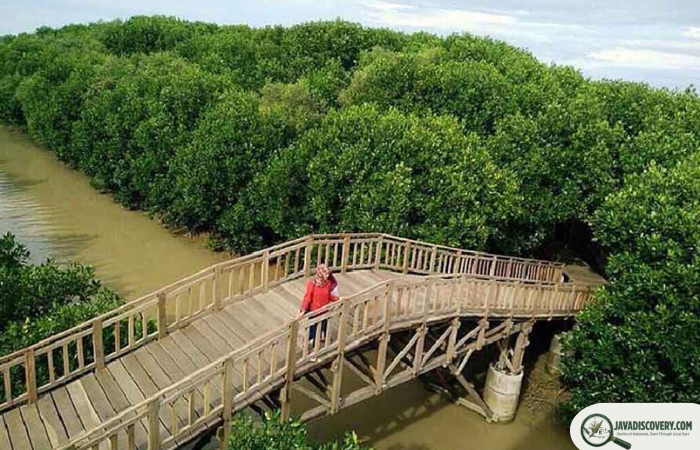
- Hutan Mangrove Kaliwlingi (Ecotourism Hub): The once-submerged wasteland of Kaliwlingi was transformed into a thriving mangrove ecotourism park (*Pandang Takasima*). Boardwalks winding through dense, green mangrove canopies now attract thousands of visitors, providing local families with alternative livelihoods as tour boat operators, guides, and food vendors.
- Silvofishery (Integrated Aquaculture): Villagers adopted *silvofishery* techniques, integrating mangrove trees directly into sustainable fish ponds. The natural detritus from mangrove leaves enriches the water, boosting populations of wild mud crabs, milkfish (*bandeng*), and prawns without requiring chemical fertilizers or synthetic feeds.
- Return of Coastal Biodiversity: The restored forest cover provided critical nesting grounds for migratory shorebirds and spawning habitats for marine life, rejuvenating local offshore fisheries that had collapsed during the era of degraded coastlines.
Legacy: A Green Model for Java’s Sinking Coastlines
The living mangrove barriers of Brebes offer a powerful, scalable model for coastal adaptation across Southeast Asia. They demonstrate that while engineering solutions like hard seawalls have their place, living ecosystems—nurtured by local stewardship—provide dynamic, self-healing defenses capable of adapting to rising seas and land subsidence.
In the face of daunting climate challenges, the people of Brebes have proven that by working in harmony with nature, communities can reclaim their land, safeguard their heritage, and build a sustainable green barrier for generations to come.