Horror Voices from Beside the Elephant Museum


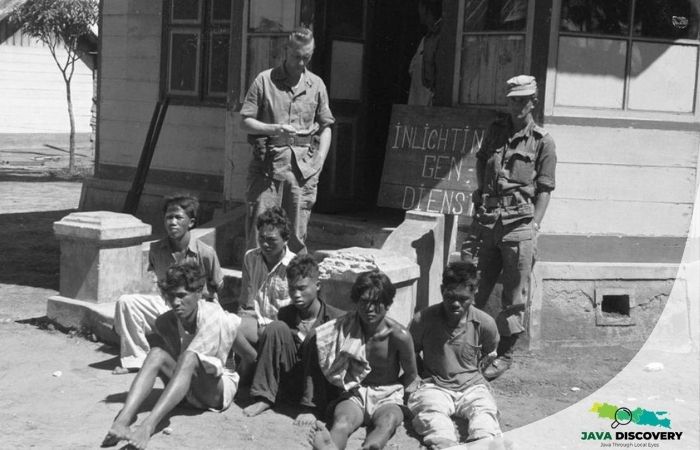
javadiscovery.com – In the heart of old Batavia, where silence should have wrapped the National Museum’s marble halls, another sound once ruled—the piercing cries of men under interrogation. During the Japanese occupation, the building beside today’s Elephant Museum was not a law school anymore; it was the headquarters of the Kempeitai, Japan’s secret military police.
A Library Beside the Law
Before war shadowed the city, the Recht Hogeschool (Law School) on Jalan Merdeka Barat thrived with lectures and literature. In 1940, Professor A. J. Bernet Kempers founded a Faculty of Letters within its complex. Students read history, philosophy, and Javanese classics in a bamboo-walled library that stayed open until night. It was a place of learning and hope, unaware that history itself was about to invade its shelves.
When Books Met Bayonets
As Japanese troops entered Jakarta, soldiers stormed the campus and hurled books out of windows. Pages fluttered like wounded birds. Dutch professors and Indonesian intellectuals could do nothing. Dr. Prijono warned a colleague who tried to intervene: “Madam, remember your life.” The law school became a place of screams instead of sentences, a fortress of fear beside the museum’s quiet galleries.

The Screams Next Door
Inside the museum, scholars like Koentjaraningrat and Poerbatjaraka continued their work, trying to rescue what knowledge could be saved. But even amid catalogues and inscriptions, horror intruded. Visitors to the museum heard the cries from the neighboring building—men tortured by the Kempeitai, their pain seeping through the walls. Reading in the library was no longer peaceful; it was haunted by human agony.
What the Walls Remember
Every museum holds memory, but this one holds two. One of art and civilization—bronze statues, stone reliefs, manuscripts. And another, unseen—the echo of suffering that once stained its silence. The Elephant statue at the front, a gift from Siam’s King Chulalongkorn, still stands calm as if guarding the stories that history tried to bury. Yet the walls remember. They remember the night when knowledge was thrown from windows, and screams answered from the dark.
Perhaps that is the truest lesson left behind—that even in the heart of cruelty, the pursuit of knowledge never truly dies.