Sasak Wedding Traditions in Lombok and the Rituals of Marriage

javadiscovery.com – In villages across Lombok, marriage is not simply a union between two people. It is a community story unfolding through rituals that stretch across days, sometimes weeks, filled with music, negotiations, symbolic gestures, and traditions passed down through centuries. Among the Sasak people, Lombok’s largest ethnic group, weddings represent a powerful moment when family honor, faith, heritage, and social bonds come together in a living cultural performance.
In narrow village lanes framed by bamboo fences and flowering trees, the preparations begin long before the ceremony itself. Women gather to cook enormous pots of traditional dishes while men assemble tents, decorate entrances, and prepare space for guests who may arrive from distant villages. Children run between houses carrying messages, fabrics, and trays of ingredients. The atmosphere hums with anticipation.
For the Sasak community, a wedding is not merely an event. It is a carefully structured journey marked by stages that symbolize courtship, bravery, negotiation, reconciliation, and the eventual merging of families.
The Cultural Roots of Sasak Marriage
The Sasak people have lived on Lombok for centuries, shaping a cultural identity influenced by local customs, Islamic traditions, and historical trade networks that once linked the island with Java, Bali, and distant maritime routes.
Marriage traditions among the Sasak reflect this layered heritage. Rituals combine Islamic values with older customary practices known as adat, creating ceremonies that are deeply symbolic and socially meaningful.
In many villages, elders describe marriage as a transformation not only for the couple but for the families involved. A wedding establishes alliances, strengthens social ties, and reaffirms cultural continuity.
“Marriage here is about responsibility,” says an elder in a rural village near Lombok’s central highlands. “It means becoming part of a larger story that connects generations.”
The Bold Tradition of Merariq
One of the most distinctive aspects of Sasak marriage is the tradition known as merariq, often translated as “bride kidnapping.” While the phrase can sound alarming to outsiders, within the cultural context it represents a symbolic act rooted in historical courtship traditions.
In this practice, the groom and his companions secretly take the bride from her family home, usually with the woman’s prior agreement. The event typically happens at night and is planned carefully to avoid conflict between families.
The moment carries dramatic tension. Young men gather quietly, whispering and waiting for the right moment. When the bride steps out, sometimes escorted by a trusted friend, she is quickly taken to the groom’s house or to a relative’s home where she stays temporarily.
In earlier centuries, this ritual symbolized courage and determination. A young man demonstrated his seriousness about marriage by taking the initiative to claim his future bride.
Today, the tradition continues in many communities but often follows modern understandings of consent and communication between families.
Family Negotiations and the Selabar Ceremony
Once the bride has been taken, the next stage begins. Representatives from the groom’s family visit the bride’s parents to formally inform them of what has happened. This moment is known as selabar.
The visit is respectful and ceremonial. Elders sit cross-legged on woven mats while tea and snacks are served. Conversations unfold slowly, guided by cultural etiquette and subtle language.
Rather than expressing anger, the bride’s family acknowledges the tradition and begins discussing the next steps. These discussions include wedding plans, ceremonial dates, and arrangements related to dowry and family obligations.
The tone is rarely confrontational. Instead, it reflects a delicate balance between pride, negotiation, and mutual respect.
“The process shows how two families learn to trust each other,” explains a community leader from East Lombok. “It is not about taking a daughter away. It is about welcoming a new family connection.”
The Role of Dowry and Community Contribution
In Sasak weddings, financial arrangements often involve contributions from the groom’s family. These are not viewed simply as payments but as symbols of responsibility and readiness to support a household.
The dowry can include money, textiles, livestock, or household items depending on local traditions and the agreement between families.
At the same time, weddings in Sasak villages often involve strong communal cooperation. Neighbors volunteer their time and resources to help organize the celebration.
Large cooking areas appear behind houses where women prepare dishes such as spiced chicken, rice wrapped in banana leaves, and traditional Lombok specialties rich with chili and coconut.
The preparation itself becomes a social gathering where laughter, storytelling, and shared work reinforce community bonds.
The Nyongkolan Procession
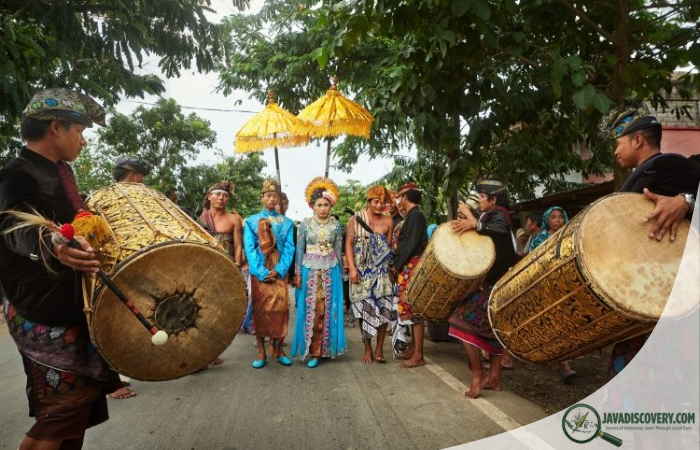
Perhaps the most visually striking part of a Sasak wedding is the nyongkolan procession.
On this day, the groom’s family escorts the bride and groom through village roads in a lively parade that introduces the couple to the wider community.
Men wear traditional clothing that includes songket fabric, embroidered jackets, and decorative headpieces. Women dress in vibrant textiles that shimmer in the tropical sunlight.
Musicians lead the procession with drums and wind instruments, filling the air with rhythmic melodies that echo across rice fields and narrow streets.
As the procession moves forward, neighbors step outside their homes to watch. Some wave, others join the celebration, and children run alongside the group laughing and cheering.
The parade represents more than celebration. It publicly confirms the marriage and symbolizes the couple’s entry into social life as a new household.
Music, Dance, and Cultural Expression
Music plays a central role throughout the wedding celebration.
Traditional ensembles often accompany processions and ceremonies, performing rhythms that have echoed through Sasak villages for generations.
The music is energetic and hypnotic. Drums beat in steady patterns while metallic percussion instruments create shimmering textures of sound.
In some communities, dancers perform movements inspired by martial traditions or historical storytelling. Their steps are precise, graceful, and full of symbolism.
These performances transform the wedding into a vibrant cultural showcase, reminding younger generations of the artistic traditions that shape their identity.
Islamic Blessings and Sacred Commitment
While many Sasak wedding customs come from local traditions, Islamic faith also plays a significant role in the marriage ceremony.
The formal marriage contract is conducted according to Islamic law, usually led by a religious leader.
During this ceremony, the groom recites vows that confirm his commitment to the bride. Witnesses listen carefully as the words are spoken.
The moment is solemn and deeply emotional. Families gather closely, some quietly wiping away tears as the couple enters a new stage of life.
Prayers follow, asking for harmony, patience, and blessings for the future household.
The Feast That Unites the Village
No Sasak wedding is complete without a large communal feast.
Long rows of guests sit together under decorated tents, sharing meals that reflect the culinary traditions of Lombok.
Plates overflow with rice, spicy chicken dishes, grilled fish, vegetables cooked in coconut milk, and sambal known for its fiery intensity.
The feast is not limited to close relatives. Entire neighborhoods may attend, turning the celebration into a village gathering.
Conversations flow easily across generations. Elders share advice, teenagers laugh with friends, and children weave between tables carrying snacks.
Through food and hospitality, the community celebrates the creation of a new family.
Changing Traditions in a Modern Era
Like many cultural traditions, Sasak wedding practices continue to evolve.
Urbanization, education, and economic shifts have influenced how some ceremonies are conducted. In cities, couples sometimes simplify rituals or combine traditional elements with modern wedding styles.
Yet many families remain deeply committed to preserving core traditions such as merariq and nyongkolan.
For younger Sasak generations, these customs offer a connection to heritage in a rapidly changing world.
“We want to keep the meaning,” says a university student from Lombok who recently attended a cousin’s wedding. “Even if the celebrations become simpler, the traditions remind us who we are.”
The Meaning Behind the Rituals
At its heart, a Sasak wedding represents a philosophy about community and belonging.
Marriage is not seen as a private milestone but as a social event where families, neighbors, and traditions converge.
The rituals express values that have guided Sasak society for generations: courage in courtship, respect between families, communal cooperation, and spiritual commitment.
Even the dramatic tradition of merariq reflects an older belief that marriage requires initiative and determination.
The processions, music, and feasts reinforce the idea that a new household becomes part of a larger social network.
A Living Cultural Heritage
As dusk settles over Lombok’s villages after a wedding celebration, the sounds of music fade and lanterns glow softly outside homes.
The newly married couple sits surrounded by relatives, their ornate clothing now slightly rumpled after hours of ceremonies and greetings.
In the quiet moments after the festivities, the deeper meaning of the celebration becomes clear.
A wedding has taken place, but more importantly, traditions have been renewed.
Stories once told by grandparents have been acted out again through ritual and celebration. Cultural memory has moved forward another generation.
Across Lombok, these ceremonies continue to shape identity, reminding communities that heritage lives not in museums or books but in the shared experiences of everyday life.
Each wedding, with its music, processions, negotiations, and feasts, becomes another chapter in the enduring story of the Sasak people.