Botanical Fortification: The Sacred Geometry of Pagar Gaib in Javanese Homesteads

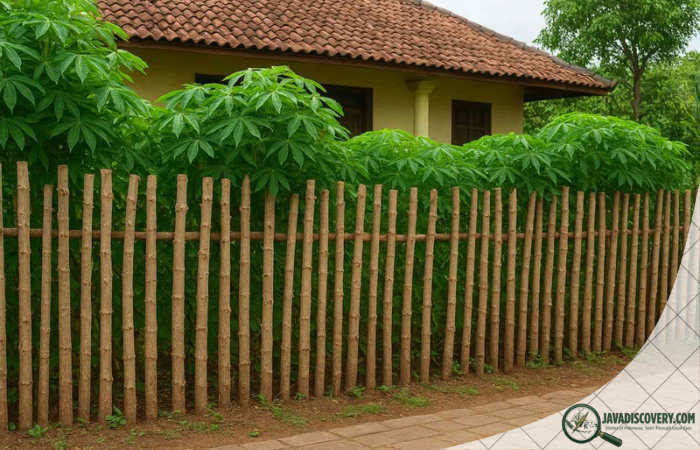
javadiscovery.com – Step into a traditional pakarangan (homestead compound) in rural Central Java, and you will quickly notice that the placement of flora is rarely accidental. While vibrant hibiscus and sweet-scented frangipani adorn the front entrance, the four corners of the property boundary often harbor a very specific, deliberate triumvirate of plants: Pacing (spiral ginger), Tebu Hitam (black sugarcane), and Kelor (moringa). To an uninitiated observer, this looks like simple home gardening. However, within the esoteric tradition of Javanese spatial philosophy, this practice represents cangkok gaib—the living, botanical fortification of the home against intrusive physical and metaphysical energies.
The Four Corners and the Cosmology of ‘Pancer’
To understand why plants are placed precisely at the cardinal corners of a homestead, one must understand the Javanese concept of Sedulur Papat Limo Pancer (the Four Spiritual Siblings centered around the Soul). In Javanese architecture and land consecration, a property is not merely a piece of earth bounded by property deeds; it is a living entity with an energetic heart (the center of the home, or saka guru) and four directional anchors corresponding to North, South, East, and West.
Unseen energies—whether turbulent natural currents, envy-borne malevolence (sihir or santet), or wandering spirits—enter a property at its vulnerable outer intersections: the four corners where opposing energetic lines cross. Planting specific vegetative anchors at these four nodes creates a living perimeter known as Pagar Gaib (the Unseen Fence). Rather than building a cold stone wall, traditional practitioners utilize living plants because flora possesses an active prana (life force) capable of continually absorbing, filtering, and redirecting subtle forces day and night.
The Botanical Triad: Roles and Energetic Signatures
The strategic deployment of Pacing, Tebu Hitam, and Kelor relies on a sophisticated understanding of each plant’s physical structure, elemental association, and spiritual frequency.
1. Pacing (Costus speciosus / Spiral Ginger): The Neutralizer
Characterized by its spiraling stems, soft leafy bracts, and striking white crepe-like flowers, Pacing is historically associated with water and earth elements. In spiritual herbology, Pacing acts as an energetic grounding wire. Its spiraling growth pattern is believed to twist and break apart focused beams of negative intent before they can consolidate into a property’s center.
Metaphorically, Pacing represents cooling and dampening. If an envious force or “hot” energy (energi panas) is cast toward the home, the Pacing root system absorbs the charge and dissipates it harmlessly into the damp soil beneath the boundary fence, keeping the domestic interior adem (cool and peaceful).
2. Tebu Hitam / Tebu Wulung (Saccharum officinarum var. Rubrum): The Armor
Unlike standard green agricultural sugarcane, Tebu Hitam features deep purple to blackish-red stalks and dark leaves. In Javanese symbolism, the color dark purple or black (wulung) signifies protection, authority, and absorbency. The word tebu itself is linguistically linked in folk etymology to antepe kalbu—meaning a firm, unshakeable heart.
When planted at property intersections, the dense, fibrous, mineral-rich stalks of Tebu Hitam serve as a literal and metaphysical shield. The plant’s high concentration of anthocyanins and iron gives it an intense physical presence, while in local belief, its dark exterior acts like a black hole for malicious spiritual projectiles, trapping intruding frequencies within its dense stalk structure before they reach the dwelling.
3. Kelor (Moringa oleifera): The Dissolver
Perhaps the most famous spiritual botanical in Indonesia, Kelor holds an legendary reputation as a disruptor of harmful illusions and dark magic. In local folklore, a gentle strike from a Kelor branch or a wash made from its crushed leaves is said to immediately neutralize invulnerability charms (susuk) and shatter harmful esoteric spells.
In the perimeter defense system, Kelor plays the role of the active disinfectant. While Pacing neutralizes heat and Tebu Hitam absorbs impact, Kelor actively strips away the spiritual payload of any incoming entity or intention. Its tiny, fluttering leaves emit a high-vibrational energetic field that makes the immediate perimeter unbearable for low-frequency spirits or malicious astral entities, causing them to turn away.
The Ritual of ‘Cangkok’ and Corner Consecration
The term cangkok usually refers to horticultural grafting, but in esoteric homesteading, it refers to grafting spiritual intention onto physical root systems. Planting these species is not a casual Saturday gardening project; it is traditionally performed during specific auspicious days (such as Jumat Kliwon or Satu Suro) accompanied by localized prayers and offerings.
Before the cuttings are set into the earth at the four corners, small holes are dug and line with small ritual tokens—often a slice of turmeric, a drop of coconut oil, and a pinch of aromatic sea salt. The seedlings of Pacing, Tebu Hitam, and Kelor are then planted together or in close sequence at each of the four boundary markers. As the plants put down roots and grow, their root networks interlock beneath the surface while their leaves weave an invisible canopy above.
Elders explain that the living nature of this barrier is precisely why it outlasts mechanical or inanimate charms. A brass talisman or carved stone can become dormant over time, but a living plant continuously refreshes its energetic output with every gallon of water it draws from the earth and every ray of sunlight it absorbs from above.
Practical Wisdom Meets Esoteric Heritage
Beyond the mystical explanations of Pagar Gaib, this traditional botanical fortification showcases the seamless integration of ecology and daily life that characterizes classic Javanese philosophy. Every plant chosen for the spiritual boundary also carries immense practical value:
- Kelor provides one of the world’s most nutrient-dense superfoods, packed with vitamins, iron, and antioxidants readily available for daily household cooking.
- Pacing yields rhizomes long used in traditional jamu herbal medicine to treat fever, inflammation, and skin ailments.
- Tebu Hitam provides natural medicinal syrup used in home remedies for coughs and respiratory comfort.
In this sense, cangkok gaib is a masterclass in holistic living. By planting Pacing, Tebu Hitam, and Kelor at the four corners of a homestead, a household builds a physical garden, an emergency pharmacy, a fresh food source, and a psychological sanctuary all in a single act of intentional cultivation. It is a poignant reminder that in traditional Java, the line between nature, medicine, and the sacred is never truly divided.
Category: Cultural Philosophy & Spiritual Heritage
Writer: Laras Pramesti
A. SEO Title
B. Meta Description
C. Meta Keywords
D. Excerpt
F. Focus Keyword
Botanical Fortification