Beyond the Crowds Batu Hides a Quieter Side in Its Highlands

On a weekend morning, the road into Batu moves at the pace of a procession. Motorbikes weave between tour buses, the air smells of exhaust and frying batter, and the queues at the big attractions stretch into the cool highland haze.
This is the Batu most visitors know. Yet a short ride from the busiest streets, the city shows another face: a waterfall tucked into its edge, a farmland hilltop reached by a rough track, and a café that has quietly declined to hand out plastic.
A Highland City Built for Crowds
Batu sits on the slopes of the volcanic massif west of Malang, in a bowl of orchards, vegetable fields and flower farms. It is best known for its apples, and in recent decades for a cluster of theme parks and zoos that have turned it into one of East Java’s busiest weekend escapes.
Administratively, Batu is a city in its own right, separated from Malang Regency in 2001, though it is still counted within the wider Malang Raya area. Culturally, it belongs to the Arek sphere, the region of Surabaya, Malang and their surroundings, known for a plain-spoken, egalitarian manner and its own dialect.
That directness extends to hospitality. Many of the quieter places in Batu are small, locally run ventures, and they offer a very different kind of visit from the large parks.
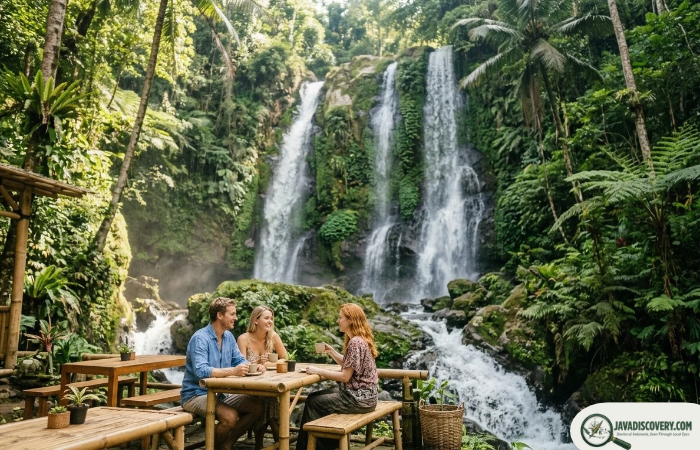
Coban Lanang, the Waterfall Close to Town
In Javanese-speaking East Java, a waterfall is called a coban. Malang Raya has many, among them Coban Rondo in nearby Pujon, but most lie far from town and require long drives or demanding walks.
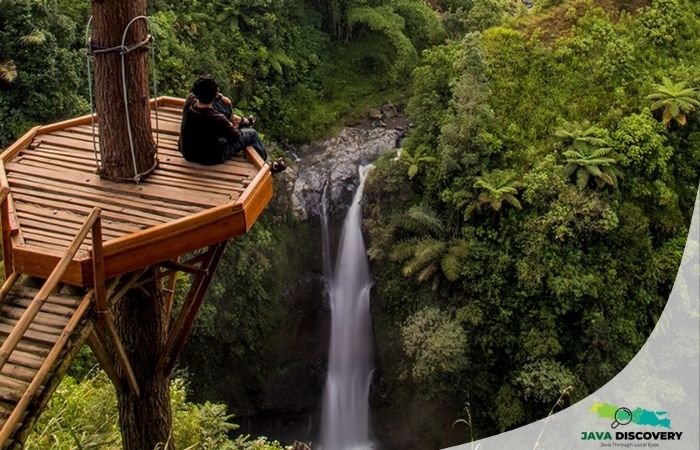
Coban Lanang is a different proposition. According to visitor accounts, it opened to the public in 2022 and lies only minutes from Batu’s town square, in the Pandanrejo area, where visitors leave their vehicles and continue on foot.
Three Ways to See the Falls
The site is arranged around three vantage points. A lower viewpoint places visitors at the foot of the cascade, where the spray cools the air. A stairway leads to the hollow behind the falling water, a rare angle on a waterfall.
An upper viewpoint looks down on the scene from a height, and it is the easiest option for small children and older visitors who prefer not to descend.
A Walk Through the Flowers
The approach is part of the experience. A stone path runs between flower gardens, and on clear days Mount Panderman rises in the background. Visitors also describe a wooden deck for resting, a small children’s pool, a bamboo bridge and a café on site, features that give the place the feel of a village-scale eco-tourism project.
Bukit Jengkoang, Farmland and a Colonial-Era Lodge
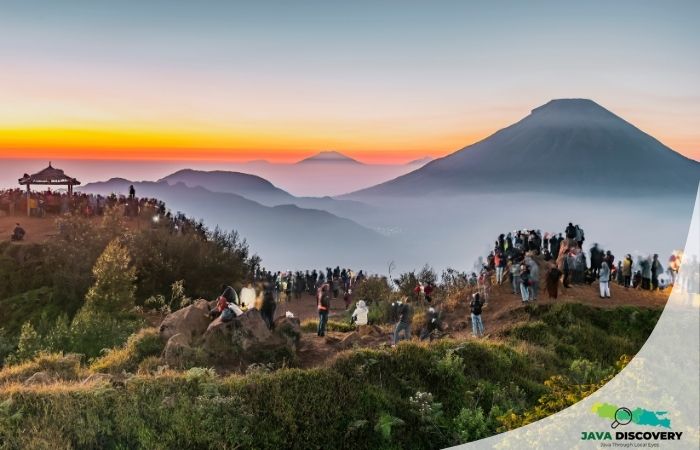
Higher up lies Bukit Jengkoang, a hill surrounded by farmland that spreads to the horizon. Local residents run it as an off-road destination, and by visitor accounts it became popular only in the last few years.
The track is deliberately rough, and motorbikes are the usual way up. Some travelers leave their vehicles on the main road and walk the last stretch, trading speed for the sound of wind moving through the fields.
On clear days, the volcanic peaks around Batu rise above the patchwork of crops, with Mount Arjuno among those mentioned by visitors. A Dutch-era lodge stands among the fields, and photographers favor it as a subject. A small warung serves home-style local dishes, the kind best eaten with a hot drink while mist drifts across the slope.
Retrorika, a Café That Refuses Plastic
The third stop is in the village of Bumiaji, a few minutes from the town square. Retrorika Coffee Bar and Resto fills its rooms with retro furnishings, reused objects and potted plants.
Its green ambitions extend to the table. According to visitor accounts, the café does not serve drinks with plastic straws or paper tissues. Takeaway food comes in a besek, a woven bamboo container, for a small charge, and customers wanting drinks to go are asked to bring their own bottles.
The menu mixes soto, fried rice and other familiar dishes with coffee and tisane, the herbal infusions. In one corner, a small shop sells reusable goods such as cloth bags, metal straws and bamboo bottles.
In a tourist city where weekend crowds generate mountains of waste, such small rules can seem modest. They are also a quiet argument that visitors can change habits as easily as scenery.
The Case for Traveling Slowly in Batu
None of these places rivals the scale of Batu’s famous attractions, and that is precisely the point. Each asks the visitor to move more slowly: to walk the last stretch, to wait for the mist to lift, to carry a bottle from home.
Batu may always be a city of weekend crowds. But for those willing to turn off the main road, it still offers cool air, open fields and the sound of falling water.
Perhaps the real discovery in Batu is not a secret place at all, but the pace at which one chooses to arrive.
Writer: Sari Mahendra