Honoring Ancestors Across East Java’s Sacred Lands

Across the diverse landscapes of East Java, reverence for those who came before is not merely a memory preserved in old stories—it is a living, breathing social practice. From coastal fishing communities to isolated volcanic villages, people maintain an ongoing conversation with their departed relatives and community founders. This enduring ancestral connection shapes daily life, seasonal harvests, and communal decision-making across the region.
Far from being a static relic of the past, ancestor veneration in East Java seamlessly weaves together ancient indigenous worldviews with established religious traditions. Known locally through practices such as nyekar (grave visitations) and slametan (communal feast rituals), these customs reflect a deep-seated belief that the living and the spiritual realm share a reciprocal relationship rooted in respect, harmony, and ongoing protection.
The Roots of Ancestral Veneration in East Java
At the center of traditional East Javanese spiritual life is the concept of the danyang—the guardian spirit or original founder of a village or settlement. According to regional tradition, the danyang cleared the land, established the community, and left behind a spiritual mantle of protection over the soil. Honoring these foundational figures is seen as essential for ensuring agrarian fertility, peace, and safety from natural disasters.
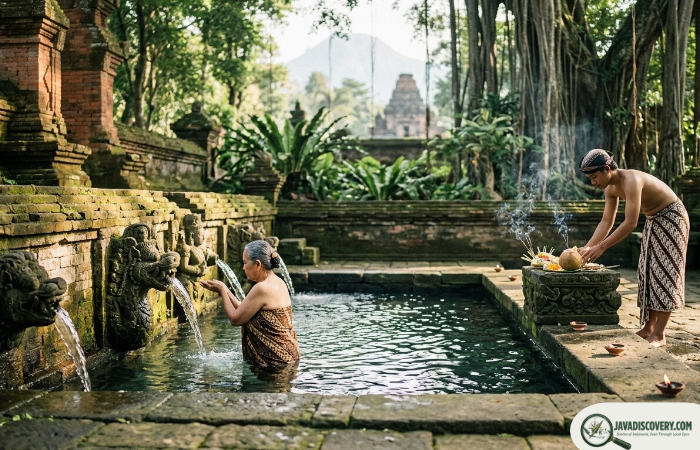
Rather than existing in conflict with major world religions, these ancestral customs often operate alongside formal faith practices. Through the slametan—a communal ritual meal accompanied by shared prayers—villagers gather to express gratitude, seek blessings, and honor both divine power and ancestral guardians. The aroma of incense, burning resins, and fragrant flowers serves as a sensory bridge connecting physical gatherings with the spiritual world.
Regional Subregional Expressions
East Java is not culturally homogenous, and its traditions of ancestral reverence vary significantly across its distinct subregions, each reflecting unique historical roots and socio-cultural identities.
Punden Worship in the Arek and Mataraman Belts
In the egalitarian Arek lands (including Surabaya, Malang, and Pasuruan) and the western Mataraman region (such as Madiun and Kediri), community life frequently revolves around the punden. The punden is a designated sacred site—often an ancient grave, an old banyan tree, or a natural spring—associated with the village founder.
During the annual bersih desa (village cleansing ritual), residents gather at the punden to clean the physical grounds and offer gratitude for the year’s harvest. Families also perform individual nyekar, scattering fresh flower petals over ancestral graves before major life events or religious holidays, asking for blessings and paying their respects to lineage elders.
Tengger Ancestor Worship and Bromo Altars
High in the Tengger mountains surrounding Mount Bromo, the indigenous Tenggerese people maintain a distinct spiritual identity tied directly to their ancestral lineage. They trace their ancestry to Roro Anteng and Joko Seger, legendary figures whose sacrifice created the foundation of Tenggerese life in the volcanic highlands.
During the major annual Yadnya Kasada festival, Tenggerese devotees ascend the steep slopes of Mount Bromo to throw agrarian offerings—including vegetables, livestock, rice, and money—directly into the steaming volcanic crater. This act is not performed out of fear, but as a fulfillment of a sacred ancestral vow to express gratitude and preserve communal well-being.
Osing and Madurese Ancestral Rites
In the easternmost region of Banyuwangi, the Osing people preserve ancestral rituals like the Seblang dance. In this sacred performance, an appointed dancer enters an ecstatic trance state, believed to be guided by ancestral spirits to cleanse the village of illness and ward off misfortune during the harvest season.
Across the Madura Strait, Madurese communities maintain strong traditions of ancestral remembrance through family lineage gatherings and meticulous grave upkeep. During holy periods, extended families return to ancestral home grounds to perform prayers and clean family burial plots, reinforcing social bonds and lineage continuity across generations.
The Ritual Architecture of Remembrance
The physical practice of ancestor veneration relies on specific symbolic items that carry deep traditional meanings. Central to many rituals is the tumpeng, a cone-shaped mountain of yellow rice surrounded by various side dishes, symbolizing the relationship between humans, nature, and the divine.
Fragrance plays an essential role in inviting ancestral spirits to ritual gatherings. A ceremonial mix of flowers—often known as kembang 7 rupa (seven types of fresh petals)—is scattered over graves or placed near altars alongside burning menyan (incense resin). Through these tangible elements, communities across East Java continue to honor the enduring presence of those who cleared the paths they walk today.
In every scattered flower petal and shared communal meal, East Java preserves a continuous thread connecting past generations to the present, reminding the living that they are part of a timeless human story.
Writer: Sari Mahendra