The Evolution of Footwear in Rural Java

javadiscovery.com – In the soft, volcanic mud of a terraced rice field in Central Java, the evolution of footwear in rural Java begins with the intimate, tactile connection of the “nyeker” or the bare foot. For centuries, the Javanese farmer operated with a profound sensory understanding of the earth, using the soles of the feet to read the moisture of the soil and the stability of the dikes. However, as the island transitioned through eras of trade, colonization, and industrialization, the way the Javanese protected their feet transformed into a complex narrative of social status and practical adaptation. The evolution of footwear in rural Java is a journey from the primordial freedom of the barefoot “petani” to the ingenious “teklek” wooden clogs, and finally to the ubiquitous rubber “sandal jepit” that now defines modern village life. This progression is not merely a change in material, but a reflection of the “unggah-ungguh” (etiquette) and “manunggal” (unity) that characterize the Javanese relationship with the physical world and the spiritual path they walk upon.
The Nyeker Era: The Sacred Contact with Earth
To understand the local reliance on the evolution of footwear in rural Java, one must first appreciate the cultural significance of being barefoot. In traditional Javanese philosophy, the feet are the “sikil,” the foundation of the body that must remain “eling” (mindful) of the “bumi” (earth). Walking barefoot, or nyeker, was not a sign of poverty but a practical and spiritual choice. In the “sawah” (wet rice field), footwear would be an encumbrance, a barrier to the “roso” (feeling) required to navigate the slippery clay. The evolution of footwear in rural Java remained dormant for centuries because the human foot was seen as the most perfect tool for the island’s topography, capable of gripping mountain slopes and wading through monsoon floods with equal grace.
Even in the “keraton” (palace) circles, being barefoot was a sign of “kawula” (humility) before the Divine and the Sultan. When entering a sacred space or a “ndalem” (inner house), shoes were—and still are—removed to maintain the “resik” (purity) of the floor. The evolution of footwear in rural Java was thus guided by this dialectic between the outside “kasar” (coarse) world and the inside “alus” (refined) space. Outside, the foot braved the stones and thorns; inside, it enjoyed the cool touch of polished teak or terracotta. This sensory shifting is a foundational Javanese experience, reinforcing the idea that the soul must be adaptable to its environment.

Local voices in the rural hamlets of the Dieng Plateau often speak of the “nyeker” days with a sense of “kangen” (longing) for the physical toughness it produced. An elderly grandmother, her feet wide and calloused like the bark of a banyan tree, explains that when you walk barefoot, you “know where you are.” You can feel the change in the soil’s temperature and the vibration of the coming rain. The evolution of footwear in rural Java, while bringing comfort, has arguably thinned the connection between the person and the “nyawa” (spirit) of the land. The calloused foot was a badge of “prihatin” (ascetic discipline), a sign of a life lived in direct dialogue with the elements.
The Teklek and Kelom: The Architecture of Wood
As village life became more structured and “pasar” (markets) grew, the evolution of footwear in rural Java saw its first major technological leap with the “teklek.” These are traditional wooden clogs, typically made from lightweight “kayu albasia” or “pine,” featuring a simple strap made of scrap rubber or woven fiber. The teklek was a stroke of rural genius designed specifically for the “pawon” (kitchen) and the “sumur” (well). Because the wood is elevated on two small blocks, it keeps the feet above the damp, often muddy floors of the traditional washing areas. The name “teklek” is onomatopoeic, mimicking the rhythmic “tek-lek-tek-lek” sound of wood hitting stone, a sound that became the acoustic signature of the Javanese morning.
The teklek represents the Javanese value of “gemmi” or frugality. They were often homemade, carved with a simple “mendo” (machete) from leftover timber. The evolution of footwear in rural Java in this form was about domestic hygiene and status. Having a pair of teklek specifically for the bathroom showed a level of “tertib” (orderliness) within the household. For more formal occasions, the wood was refined into “kelom geulis,” beautifully carved and painted wooden sandals that originated in West Java but spread through the rural trade routes. These were the “alus” versions of the teklek, showing that even footwear made from the forest could be elevated to an art form through “ukiran” (carving).
The social function of the teklek was also significant. In a village, you could hear who was coming before you saw them. The evolution of footwear in rural Java provided a way to “announce” one’s presence without speaking, a subtle form of social signaling that fit perfectly with the Javanese preference for indirect communication. The sound of the teklek on the path signaled the start of the day’s labor or the arrival of a neighbor for “ngobrol” (chatting). It was a functional boundary-maker, separating the muddy yard from the clean veranda, ensuring that the “kesucian” (sanctity) of the home was preserved.
The Colonial Shadow: Shoes as Social Hierarchy
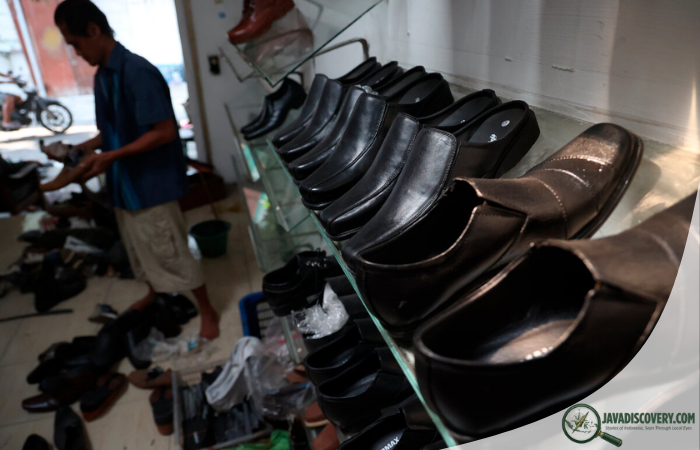
The evolution of footwear in rural Java took a sharp turn during the Dutch colonial era. Leather shoes and boots became the ultimate symbols of “pangkat” (rank) and proximity to European power. For the “priyayi” (Javanese aristocracy) and the village “lurah” (headman), wearing shoes was a way to distinguish themselves from the barefoot “wong cilik” (common people). This created a complex psychological layer in the evolution of footwear in rural Java; footwear became a tool of “gengsi” (prestige) and a marker of the “modern” world vs. the “traditional” one.
However, leather was expensive and impractical for the tropical heat and humidity. The evolution of footwear in rural Java for the masses remained focused on simpler materials. The introduction of the “selop”—a velvet or leather mule with a closed toe—became the compromise. It offered the dignity of a shoe but was easy to slip off at the threshold of a house, respecting the Javanese “adat” (custom). The selop remains the standard footwear for Javanese weddings and formal ceremonies today, a remnant of this era where the foot had to be dressed up to show “urmat” (respect) to the community and the host.
In the fields, however, the colonial influence was minimal. The farmer continued to “nyeker” or use the simplest wooden sandals. The evolution of footwear in rural Java was bifurcated: one path led toward the “barat” (Western) shoe for public display, and the other remained rooted in the “tradisional” wood and bare skin for the reality of labor. This duality is a recurring theme in Javanese history, where the “lair” (outer appearance) adopts new forms while the “batin” (inner self) remains tied to ancient practices.
The Sandal Jepit: The Rubber Revolution
The most profound and permanent change in the evolution of footwear in rural Java arrived with the mass production of synthetic rubber and the “sandal jepit” (flip-flops). In the mid-20th century, brands like Swallow became the unofficial footwear of the nation. The sandal jepit was the perfect answer to the Javanese environment. It was cheap, waterproof, easy to clean, and—most importantly—easy to remove at the door. The evolution of footwear in rural Java reached its democratic peak with the rubber sandal; from the richest landowner to the poorest laborer, everyone wore the same “jepit.”
The sandal jepit transformed village mobility. It allowed people to walk longer distances on the newly paved “aspal” roads that were replacing dirt paths, protecting them from the searing heat of the sun-baked ground. The evolution of footwear in rural Java also saw a surge in “kreativitas” (creativity) involving these sandals. In many villages, it is common to see “ukir sandal”—where people carve intricate patterns or their names into the soles of their flip-flops using a razor blade. This prevents the sandals from being “tertukar” (swapped) at the mosque during Friday prayers, a practical solution to a communal problem.
Furthermore, the sandal jepit became a tool for the “anak-anak” (children). They are used as goalposts in street soccer, as targets in “balapan” games, and as improvised tools for various household tasks. The evolution of footwear in rural Java in the rubber age is a story of total integration. The sandal is no longer an external object; it is a part of the Javanese body. It is worn until the sole is paper-thin, often repaired with a “peniti” (safety pin) or a piece of wire when the strap snaps, embodying the Javanese spirit of “ora opo-opo” (it’s okay/make do).
The Modern Foot: Sneakers and the “Muddy” Transition
In the 21st century, the evolution of footwear in rural Java is entering the era of global fashion. With the rise of “internet masuk desa” (internet in the village), young Javanese are increasingly influenced by international trends. Sneakers and sports shoes are now common sights at village “dangdut” concerts and youth gatherings. However, the old rules of the “threshold” still apply. No matter how expensive the sneakers are, they are left at the door. The evolution of footwear in rural Java continues to respect the boundary between the “kotor” (dirty) street and the “suci” (sacred) home.
Interestingly, there is a counter-movement among some Javanese hikers and environmentalists who are returning to “barefoot” trekking or using minimalist “sandal gunung” (mountain sandals). They argue that the evolution of footwear in rural Java has made the people “manja” (spoiled) and disconnected from the healing energy of the earth. This return to the “nyeker” philosophy, but with modern materials, shows that the Javanese still value the “roso” of the ground. They are looking for a way to be modern while still being “napak bumi” (stepping on the earth).
The evolution of footwear in rural Java is also visible in the “sepatu boots” used by farmers in the modern era to protect against chemical fertilizers and pesticides. While the “nyeker” was safe in the organic fields of the past, the modern “sawah” requires a different kind of armor. The rubber boot is the new “teklek” of the field, providing a heavy-duty barrier that allows the farmer to continue their work in a changing agricultural landscape. The evolution of footwear in rural Java is thus a mirror of the island’s changing ecology.
The Legacy of the Step
As we look back at the evolution of footwear in rural Java, we see a culture that has always prioritized the “fungsi” (function) and the “spirituil” (spiritual) over the purely aesthetic. Whether it is the bare sole of the ancestor, the clicking wood of the grandmother, or the rubber strap of the grandchild, each step has been an act of navigation through the Javanese world. The evolution of footwear in rural Java teaches us that how we dress our feet says everything about how we view our place in the universe.
The Javanese foot remains a bridge. It bridges the mud and the tile, the past and the present, the earth and the soul. The evolution of footwear in rural Java is far from over; it will continue to adapt as long as the volcano provides the soil and the monsoon provides the rain. But even as the materials change from wood to rubber to high-tech mesh, the fundamental Javanese act remains the same: removing the shoes at the door, bowing the head slightly, and stepping into the house with a “permisi”—a request for permission to enter the shared peace of the home.
Ultimately, the evolution of footwear in rural Java is a story of “keseimbangan” (balance). It is about knowing when to be protected and when to be vulnerable. It is about the wisdom of the foot that knows how to walk in the mud without losing its dignity. As the “surya” (sun) sets over the rice fields, and the farmers return home, the rows of sandals at the doorsteps of the village are the silent markers of a people who have walked a long way, but always know exactly where their home is.