Household Altars and Their Subtle Presence: The Sacred Interior of Javanese Homes

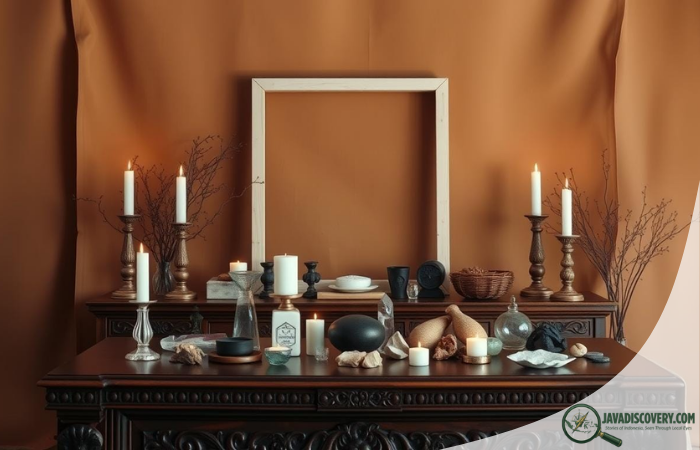
javadiscovery.com – In the quiet, amber-lit depths of a traditional “joglo” house in the heart of Yogyakarta, the phenomenon of household altars and their subtle presence begins with the faint, sweet scent of “kembang setaman”—a medley of jasmine, rose, and magnolia soaking in a simple brass bowl. To the casual visitor, these small arrangements might seem like mere decoration, but to the Javanese, they are the vital anchors of “eling” or mindfulness. Unlike the towering, ornate shrines found in other parts of the archipelago, the Javanese approach to the divine is defined by “samudana”—a polite concealment. Household altars and their subtle presence are woven into the very architecture of the home, often hidden in plain sight within the “senthong tengah” (the central chamber) or tucked behind a polished teak screen. This is the “ruang batin” or the inner space, where the family maintains a quiet, constant dialogue with the ancestors and the “Gusti” (the Divine). In a culture that prizes “alus” (refinement) over “kasar” (coarseness), the altar is not a place for loud proclamations of faith, but a silent sanctuary for the “roso”—the intuitive feeling of peace and spiritual alignment that sustains the household through the tides of time.
The Senthong Tengah: The Womb of the Household
To understand the local reliance on household altars and their subtle presence, one must first look at the “senthong tengah.” In traditional Javanese domestic architecture, the house is divided into three rear chambers. The left and right rooms are for sleeping and storage, but the central room, the senthong tengah, is reserved exclusively for the sacred. This is the primary site of household altars and their subtle presence. Traditionally, this room was left empty of furniture, save for a low wooden platform or “amben” covered with a fine “tikar” (mat). It is considered the “pedharingan” or the place where the rice spirit, “Dewi Sri,” resides. The altar here is often nothing more than a small wooden pedestal or a specific corner of the room where offerings are placed, yet its spiritual gravity pulls at every member of the family.
The senthong tengah represents the “pusat” or the center of the family’s universe. Household altars and their subtle presence in this room act as a gravitational well for “berkah” (blessings). It is here that the family’s “pusaka” (heirlooms), such as an ancestral “keris” (dagger), are kept. These objects are not merely antiques; they are considered “living” vessels for spiritual energy. The altar is the space where these objects are “fed” with incense and flowers on “Kliwon” nights—the most sacred day in the Javanese five-day calendar. This ritual maintenance is a form of “nguri-uri,” the preservation of ancestral roots that ensures the family does not lose its “jatidiri” or true identity in the modern world.

Local voices in the rural “desa” of Central Java describe the senthong tengah as the “heartbeat” of the house. An elderly grandmother, her voice a soft rasp like dry bamboo, explains that if the central room is “resik” (spiritually clean), the whole family will be “tentrem” (tranquil). Household altars and their subtle presence in this context are not meant for show. In fact, many Javanese are hesitant to show this room to strangers. It is a “pingitan” (secluded) space, reflecting the Javanese belief that true power and true holiness are always “ndhelik”—hidden. The altar is a secret between the family and the Creator, a private threshold where the mundane ends and the eternal begins.
Incense and Petals: The Sensory Language of the Altar
The “subtle” nature of household altars and their subtle presence is achieved through sensory cues rather than visual spectacle. The primary markers are “dupa” (incense) and “sesaji” (offerings). The smell of sandalwood or “menyan” (frankincense) wafting through the house in the early evening is the signal that the altar is active. This olfactory presence is a form of “sapaan” or greeting to the unseen world. Household altars and their subtle presence use scent to bridge the gap between the “lair” (the physical) and the “batin” (the spiritual). The smoke is believed to carry the family’s prayers upward, acting as a messenger to the “leluhur” (ancestors).
The “sesaji” or offerings are equally understated. A small cup of bitter coffee, a glass of water, a piece of “jajan pasar” (market snacks), and the “kembang telon” (three types of flowers). These items are not “sacrifices” in the aggressive sense, but “tanda tresno”—tokens of love and remembrance. Household altars and their subtle presence are maintained through these small, daily acts of “syukur” (gratitude). The flowers are replaced when they wither, and the water is refreshed every morning, mirroring the Javanese ideal of “kontinuitas” or continuity. The altar is a living organism that requires the same care as a garden or a child.
This sensory approach allows household altars and their subtle presence to exist harmoniously within modern, multi-faith households. Even as Javanese families have embraced Islam, Christianity, or Buddhism, the “subtle altar” remains a cultural anchor. The “sesaji” might be interpreted by some as a cultural tradition and by others as a religious duty, but the physical presence of the flowers and the incense remains a constant. It is a form of “syncretism” that is uniquely Javanese—a way of honoring the new while never abandoning the old. The altar is the “ruang tengah” (middle room) not just in the house, but in the Javanese soul, where different beliefs meet in a state of “rukun” (harmony).
The Keris and the Pedestal: Anchors of Power
Central to many household altars and their subtle presence is the “keris.” This asymmetrical dagger is the most potent symbol of Javanese spiritual heritage. When placed on the altar, usually on a carved wooden stand called a “jagrak,” the keris acts as a lightning rod for “wahyu” (divine guidance). The evolution of household altars and their subtle presence is often tied to the history of the family’s keris. Each blade has a “tangguh” (era) and a “pamor” (pattern) that tells the story of the ancestors’ struggles and triumphs. To keep a keris on the altar is to keep the ancestors’ “semangat” (spirit) alive within the home.
The placement of the keris on the altar is governed by strict “unggah-ungguh.” It must face a certain direction, often toward the “kiblat” or toward a sacred mountain like Merapi or Lawu. This alignment is part of the “geomancy” of the Javanese home, where household altars and their subtle presence are positioned to harmonize with the earth’s natural “energi.” The altar is not just a shelf; it is a coordinate in a spiritual map. By placing the keris at this coordinate, the household ensures that they are “napak bumi”—stepping firmly on the earth while remaining connected to the heavens.
During the month of “Suro” (the Javanese New Year), household altars and their subtle presence become the site of “jamasan,” the ritual cleaning of the keris. The blades are bathed in lime juice and coconut water, then treated with arsenic and oil to preserve the steel. This “physical” maintenance is inseparable from the “spiritual” maintenance of the altar. As the blade is cleaned, the family’s intentions are also “diresapi” (purified). The subtle presence of the altar becomes momentarily overt during these times, as the house is filled with the scent of “minyak pusaka” (heirloom oil) and the quiet murmurs of “sholawat” or ancient mantras.
Modernity and the “Invisible” Altar
As Java urbanizes and the “joglo” gives way to modern brick-and-mortar “perumahan” (housing complexes), household altars and their subtle presence are adapting to smaller spaces. In many urban homes, the “senthong tengah” has disappeared, replaced by a “ruang tamu” (living room) or a television area. However, the Javanese “roso” for an altar remains. It often migrates to a top shelf of a bookshelf, a small niche in the wall, or even a specific corner of the master bedroom. Household altars and their subtle presence in the city are even more “ndhelik” (hidden) than in the village, often appearing as nothing more than a particularly clean and fragrant corner of the room.
This “invisible” altar is a testament to the Javanese ability to maintain “kebatinan” (inner spirituality) regardless of external circumstances. Even in a high-rise apartment in Jakarta, a Javanese businessman might keep a small “cupu” (brass container) of jasmine on his desk. Household altars and their subtle presence have become portable and personal. This shift reflects the Javanese concept of “manunggaling kawula gusti”—the idea that the ultimate altar is within the “manungsa” (human) themselves. The physical altar is merely a “sarana” or a tool to help the mind reach that inner sanctuary.
The “subtle” nature of these urban altars also serves as a protective layer in a more homogenized society. By keeping household altars and their subtle presence “alus” and understated, Javanese families avoid the “fitnah” (slander) or misunderstanding of those who might view their traditional practices as “syirik” (idolatry). The altar remains a “rahasia” (secret), a quiet act of cultural resistance that keeps the flame of Javanese identity burning in an era of globalization. It is a “pager gaib” (spiritual fence) that protects the family’s inner peace from the noise and “keramaian” of the modern world.
The Altar of the Hearth: Spiritual Culinary Connections
Interestingly, household altars and their subtle presence often have a secondary “branch” in the “pawon” or kitchen. Near the “luweng” (wood-burning stove) or the modern gas range, one might find a small “sesaji” for the spirits of the hearth. This reflects the Javanese belief that cooking is a sacred act of “sedekah” (charity). The kitchen altar is usually more humble—perhaps just a small bundle of “pari” (rice stalks) or a specific stone. The presence of household altars and their subtle presence in the kitchen ensures that the food produced is “berkah” and provides “kekuatan” (strength) for the family’s “amal” (good deeds).
The relationship between the kitchen and the main altar is one of “input” and “output.” The bounty of the earth enters through the kitchen, is offered at the altar, and then sustains the family. Household altars and their subtle presence are the “processing centers” for this cosmic exchange. This is why a Javanese mother will often take the first scoop of newly cooked rice—the “sega punar”—and place it on a small leaf near the altar before anyone else eats. This act of “ngajeni” or respecting the source of nourishment is what keeps the “rezeki” (blessing) flowing into the home.
The kitchen altar also serves as a reminder of “kesabaran” (patience). Just as the fire must be tended and the rice must be steamed to perfection, the spiritual life must be cultivated with “telaten” (meticulous care). Household altars and their subtle presence in the kitchen and the senthong together create a “diagonal” of sanctity that runs through the entire house. This ensures that no part of the home is “kosong” (empty) of spiritual presence. The house is a “candi” (temple) in miniature, and the daily rituals are the “pujas” that keep the structure standing.
Conclusion: The Silent Guardian of the Soul
Household altars and their subtle presence are the silent guardians of the Javanese soul. They are the physical manifestations of the Javanese desire to live a life that is “seimbang” (balanced)—a life where the demands of the “dunia” (world) are always tempered by the wisdom of the “akhirat” (hereafter). The altar is the place where the Javanese person goes to “ngenggar-enggar penggalih”—to refresh the mind and the heart. It is a space of “sunyi” (silence) that speaks louder than any sermon, a place where the family’s past, present, and future are woven into a single, fragrant strand of “anyaman.”
As the “surya” (sun) sets and the village grows quiet, the smell of jasmine begins to fill the “senthong tengah.” The family gathers for prayer, their shadows flickering against the teak walls. The altar is there, nearly invisible in the darkness, yet its presence is felt like a warm, protective hand. Household altars and their subtle presence have done their work for the day, grounding the family in their “lelabuhan” (duty) and their “tresno” (love). In the heart of Java, the most powerful things are the ones you cannot see, and the most sacred places are the ones that never need to raise their voice. As long as the incense burns and the flowers are refreshed, the “roso” of Java will remain alive, anchored in the subtle sanctity of the home.